Facts
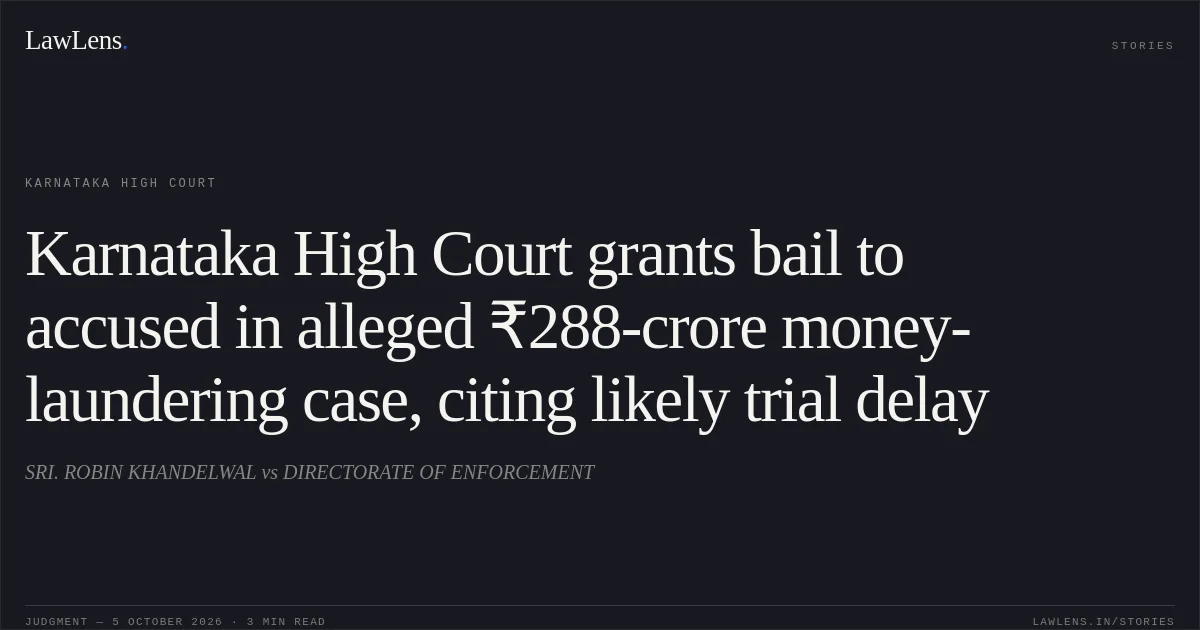
The petitioners, accused Nos. 1 and 3 in an ECIR registered in 2021 for alleged offences under Sections 3 and 4 of the Prevention of Money Laundering Act, 2002 (PMLA), were arrested on 8 May 2026.
Source reference: paras. 3–9, 17They had been granted bail in the predicate-offence cases and in an earlier ECIR case, and had cooperated with the investigation.
Source reference: paras. 3–9, 17After the prosecution complaint was filed on 6 July 2026, the matter remained at the pre-cognizance stage.
Source reference: paras. 3–9, 17The complaint comprised approximately 8,103 pages and cited ten witnesses; the petitioners had been in custody since their arrest.
Source reference: paras. 3–9, 17Accused No. 2 had also been granted bail by the High Court.
Source reference: paras. 3–9, 17The petitioners sought regular bail under Section 483 of the Bharatiya Nagarik Suraksha Sanhita, 2023, after the Special Court rejected their applications.
Source reference: paras. 1, 3Issues
Whether the petitioners should be granted regular bail in the PMLA case, having regard to the statutory restrictions on bail and the circumstances of the alleged offences.
Source reference: paras. 5, 18Whether continued pre-trial detention was justified where the investigation was complete, the petitioners had cooperated, and trial was unlikely to conclude in the near future.
Source reference: paras. 7–9, 17–18Law Applied
Sections 3 and 4 of the PMLA define and punish money laundering, while Section 45 imposes twin conditions for granting bail.
Source reference: no citationThe Court applied the principle, recognized in V. Senthil Balaji v. Deputy Director, Directorate of Enforcement, 2024 SCC OnLine SC 2626, that stringent statutory bail conditions cannot justify unreasonably prolonged pre-trial incarceration and that constitutional courts may grant bail where delay in trial infringes the right to a speedy trial under Article 21; the duration of the prescribed sentence and the likely time to trial are relevant considerations.
Source reference: para. 12It also relied on Manish Sisodia v. Directorate of Enforcement, (2024) 12 SCC OnLine 2626, and the other cited Supreme Court decisions concerning custody, delay, and the prospects of trial, including Arvind Dham v. Directorate of Enforcement, (2026) 7 SCC 330.
Source reference: paras. 11–14, 16As to reliance on an accused’s confession, the Court cited P. Krishna Mohan Reddy v. State of Andhra Pradesh, 2025 SCC OnLine SC 1157, and Kashmira Singh v. State of M.P., (1952) 1 SCC 275, for the principle that a co-accused’s confession may lend assurance to other evidence but cannot, by itself, replace such evidence at the bail stage.
Source reference: para. 15Reasoning
The Court noted that the petitioners had cooperated with the investigation, had not been alleged to have breached bail conditions in the predicate cases, and were arrested only several years after registration of the ECIR.
Source reference: paras. 7–9The investigation was complete and the prosecution complaint had been filed; the Court also found the prosecution’s apprehension that the petitioners might shift or misuse proceeds of crime unpersuasive in light of the period during which they had remained at liberty without such conduct.
Source reference: paras. 7–9Given the matter’s pre-cognizance stage, the volume of documents, and the expected duration of trial, the Court concluded that trial was unlikely to conclude in the near future.
Source reference: para. 17Applying the cited Article 21 principles, it held that continued detention was not warranted, notwithstanding the seriousness of the allegations and the PMLA’s stringent bail framework.
Source reference: paras. 5, 12, 18Holding
The High Court allowed both petitions and directed that the petitioners be released on regular bail in the ECIR case.
Each petitioner was required to execute a personal bond of ₹1,00,000 with two sureties for the like sum, attend trial unless exempted, refrain from threatening or tampering with prosecution witnesses and from committing similar offences, and not leave the trial court’s jurisdiction without permission until disposal of the case.
Source reference: para. 19Acts & Sections Cited
15 provisions across 5 statutes referred to in this judgment. Each provision opens on LawLens.
Code of Criminal Procedure, 19731
Bharatiya Nagarik Suraksha Sanhita, 20231
Prevention of Money-Laundering Act, 20024
Information Technology Act, 20001
Indian Penal Code, 18608
Original Court PDF
SRI. ROBIN KHANDELWALvsDIRECTORATE OF ENFORCEMENT
Click to open original judgment
Original judgment, available to read, download and summarize on LawLens.in