Facts
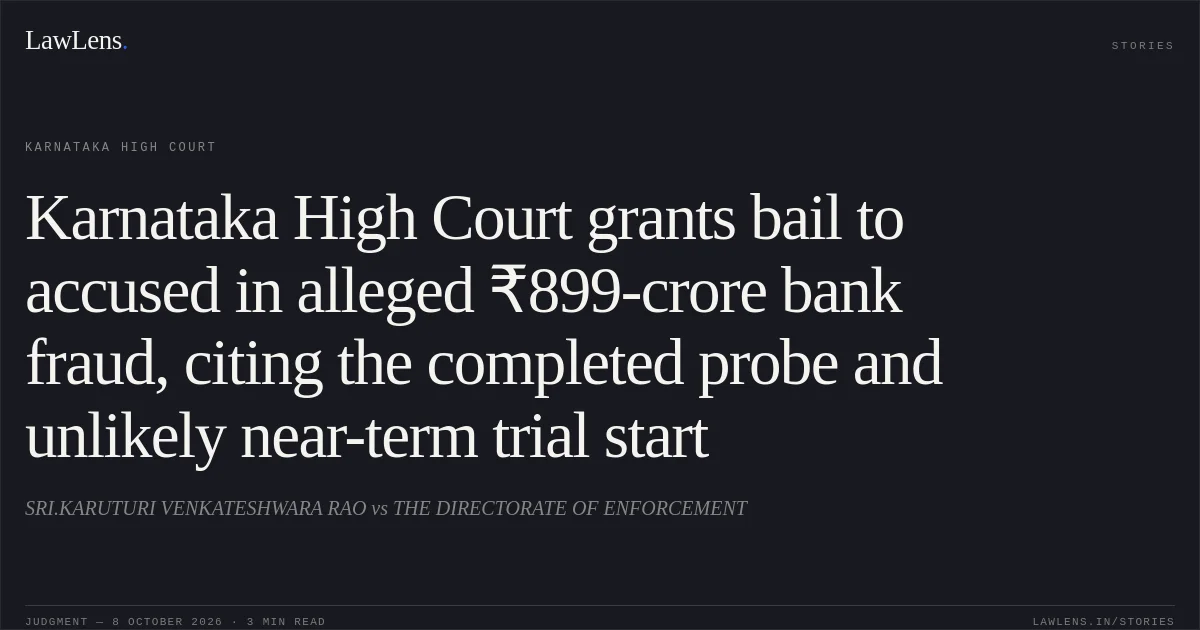
The petitioner, Accused No. 2 in an Enforcement Case Information Report (ECIR) under Sections 3 and 4 of the Prevention of Money Laundering Act, 2002 (PMLA), sought regular bail under Section 483 of the Bharatiya Nagarik Suraksha Sanhita, 2023.
Source reference: para. 1The ECIR arose from allegations that Deepak Cables (India) Ltd. and its directors obtained bank loans through forged or manipulated documents and diverted loan funds.
Source reference: para. 1The petitioner was arrested on 2 June 2026; the investigation was subsequently completed and the prosecution complaint filed.
Source reference: para. 3His bail application before the Special Court was rejected on 28 August 2026.
Source reference: para. 1, 3He argued that he had cooperated with the investigation, had not been arrested in the predicate-offence cases, and that the PMLA case was at the pre-cognizance stage, with a lengthy trial unlikely to conclude soon.
Source reference: para. 4, 7–8The prosecution opposed bail, relying on the alleged prima facie case, the Section 45 PMLA conditions, and the risk of evidence tampering.
Source reference: para. 6Issues
1. Whether the petitioner should be granted regular bail under Section 483 of the BNSS in the PMLA proceedings, having regard to the statutory bail restrictions under Section 45 of the PMLA and the circumstances of the case.
Source reference: para. 6, 162. Whether the expected delay in trial, the nature and volume of the evidence, and the petitioner’s period of custody warranted release on bail in light of the right to a speedy trial under Article 21 of the Constitution.
Source reference: para. 8–16Law Applied
Section 483 of the BNSS empowers the High Court to grant regular bail; Sections 3 and 4 of the PMLA define and punish money-laundering offences, while Section 45 imposes twin conditions for bail.
Source reference: no citationThe Court relied on the principle that Section 45’s restrictions cannot justify unreasonable pre-trial incarceration that undermines Article 21; the need for expeditious trials must be read alongside stringent bail conditions.
Source reference: para. 9–15It applied the Supreme Court’s reasoning in *P. Chidambaram v. Directorate of Enforcement*, *Manish Sisodia v. Directorate of Enforcement*, *V. Senthil Balaji v. Deputy Director, Directorate of Enforcement*, *Padam Chand Jain v. Enforcement Directorate*, and *Arvind Dham v. Directorate of Enforcement*, concerning custody, trial delay, documentary evidence, and constitutional safeguards.
Source reference: para. 9–15The Court also considered *Tarun Kumar v. Assistant Director, Directorate of Enforcement*, cited by the prosecution in support of the Section 45 restrictions.
Source reference: para. 6Reasoning
The Court considered that the petitioner had cooperated with the investigation, which was complete, and that the prosecution complaint had been filed; the case remained at the pre-cognizance stage.
Source reference: para. 7–8The complaint involved 32 witnesses and 154 documents in six volumes, making disposal in the near future unlikely.
Source reference: para. 7–8The alleged maximum punishment was seven years, the relevant properties had been attached, and the evidence was substantially documentary.
Source reference: para. 7–8The Court also noted that the petitioner had not been arrested in the predicate cases and had been enlarged on bail there.
Source reference: para. 7–8Applying the cited authorities, it concluded that the prospect of a lengthy trial, considered alongside the circumstances of the case and Article 21 concerns, supported release on bail notwithstanding the statutory restrictions.
Source reference: para. 9–16Holding
The High Court allowed the petition and directed that the petitioner be released on regular bail in ECIR/BGZO/61/2022, subject to conditions.
He was required to execute a personal bond of Rs. 1,00,000 with two sureties for the like sum, attend the trial unless exempted, refrain from threatening or tampering with prosecution witnesses or engaging in similar offences, and not leave the trial court’s jurisdiction without permission until the case is disposed of.
Source reference: para. 17Acts & Sections Cited
8 provisions across 5 statutes referred to in this judgment. Each provision opens on LawLens.
Code of Criminal Procedure, 19731
Bharatiya Nagarik Suraksha Sanhita, 20231
Prevention of Money-Laundering Act, 20023
Indian Penal Code, 18602
Prevention of Corruption Act, 19881
Original Court PDF
SRI.KARUTURI VENKATESHWARA RAOvsTHE DIRECTORATE OF ENFORCEMENT
Click to open original judgment
Original judgment, available to read, download and summarize on LawLens.in