Facts
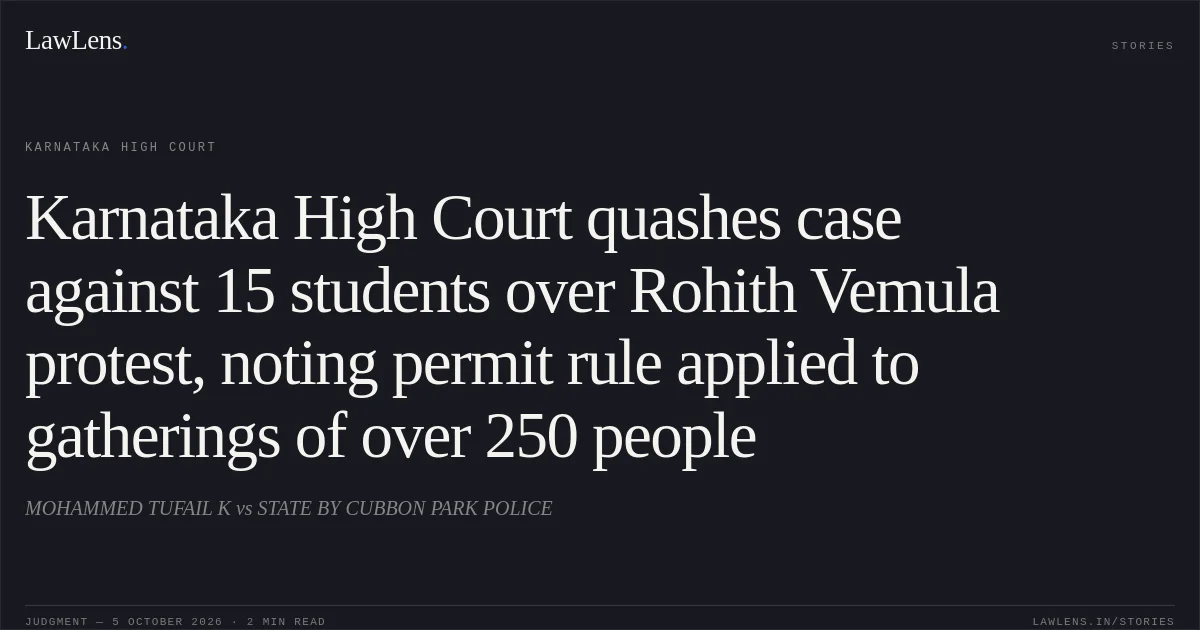
The petitioners, accused Nos. 1–15, were alleged to have assembled with approximately 100–150 students near Capital Hotel on 10 February 2016, in connection with the death of Rohith Remula, raised slogans and displayed flags, and obstructed traffic while proceeding towards Raj Bhavan to submit a representation
Source reference: p. 5–6, 8–10A charge-sheet was filed in C.C. No. 26971/2016 for offences under Sections 283, 341, 143 and 144 read with Section 149 of the IPC. The petitioners sought to quash the proceedings under Section 482 CrPC; the State opposed the petition, relying on witness statements and the need for trial
Source reference: p. 5, 8Issues
1. Whether the allegations and charge-sheet materials justified continuing proceedings against the petitioners for the alleged offences, including unlawful assembly and its common-object liability
Source reference: p. 8–102. Whether the High Court should exercise its inherent jurisdiction under Section 482 CrPC to quash the proceedings
Source reference: p. 10Law Applied
Section 482 CrPC empowers the High Court to quash criminal proceedings where the circumstances warrant its inherent intervention.
Source reference: p. 10The Court considered Sections 283, 341, 143, 144 and 149 of the IPC, noting the prescribed penalties for Sections 283 and 341.
Source reference: p. 6, 9It relied on Charan Singh and Others v. State of U.P., (2004) 4 SCC 205, for the principle that Section 149 liability requires proof of the unlawful assembly’s common object and that mere presence in an assembly is insufficient.
Source reference: p. 6–8The Court also applied the Licensing and Controlling of Assemblies and Public Processions (Bangalore City) Order, 2009, as requiring permission for the specified meetings or protests involving more than 250 persons.
Source reference: p. 7, 9Reasoning
The Court found that the charge-sheet alleged a gathering of 100–150 students, below the 250-person threshold it identified under the 2009 Order, and did not specify which provision of that Order the petitioners had violated.
Source reference: p. 9–10It also noted that the charge-sheet named only the petitioners, not the other students allegedly present, and that the allegation was that the petitioners obstructed traffic while proceeding to give a representation.
Source reference: p. 8–10Applying the reasoning in Charan Singh and its own decision in a similar matter, the Court concluded that the material did not warrant continuation of the proceedings against these petitioners.
Source reference: p. 8–10Holding
The Court allowed the petition and quashed the proceedings against petitioners/accused Nos. 1–15 in C.C. No. 26971/2016, arising from Crime No. 33/2016.
Acts & Sections Cited
7 provisions across 2 statutes referred to in this judgment. Each provision opens on LawLens.
Code of Criminal Procedure, 19731
Indian Penal Code, 18606
Original Court PDF
MOHAMMED TUFAIL KvsSTATE BY CUBBON PARK POLICE
Click to open original judgment
Original judgment, available to read, download and summarize on LawLens.in