Facts
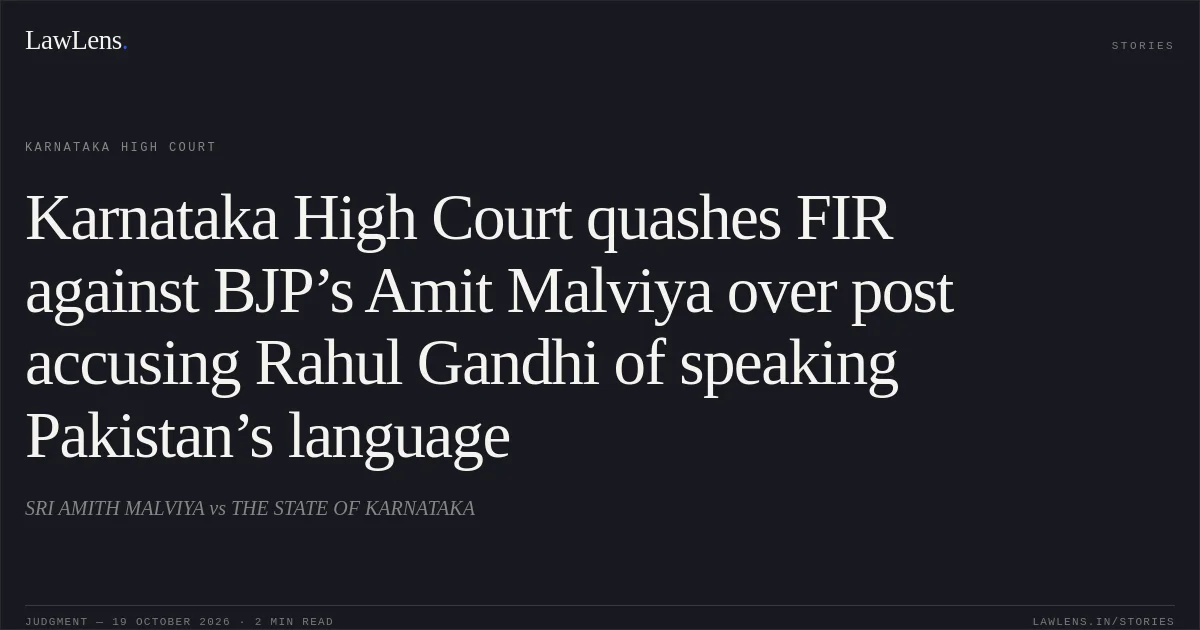
On 20 May 2025, respondent No. 2 complained that the petitioner, through a post on his X account, had shared an edited image of Rahul Gandhi and accused him of speaking “the language of Pakistan” in his criticism concerning Operation Sindoor.
Source reference: para. 3, pp. 3–4The complaint alleged several offences; Crime No. 133 of 2025 was registered at High Grounds Police Station under Sections 192 and 353 of the Bharatiya Nyaya Sanhita, 2023 (BNS).
Source reference: para. 3, pp. 3–4; para. 7, pp. 5–7The petitioner sought quashing under Section 528 of the Bharatiya Nagarik Suraksha Sanhita, 2023 (BNSS).
Source reference: para. 1, p. 3The State and complainant opposed the petition, arguing that investigation should be permitted.
Source reference: paras. 1, 5, pp. 3–4Issues
Whether the complaint and the post attributed to the petitioner prima facie disclosed the ingredients of the offences under Sections 192 and 353 BNS.
Source reference: paras. 7–8, pp. 7–23Whether the FIR should be quashed under Section 528 BNSS as an abuse of the process of law.
Source reference: paras. 8–9, pp. 8–25Law Applied
Section 528 BNSS empowers the High Court to prevent abuse of process and secure the ends of justice.
Source reference: para. 1, p. 3The Court relied on State of Haryana v. Bhajan Lal, which identifies, illustratively, cases where quashing may be justified, including where allegations taken at face value do not constitute an offence.
Source reference: para. 9, pp. 23–24It also relied on Imran Prathapgadhi v. State of Gujarat, Javed Ahmad Hajam v. State of Maharashtra, Patricia Mukhim v. State of Meghalaya, and Mithun Chakravarty Devidas Shet v. State of Karnataka.
Source reference: paras. 8.1–8.4, pp. 8–23Those decisions stress that speech-related offences require assessment of the words in context and as a whole; where the relevant statutory ingredients, including the requisite intent in the offences discussed, are not disclosed, continuation of proceedings may amount to abuse of process.
Source reference: paras. 8.1–8.4, pp. 8–23The judgment’s detailed speech analysis concerns Section 196 BNS and Section 153-A IPC, although the FIR at issue was registered under Sections 192 and 353 BNS.
Source reference: paras. 3, 7–8, pp. 3–8Reasoning
The Court considered the complaint and the post as a whole and concluded that the allegations did not justify continuation of the criminal proceedings.
Source reference: paras. 7–8.4, pp. 7–23It applied the cited speech-offence authorities and reasoned that, on the complaint’s own account, further investigation would serve no legitimate purpose and would constitute an abuse of process.
Source reference: paras. 7–8.4, pp. 7–23It then applied the Bhajan Lal principles to conclude that the FIR was liable to be quashed.
Source reference: para. 9, pp. 23–24The judgment does not separately set out an element-by-element analysis of Sections 192 and 353 BNS; its principal reasoning addresses the speech-related principles discussed in the authorities cited.
Source reference: paras. 8–9, pp. 8–25Holding
The Court allowed the petition and quashed Crime No. 133 of 2025, registered at High Grounds Police Station and pending before the I Additional Chief Metropolitan Magistrate, Bengaluru.
Pending applications were disposed of accordingly.
Source reference: para. 9 and operative order, pp. 24–25Acts & Sections Cited
10 provisions across 4 statutes referred to in this judgment. Each provision opens on LawLens.
Bharatiya Nyaya Sanhita, 20235
Indian Penal Code, 18601
Code of Criminal Procedure, 19733
Bharatiya Nagarik Suraksha Sanhita, 20231
Original Court PDF
SRI AMITH MALVIYAvsTHE STATE OF KARNATAKA
Click to open original judgment
Original judgment, available to read, download and summarize on LawLens.in