Facts
The petitioner-father and respondent No. 2-mother married in 2013 and moved to Ontario, Canada, where their daughter was born in 2020.
Source reference: paras. 3–6After the parties separated, the mother initiated divorce and custody proceedings in Ontario. In March 2025, she travelled to India with the child. The Ontario court later held that it retained jurisdiction and, by final order dated 27 October 2025, directed the child’s return to Ontario.
Source reference: paras. 3–6Meanwhile, the mother obtained an interim custody order from the Family Court, Mysuru, on 12 June 2025. The father sought habeas corpus and repatriation of the child to Canada.
Source reference: paras. 3–6The mother opposed the petition, relying on her role as the child’s primary caregiver, the subsisting Mysuru order and the child’s welfare.
Source reference: paras. 11–14Issues
1. Whether this Court was bound, in habeas corpus jurisdiction, to direct the child’s repatriation to Ontario in enforcement of the Ontario court’s order.
Source reference: para. 162. Whether the child’s custody with her mother warranted interference through a writ of habeas corpus, having regard to the child’s welfare and the available Indian proceedings.
Source reference: paras. 20–22Law Applied
Under Article 226, habeas corpus may be used to restore a minor to a lawful guardian where the child is wrongfully detained, but it is an extraordinary and summary remedy; in child-custody matters, it is generally available where the child is held by a person not entitled to legal custody, and a detailed welfare inquiry may instead be left to the competent civil or family court (*Tejaswini Gaud v. Shekhar Jagdish Prasad Tewari*).
Source reference: para. 20The child’s welfare is the paramount consideration, and an Indian court is not mechanically bound to enforce a foreign return order; it may conduct a summary or elaborate inquiry, with the foreign order being one relevant circumstance rather than conclusive proof of where the child’s welfare lies (*Dhanwanti Joshi v. Madhav Unde*; *Nithya Anand Raghavan v. State (NCT of Delhi)*).
Source reference: paras. 17–18Comity of courts does not displace the Indian court’s welfare inquiry, and custody with a natural guardian is ordinarily presumed lawful, subject to exceptional circumstances warranting intervention (*Kanika Goel v. State of Delhi*).
Source reference: paras. 17, 21Reasoning
The Court found no material showing that the child’s welfare would be better served by returning her to Canada. The child was six years old, living with her mother and maternal grandparents in India, attending school there, and continuing to have video-call access with her father.
Source reference: para. 19The Mysuru Family Court’s interim order protecting the mother’s custody remained in force. Further, the Ontario order directed return but did not declare the mother’s custody unlawful or grant sole custody to the father; the father was exercising visitation rights.
Source reference: para. 22In these circumstances, the Court held that the custody and welfare questions should be determined in the proceedings where the parties had joined issue, rather than through the extraordinary writ jurisdiction.
Source reference: paras. 20–22Holding
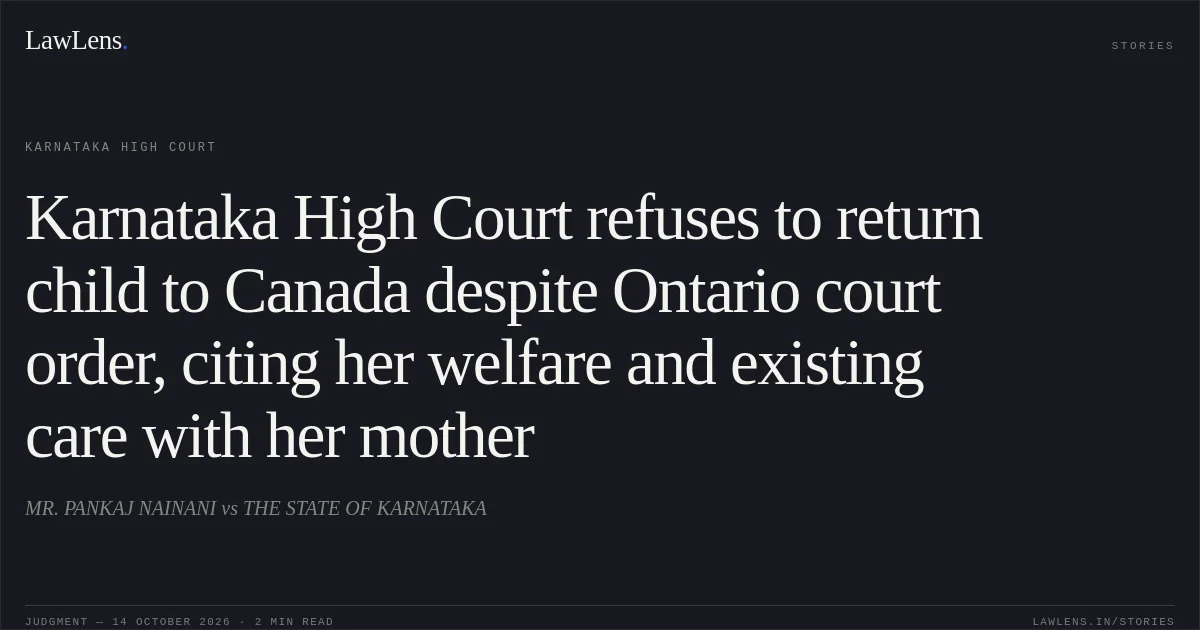
The Court held that it was not bound to order repatriation merely because the Ontario court had directed the child’s return.
Finding no exceptional basis to disturb the mother’s custody through habeas corpus, it dismissed the writ petition and disposed of the pending interlocutory applications.
Source reference: paras. 23–24Original Court PDF
MR. PANKAJ NAINANIvsTHE STATE OF KARNATAKA
Click to open original judgment
Original judgment, available to read, download and summarize on LawLens.in


