Facts
Respondent No. 1 brought a partition suit, O.S. No. 138/2013.
Source reference: para. 3The petitioners, who were defendants, denied the claim and asserted that a partition had already taken place.
Source reference: para. 3The Trial Court decreed the suit and allotted the plaintiff a 1/6 share.
Source reference: para. 4In the appeal, the petitioners sought under Order VI Rule 17 CPC to amend their written statement by pleading details of a family arrangement.
Source reference: para. 5The First Appellate Court rejected the application as belated and an afterthought.
Source reference: para. 7–8The petitioners challenged that order by writ petition.
Source reference: para. 7–8Issues
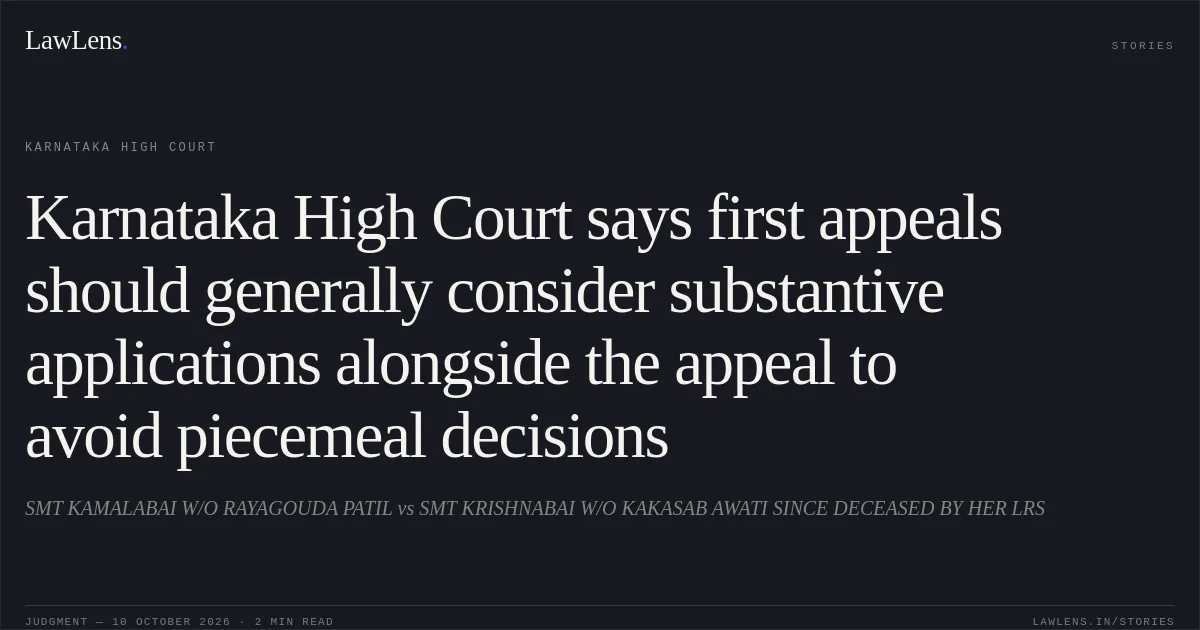
1. Whether the First Appellate Court should have considered the amendment application along with the main appeal rather than dismissing it separately at the threshold.
Source reference: para. 6, 10–122. Whether the rejection of the amendment application could stand when the proposed amendment had a material bearing on the appeal and the parties’ contentions remained to be considered.
Source reference: para. 10–12Law Applied
Order VI Rule 17 CPC governs amendment of pleadings.
Source reference: no citationUnder Section 96 CPC, a first appeal is a continuation of the suit, and the appellate court must independently evaluate the controversy and the Trial Court’s findings.
Source reference: para. 6, 11Relying on Santosh Hazari v. Purushottam Tiwari, (2001) 3 SCC 179; Dilip v. Mohd. Azizul Haq, AIR 2000 SC 1976; Triloki Nath Singh v. Anirudh Singh, (2020) 6 SCC 629; V. Prabhakara v. Basavaraj K. (Dead) by LRs., 2021 SCC OnLine SC 896; and the coordinate Bench decision in W.P. No. 101384/2021, the Court stated that applications substantially connected with the merits of an appeal should ordinarily be considered with the main appeal, unless compelling circumstances justify separate determination.
Source reference: para. 6, 11Reasoning
The amendment application concerned the petitioners’ pleaded defence of a family arrangement and therefore had a material connection to the appeal.
Source reference: para. 10–12The First Appellate Court had rejected it separately on grounds of delay and afterthought, rather than considering it in the context of the appeal as a whole.
Source reference: para. 10–12Applying the principle that substantive interlocutory applications should ordinarily be heard with the appeal, the High Court held that the application should be considered at the final-hearing stage.
Source reference: para. 10–12It did not determine whether the amendment should ultimately be allowed; all parties’ contentions were left open.
Source reference: para. 10–12Holding
The writ petition was allowed, and the order dated 25 March 2026 rejecting I.A. No. IV was set aside.
The First Appellate Court was directed to consider the amendment application along with the main appeal and decide both in accordance with law.
Source reference: para. 12It was also directed to endeavour to dispose of the appeal at the earliest, with the parties to cooperate and avoid further delay.
Source reference: para. 12Acts & Sections Cited
3 provisions across 1 statute referred to in this judgment. Each provision opens on LawLens.
Code of Civil Procedure, 19083
Original Court PDF
SMT KAMALABAI W/O RAYAGOUDA PATILvsSMT KRISHNABAI W/O KAKASAB AWATI SINCE DECEASED BY HER LRS
Click to open original judgment
Original judgment, available to read, download and summarize on LawLens.in