Facts
Minimum wages for Karnataka’s Garments Industry had previously been fixed by a 2014 notification.
Source reference: no citationIn 2018, the State issued a draft notification proposing revised wages, but withdrew it along with other wage notifications.
Source reference: no citationIn W.A. No. 1520/2019 and connected matters, a Division Bench set aside the withdrawal, revived the draft notification and directed the State to take further steps under Section 5 of the Minimum Wages Act, 1948
Source reference: para. 3–7The State later issued a final notification on 17 January 2023, relying on a 14% increase over rates in a 2019 notification.
Source reference: para. 8–10, 16–21A workers’ union challenged the 2023 notification.
Source reference: para. 8–10, 16–21The Single Judge quashed it and directed the State to complete the wage-revision exercise pursuant to the revived 2018 draft notification, including directions on the effective date, conditional interest and completion within six months
Source reference: para. 8–10, 16–21The employer associations appealed
Source reference: para. 22–27Issues
1. Whether the 2023 wage notification was invalid because the State had not followed the procedure under Section 5(1)(b) of the Minimum Wages Act after the 2018 draft notification was revived
Source reference: para. 29–322. Whether the Single Judge’s directions concerning the effective date, conditional interest and completion of the wage-revision exercise could stand, including after repeal of the 1948 Act
Source reference: para. 24–27, 36–40Law Applied
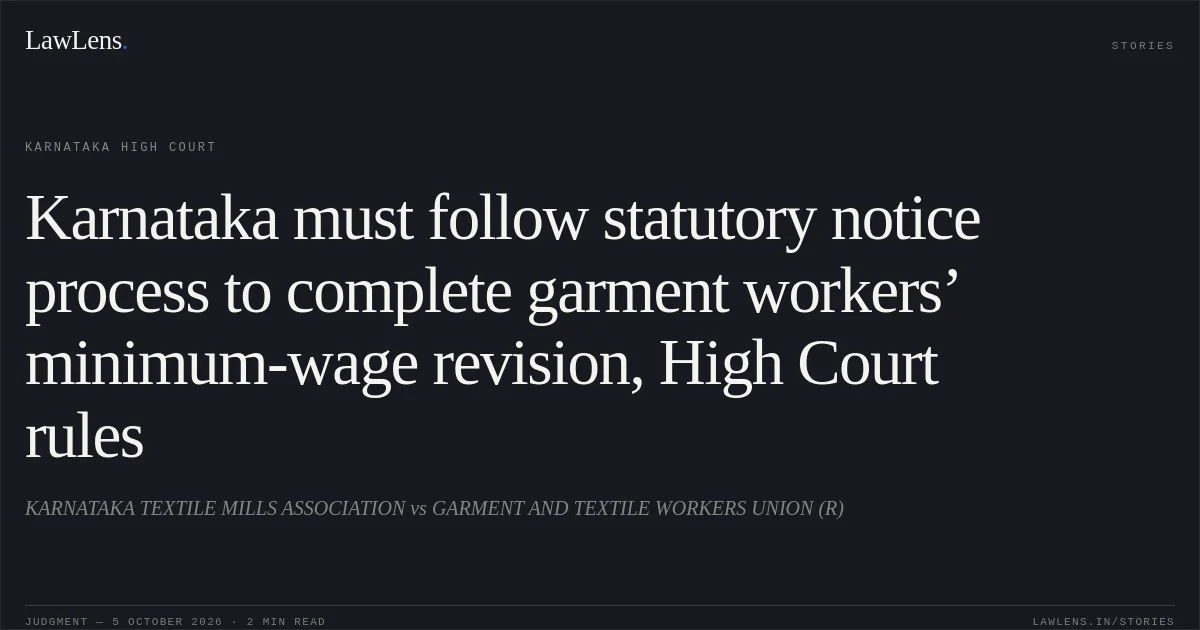
Section 5(1)(b) of the Minimum Wages Act, 1948 requires publication of wage proposals and an opportunity for objections before the Government makes a final decision under the notification method; stakeholder meetings cannot substitute for that statutory procedure.
Source reference: para. 32Section 5(2) permits the Government to specify the effective date and does not require every revision to increase wages, provided the statutory process is followed.
Source reference: para. 35, 37Sections 69(2) and 69(3) of the Code on Wages, 2019, read with Section 6 of the General Clauses Act, 1897, preserve accrued rights, liabilities and proceedings following repeal.
Source reference: para. 40The Division Bench’s judgment of 13 April 2020 in W.A. No. 1520/2019 revived the 2018 draft notification and required further steps in accordance with Section 5.
Source reference: para. 6–7, 31Reasoning
The State had relied on Section 5(1)(b), but after the 2018 draft notification was revived, it did not republish the proposal and provide the statutory objection period.
Source reference: para. 32The 2022 Board and stakeholder meetings did not cure that omission.
Source reference: para. 32Further, the 2023 notification used the 2019 notification as its wage baseline even though the Division Bench had held that notification inoperative
Source reference: para. 34–35The Single Judge had not fixed the wages proposed in the draft; it left the quantum to the Government after consideration of relevant factors.
Source reference: para. 36–41The effective-date and interest directions were conditional on the outcome of that exercise, and the wage-revision proceeding had already been preserved by the earlier Division Bench judgment notwithstanding repeal of the 1948 Act
Source reference: para. 36–41Holding
The High Court dismissed the appeal and confirmed the Single Judge’s order insofar as it concerned the employer associations
The State must complete the statutory wage-revision exercise pursuant to the 2018 draft notification; the judgment does not itself determine the revised wage rates.
Source reference: para. 38–39, 45–46The Single Judge’s directions, including conditional interest where the revised wages exceed wages already paid, remain in force
Source reference: para. 38–39, 45–46Acts & Sections Cited
3 provisions across 3 statutes referred to in this judgment. Each provision opens on LawLens.
KARNATAKA HIGH COURT ACT, 19611
Code on Wages, 20191
General Clauses Act, 18971
Original Court PDF
KARNATAKA TEXTILE MILLS ASSOCIATIONvsGARMENT AND TEXTILE WORKERS UNION (R)
Click to open original judgment
Original judgment, available to read, download and summarize on LawLens.in