Facts
The petitioner, a film actress, alleged that videos published and circulated on social-media platforms contained false, scandalous and sexually coloured remarks imputing sexual impropriety to her and damaging her dignity, reputation and privacy.
Source reference: paras. 2–3She approached the Station House Officer and thereafter the superior police authorities, alleging failure to register an FIR or take effective action.
Source reference: paras. 2–3, 10The police conducted a preliminary enquiry, recorded witness statements and concluded that no cognizable offence was disclosed, though the allegations might constitute defamation under Section 356 of the Bharatiya Nyaya Sanhita, 2023 (BNS).
Source reference: paras. 4, 11The petitioner then approached the Judicial First Class Magistrate under Section 175(3) of the Bharatiya Nagarik Suraksha Sanhita, 2023 (BNSS), seeking a direction for registration of an FIR and investigation for offences allegedly punishable under Sections 75(iv) and 79 of the BNS, Sections 67 and 67A of the Information Technology Act, 2000, and Section 119(a) of the Kerala Police Act.
Source reference: paras. 3, 5The Magistrate declined to direct police investigation, treated the matter as a private complaint and directed the petitioner to appear for recording her sworn statement.
Source reference: para. 5Issues
Whether the police were legally entitled to conduct a preliminary enquiry instead of registering an FIR upon receiving the petitioner’s complaint.
Source reference: paras. 13–18Whether the Magistrate properly exercised jurisdiction under Section 175(3) of the BNSS in refusing police investigation and treating the matter as a private complaint.
Source reference: paras. 19–21, 25–28Whether the Magistrate independently examined whether the allegations, taken at face value, disclosed any cognizable offence, including under Section 79 of the BNS.
Source reference: paras. 23–27Law Applied
The Court considered Section 173(1), (3) and (4) of the BNSS, governing information relating to cognizable offences, preliminary enquiry and the remedy upon refusal to record information; and Section 175(3) of the BNSS, which empowers the Magistrate to direct police investigation.
Source reference: no citationIt applied Lalita Kumari v. Government of Uttar Pradesh, (2014) 2 SCC 1, which held that FIR registration is ordinarily mandatory where information discloses a cognizable offence, while recognising a limited preliminary enquiry where the information does not clearly disclose such an offence.
Source reference: paras. 14–15The Court also relied on Imran Pratapgadhi v. State of Gujarat, 2025 INSC 410, holding that Section 173(3) of the BNSS is an express statutory exception to the general rule under Section 173(1), permitting a preliminary enquiry in cognizable offences punishable with imprisonment of three years or more but less than seven years, with prior permission of the prescribed superior police officer.
Source reference: paras. 16–17The Magistrate’s power under Section 175(3) is discretionary but must be exercised judicially, with independent consideration of whether the complaint discloses a cognizable offence and whether police investigation is necessary.
Source reference: paras. 20–21The Court also examined the ingredients of Sections 75(iv) and 79 of the BNS, noting that Section 75(iv) is gender-specific and can be committed only by a man, whereas Section 79 requires, inter alia, an intention to outrage the modesty of a woman, or conduct amounting to intrusion upon her privacy.
Source reference: paras. 23, 26Reasoning
The High Court held that the police’s preliminary enquiry was not per se illegal because Section 173(3) of the BNSS expressly permits such an enquiry in the specified category of offences, and the police had undertaken it to determine whether a prima facie case existed.
Source reference: paras. 16–18However, the Magistrate could not merely adopt the SHO’s conclusion that the allegations amounted only to defamation.
Source reference: paras. 23–27The complaint specifically alleged public dissemination of statements imputing sexual misconduct and offending the petitioner’s dignity and privacy, requiring examination of the tenor, context and intended effect of the remarks against the statutory ingredients of the offences invoked.
Source reference: paras. 23–27Although Section 75(iv) could not apply to the first accused because she was a woman, that circumstance did not resolve whether another cognizable offence, particularly under Section 79 of the BNS, was disclosed.
Source reference: para. 23The Magistrate’s order contained no adequate independent analysis of the allegations, the ingredients of the offences, or the necessity of police investigation to collect evidence unavailable to the complainant. It therefore suffered from non-application of mind.
Source reference: paras. 25–28Holding
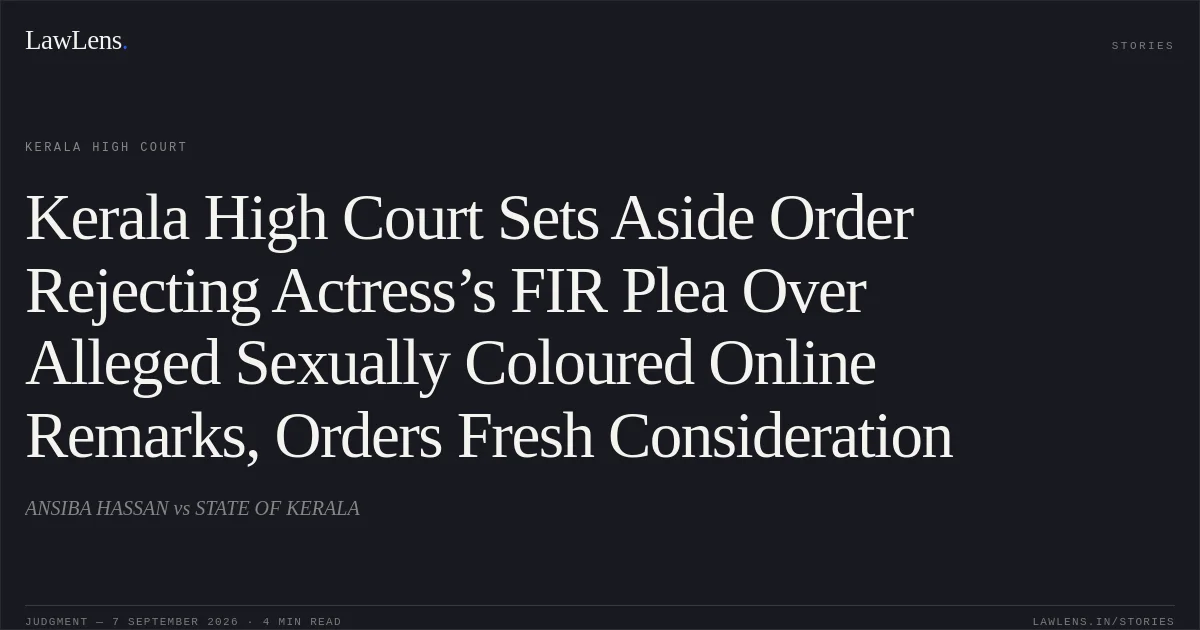
The High Court partly allowed the Criminal Miscellaneous Case and set aside the Magistrate’s order dated 27 July 2026.
It remitted the matter to the Magistrate for fresh consideration, directing the Magistrate to independently assess whether the complaint prima facie disclosed a cognizable offence and, if so, whether police investigation under Section 175(3) of the BNSS was warranted, including for collection of evidence that the petitioner could not effectively obtain herself.
Source reference: para. 29The Court did not itself direct registration of an FIR and clarified that the Magistrate must pass a fresh, reasoned order uninfluenced by the High Court’s observations on the merits.
Source reference: para. 29Acts & Sections Cited
22 provisions across 4 statutes referred to in this judgment. Each provision opens on LawLens.
Bharatiya Nagarik Suraksha Sanhita, 20234
Bharatiya Nyaya Sanhita, 2023
Information Technology Act, 20001
Code of Criminal Procedure, 19731
Original Court PDF
ANSIBA HASSANvsSTATE OF KERALA
Click to open original judgment
Original judgment, available to read, download and summarize on LawLens.in