Facts
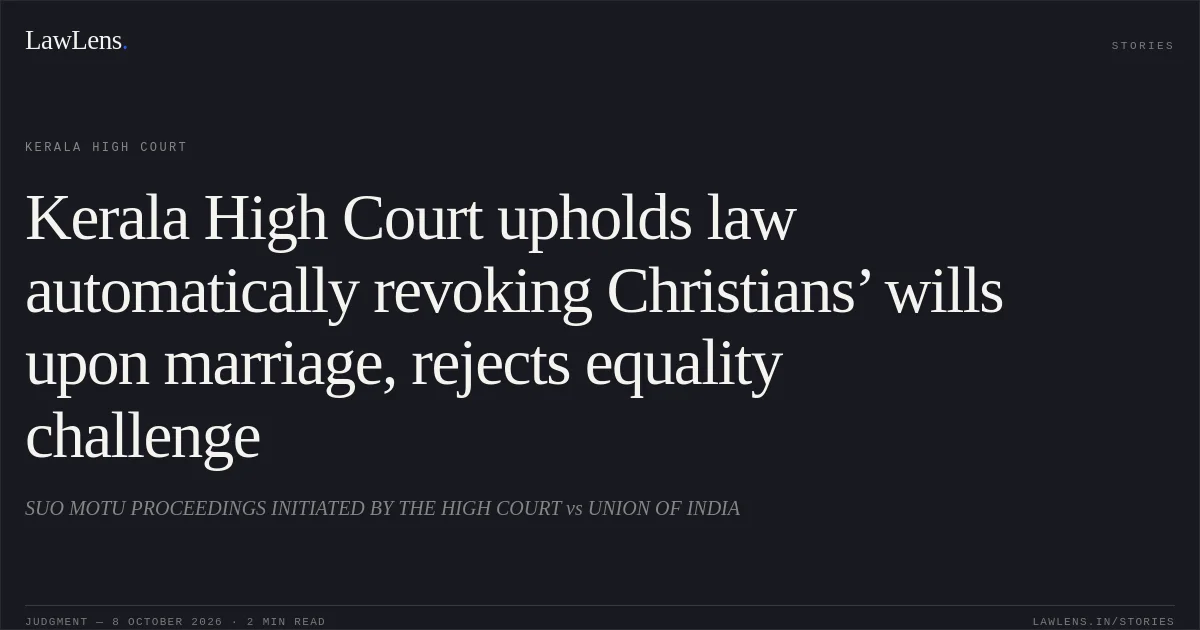
In O.S. No. 26 of 2016, the Sub Court, Punalur, by order dated 12 February 2025 in I.A. No. 216 of 2017, referred the validity of Section 69 of the Indian Succession Act, 1925, for consideration under Section 113 CPC; the High Court registered the reference as C.R. No. 1 of 2025.
Source reference: p. 1The plaintiff in the suit separately challenged the reference order in O.P.(C) No. 903 of 2026, while W.P.(C) No. 27213 of 2017 also raised a challenge to Section 69.
Source reference: pp. 1, 41–42Issues
Whether Section 69 of the Indian Succession Act, 1925, which provides for revocation of a will by the testator’s marriage but does not apply to Hindus, violates Part III of the Constitution.
Source reference: p. 1; pp. 12–13Whether Section 69 is in direct conflict with Section 20(1) of the Indian Succession Act, 1925.
Source reference: p. 40Whether the Sub Court’s reference satisfied the requirements of Section 113 and Order XLVI CPC.
Source reference: p. 41Law Applied
Section 69 provides for revocation of a will by marriage; under Section 57 and Schedule III, it does not apply to Hindus, and Section 70 is correspondingly modified for them.
Source reference: pp. 3–4Article 14 permits reasonable classification where it rests on an intelligible differentia having a rational nexus to the legislative object; a law’s under-inclusion does not, by itself, make it unconstitutional.
Source reference: pp. 13–20, 26–32Article 15 prohibits discrimination on specified grounds, including religion, but the Court relied on John Vallamattom v. Union of India to hold that the provision did not attract Article 15 in the circumstances.
Source reference: pp. 34–36Section 20(1) provides that marriage does not itself confer an interest in one spouse’s property or disable either spouse from dealing with their own property.
Source reference: p. 40Reasoning
The Court traced the distinction between Hindus and other communities to the legislative history of the Hindu Wills Act, 1870, which excluded revocation by marriage against the then-prevailing social and legal background.
Source reference: pp. 6–12It held that the distinction remained constitutionally sustainable: the object of Section 69 is to protect a new family, while Hindu law separately recognises a wife’s maintenance rights, including under Section 18 of the Hindu Adoption and Maintenance Act, 1956.
Source reference: pp. 22–25The Court further concluded that Section 69 does not create a property interest in favour of the new spouse or prevent the testator from disposing of property; it only revokes a prior will upon marriage. It therefore found no conflict with Section 20(1).
Source reference: pp. 40–41Holding
The Court rejected the challenge to Section 69 as violative of Part III and held that it does not conflict with Section 20(1).
The referred questions were answered accordingly. The Court declined to decide the challenge to the reference order in O.P.(C) No. 903 of 2026, as that issue had become academic; the connected cases were ordered in those terms.
Source reference: pp. 41–42Acts & Sections Cited
11 provisions across 6 statutes referred to in this judgment. Each provision opens on LawLens.
Indian Succession Act, 19255
Hindu Succession Act, 19561
Hindu Marriage Act, 19551
Hindu Adoptions and Maintenance Act, 19561
Transfer of Property Act, 18821
Code of Civil Procedure, 19082
Original Court PDF
SUO MOTU PROCEEDINGS INITIATED BY THE HIGH COURTvsUNION OF INDIA
Click to open original judgment
Original judgment, available to read, download and summarize on LawLens.in