01Facts
Seven petitioners claimed occupation of rooms or hutments on CTS No. 10A, Rajeev Gandhi Nagar, Kurla (East).
¶ 1 · p. 2The Court recorded that the petitioners’ structures were within the Railway land’s ten-metre buffer/safety zone.
¶ 1 · p. 2 · ¶ 4 · p. 4The Railways had issued notices in 2022 under Section 4 of the Public Premises (Eviction of Unauthorized Occupants) Act, 1971, followed by notices directing removal of the structures.
¶ 2 · pp. 2–3The petitioners challenged the notices and relied on the Supreme Court’s directions in Utran Se Besthan Railway Jhopadpatti Vikas Mandal v. Government of India & Ors. concerning eviction and rehabilitation of Railway-land occupants.
¶ 3 · pp. 3–4The Railways stated that the 2022 eviction orders had attained finality but agreed to issue fresh notices in accordance with the applicable directions.
¶ 8 · p. 902Issues
i.1. Whether the petitioners’ challenge to the Railway eviction notices warranted relief, and what process should govern their removal from Railway land.
¶ 3, 8–9 · pp. 3–4, 9–12ii.2. Whether the petitioners and other persons removed from Railway land should have their identities and eligibility considered for rehabilitation.
¶ 6, 9–10 · pp. 6–8, 10–1303Law Applied
Section 4 of the Public Premises (Eviction of Unauthorized Occupants) Act, 1971 provides for notice in proceedings to evict alleged unauthorized occupants of public premises.
¶ 2 · pp. 2–3The Court applied the Supreme Court’s directions in Utran Se Besthan Railway Jhopadpatti Vikas Mandal v. Government of India & Ors., which require notice before eviction, recording details of affected occupants, and consideration of rehabilitation under available schemes or the Pradhan Mantri Awas Yojana, subject to eligibility; occupants cannot insist on in-situ rehabilitation.
¶ 6 · pp. 6–8Those directions drew on Ahmedabad Municipal Corporation v. Nawab Khan Gulab Khan, (1997) 11 SCC 121, as a precedent concerning support for persons affected by removal of structures.
¶ 6 · p. 6The Court also followed the Bombay High Court’s directions in Rajo Ransingh Tak v. Union of India, Writ Petition (L) No. 4938 of 2026, decided 26 February 2026, concerning eviction notices and recording occupants’ details for rehabilitation consideration.
¶ 7 · pp. 8–9Provisions in the judgment · 1 · Linked ones open on LawLens
Public Premises (Eviction of Unauthorised Occupants) Act, 1971 Section 4
04Reasoning
The Court accepted that the petitioners occupied Railway land within the safety zone and that the Railways required the land for its activities.
¶ 4–5 · pp. 4–6Although eviction orders had been made in 2022, the Court considered that occupants might have changed since then and directed fresh notices, rather than relying solely on the earlier notices and orders.
¶ 8 · p. 9Applying the Supreme Court’s directions, it required a 30-day period to vacate, police assistance if necessary, and a Collector-led record of occupants before eviction.
¶ 8–10 · pp. 9–13It also directed that affected persons’ eligibility be considered under applicable rehabilitation arrangements, while limiting relief to Railway land and excluding persons occupying private land from the fresh-notice direction.
¶ 8–10 · pp. 9–1305Holding
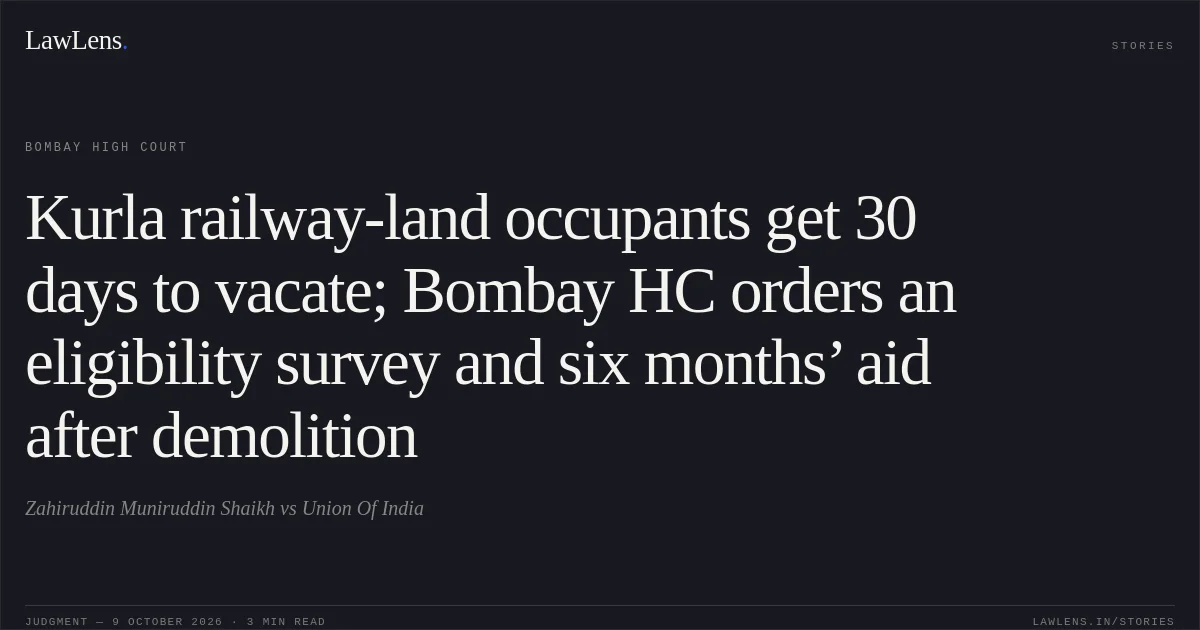
The petition was disposed of with directions that Central Railways issue fresh notices within one week, allowing occupants 30 days to vacate; if they do not, the Railways may proceed with eviction and removal with police assistance.
¶ 9(i)–(iii) · pp. 10–11Before eviction, the Collector must record the occupants’ details; Central Railways must pay ₹2,000 per month per demolished structure for six months; and affected persons may seek rehabilitation under an existing scheme or, where none applies, the Pradhan Mantri Awas Yojana, subject to eligibility and without a right to in-situ accommodation.
¶ 9(iv)–(viii) · pp. 11–12The Collector must take steps, in consultation with the Slum Rehabilitation Authority, to pursue rehabilitation within six months for the petitioners and other persons removed from Railway land.
¶ 10 · p. 13Original Court PDF
Zahiruddin Muniruddin ShaikhvsUnion Of India
Click to open original judgment
Original judgment, available to read, download and summarize on LawLens.in