Facts
UPEIDA invited bids for an expressway project, with the bid due date fixed as 7 September 2026.
Source reference: no citationOn that date, a debarment order against Larsen & Toubro Limited (L&T), issued by the U.P. Jal Jeevan Mission on 13 April 2026, remained in force.
Source reference: no citationL&T did not disclose the debarment with its bid.
Source reference: no citationAfter UPEIDA sought clarification, L&T disclosed that the debarment had been kept in abeyance from 14 September 2026.
Source reference: no citationOn 25 September 2026, UPEIDA’s Technical Evaluation Committee rejected L&T’s bid as non-responsive, citing the debarment.
Source reference: no citationL&T challenged the rejection under Article 226, arguing, among other things, that the later abeyance and its declaration concerning catastrophic structural failure meant that it should have been treated as eligible.
Source reference: paras. 18–19It also relied on an asserted price difference of approximately ₹260 crore between its bid and the lowest bid.
Source reference: paras. 18–19Issues
1. Whether clause 2.1.18 of the RFP imposed an eligibility condition requiring bidders to be free from a subsisting governmental debarment on the bid due date.
Source reference: paras. 23–262. Whether eligibility was to be assessed on the bid due date or the later date of technical evaluation, and whether the 14 September 2026 abeyance order operated retrospectively.
Source reference: paras. 29–343. Whether the rejection was arbitrary or discriminatory because L&T was not permitted to cure its ineligibility, and whether the Court should intervene under Article 226.
Source reference: paras. 36–44, 52–54Law Applied
In tender matters, judicial review examines the legality of the decision-making process, not the merits of the authority’s decision; intervention is warranted where the decision is arbitrary, irrational, mala fide or perverse, applying Tata Cellular v. Union of India and Jagdish Mandal v. State of Orissa.
Source reference: para. 20The tender’s author is ordinarily best placed to interpret its terms, and that interpretation is respected unless unreasonable or perverse, as stated in Afcons Infrastructure Ltd. v. Nagpur Metro Rail Corporation Ltd. and Agmatel India Pvt. Ltd. v. Resoursys Telecom.
Source reference: para. 21Essential tender conditions must be strictly complied with and cannot be selectively waived or cured after the deadline; ancillary conditions may be relaxed only consistently with fairness to other bidders, under Poddar Steel Corporation v. Ganesh Engineering Works, Central Coalfields Ltd. v. SLL-SML (Joint Venture Consortium) and related authorities.
Source reference: paras. 37–38A stay or suspension of an order does not quash or retrospectively erase it; it operates prospectively, under Shree Chamundi Mopeds Ltd. v. Church of South India Trust Association.
Source reference: para. 33The Court also applied the principles of a level playing field under Article 14 and the discretionary nature of relief under Article 226.
Source reference: paras. 43–49Reasoning
The Court held that clause 2.1.18 was an express threshold eligibility condition: it barred an entity from bidding where a governmental debarment subsisted on the bid due date.
Source reference: paras. 24–28Clause 2.2.2.10 concerned technical capacity and catastrophic construction failures, so compliance with it did not displace the separate debarment condition.
Source reference: paras. 24–28The RFP fixed 7 September 2026 as the relevant date; the 120-day bid-validity clause did not shift eligibility assessment to the date of evaluation.
Source reference: paras. 29–32Because the U.P. debarment was in force on 7 September and was only kept in abeyance from 14 September, L&T was ineligible on the stipulated date; the later order did not relate back.
Source reference: paras. 33–34The condition was essential and could not be cured by a post-deadline event.
Source reference: paras. 39–44The Court found that UPEIDA had sought clarification and considered L&T’s response, and that allowing L&T to proceed would disadvantage prospective bidders who relied on the same eligibility condition.
Source reference: paras. 39–44The asserted lower price did not create a right to have an ineligible bid considered.
Source reference: paras. 45–46The Court treated L&T’s late disclosure as relevant to discretionary relief, but expressly made no finding of fraud.
Source reference: paras. 47–49Holding
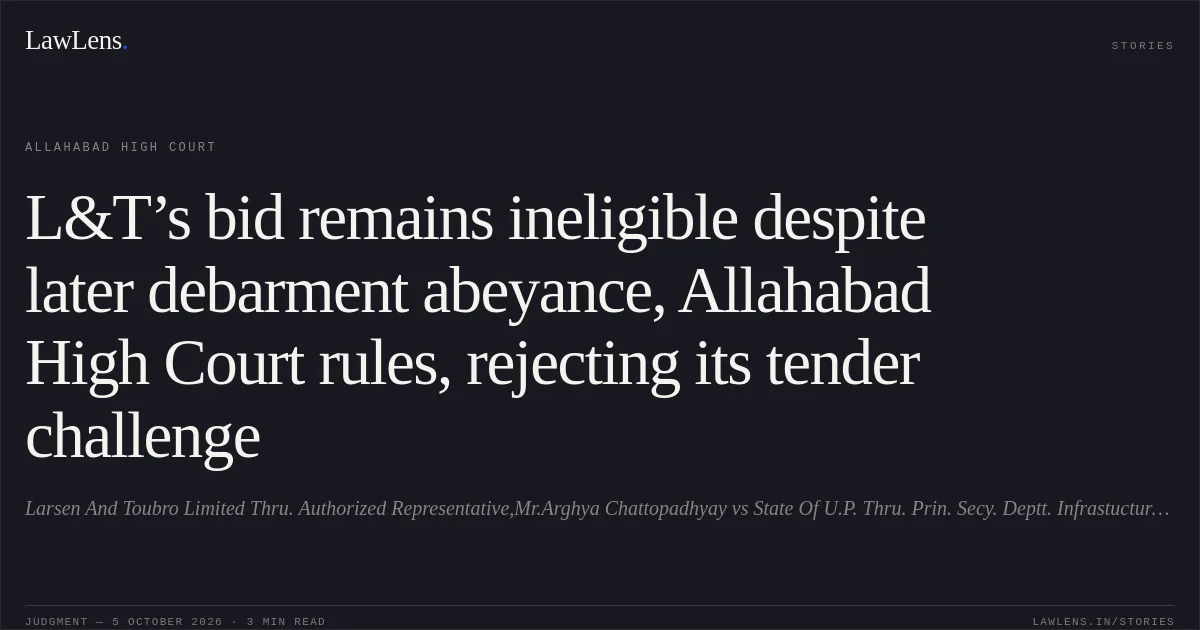
The Court held that L&T was ineligible under clause 2.1.18 on the bid due date, that the later abeyance did not cure that ineligibility, and that the Technical Evaluation Committee’s decision was neither arbitrary nor otherwise reviewable under Article 226.
The writ petition was dismissed, with no order as to costs; any interim order was vacated.
Source reference: paras. 55–56The dismissal did not prevent L&T from pursuing remedies against the debarment orders before the competent forum.
Source reference: paras. 55–56Acts & Sections Cited
4 provisions across 1 statute referred to in this judgment. Linked provisions open on LawLens.
Fugitive Economic Offenders (Procedure for Sending Letter of Request to Contracting State) Rules, 20184
Original Court PDF
Larsen And Toubro Limited Thru. Authorized Representative,Mr.Arghya ChattopadhyayvsState Of U.P. Thru. Prin. Secy. Deptt. Infrastucture And Industrial Developmanent Lko And 4 Others
Click to open original judgment
Original judgment, available to read, download and summarize on LawLens.in