Facts
The Respondent-Workman, a Head Cashier appointed in 1973, was dismissed from service on 07.02.1995 following a departmental enquiry into allegations of financial irregularities, including cash shortages and breach of trust.
Source reference: p. 2-4After his appeal was rejected by the Appellate Authority, the Workman raised an industrial dispute in 2006—approximately eleven years after his dismissal.
Source reference: p. 3-4The Central Government Industrial Tribunal (CGIT) passed an Award on 10.04.2008, setting aside the dismissal and directing reinstatement with 40% back wages and stoppage of four increments.
Source reference: p. 5The Petitioner Bank challenged this Award via a Writ Petition under Article 226, contending the reference was stale and the Tribunal improperly acted as an appellate body.
Source reference: p. 6-8Issues
1. Whether the learned Labour Court was justified in interfering with the findings of the Inquiry Officer and setting aside the order of termination?
Source reference: p. 10 / para. 102. Whether the impugned Award suffers from any perversity, patent illegality or jurisdictional error warranting interference by the High Court under Article 226?
Source reference: p. 10 / para. 10Law Applied
The Court relied on Section 11-A of the Industrial Disputes Act, 1947, which empowers Tribunals to grant relief in cases of discharge/dismissal but requires judicious exercise.
Source reference: p. 22It applied the principle from Syed Yakoob v. K.S. Radhakrishnan that writ jurisdiction is supervisory, not appellate.
Source reference: p. 11Regarding disciplinary enquiries, the court followed B.C. Chaturvedi v. Union of India and Standard Chartered Bank v. R.C. Srivastava, establishing that Tribunals shouldn't interfere with findings of fact unless they are perverse or based on "no evidence."
Source reference: p. 13-14Finally, it cited Nedungadi Bank Ltd. v. K.P. Madhankutty and U.P. SRTC v. Babu Ram regarding the doctrine of "delay and laches," holding that stale claims (e.g., 7-11 years) are fatal to industrial disputes.
Source reference: p. 24-25Reasoning
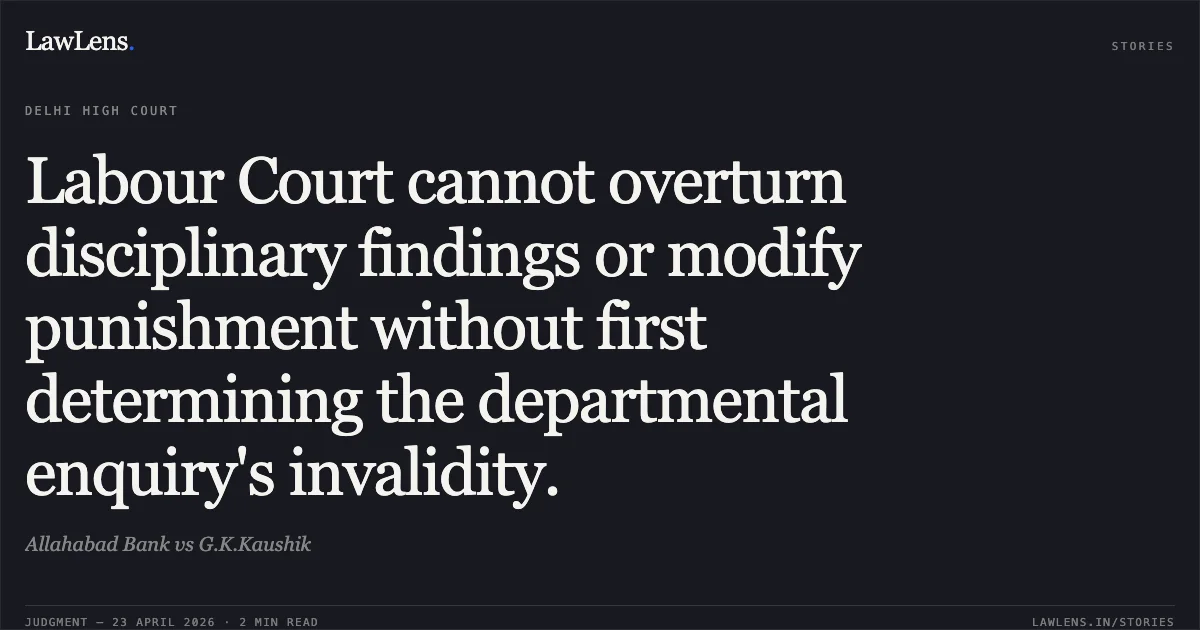
The High Court found the Tribunal’s approach legally infirm because it failed to decide the validity of the domestic enquiry as a preliminary issue before re-evaluating the evidence.
Source reference: p. 19-20, 27The Tribunal improperly substituted its own subjective assessment, characterizing financial misappropriation as "mere negligence" without recording a specific finding that the enquiry violated natural justice or was "shockingly disproportionate".
Source reference: p. 21, 23Furthermore, the Court noted a "serious jurisdictional error" as the Tribunal completely ignored the 11-year delay in raising the dispute, which rendered the claim stale under settled law.
Source reference: p. 24, 25The Court emphasized that a Head Cashier occupies a position of high trust, and the Tribunal’s "oversimplification" of the charges failed to account for individual accountability in handling public funds.
Source reference: p. 25-26Holding
The High Court answered both issues in the negative, holding that the Tribunal exceeded its jurisdiction and passed a perverse Award.
The Court set aside the CGIT Award dated 10.04.2008 and restored the Bank's order of dismissal dated 07.02.1995.
Source reference: p. 29The Court clarified that wages already paid to the Respondent under Section 17B of the Act during the pendency of the petition remain non-recoverable.
Source reference: p. 29The Writ Petition was allowed.
Source reference: p. 29Acts & Sections Cited
5 provisions across 2 statutes referred to in this judgment. Linked provisions open on LawLens.
Industrial Disputes Act, 19474
First Bipartite Agreement1
Original Court PDF
Allahabad BankvsG.K.Kaushik
Click to open original judgment
Original judgment, available to read, download and summarize on LawLens.in


![Subsequent exoneration does not retrospectively invalidate a finalized promotion select list.. UNNIKRISHNAN M vs M/o Environment And Forests. CAT - ['Ernakulam']. LawLens](/stories/thumbnails/subsequent-exoneration-does-not-retrospectively-invalidate-a-finalized-promotion-select-li-ce80a0e84f2f4887857271e8b4341c42.webp)