Facts
The petitioners, claiming to be "Pattern Masters" (skilled workmen) since 2016, challenged their alleged illegal termination by the respondent as a violation of Section 25N of the Industrial Disputes Act, 1947
Source reference: p. 2The respondent contended that the petitioners were independent "consultants" and not employees
Source reference: p. 3The Labour Court dismissed the claims, finding no employer-employee relationship existed between the parties
Source reference: p. 2Evidence showed the petitioners signed consultancy agreements, received payments against invoices, and filed tax returns under the head of ‘Income from Business and Profession’ rather than 'Salary'
Source reference: p. 4-5The petitioners approached the High Court seeking a writ of certiorari against the Labour Court’s awards
Source reference: p. 2Issues
1. Whether an employer-employee relationship existed between the petitioners and the respondent to qualify the petitioners as "workmen" under the Industrial Disputes Act
Source reference: p. 22. Whether the High Court, in the exercise of its supervisory jurisdiction under Article 226/227, can interfere with the factual findings of the Labour Court regarding the nature of employment
Source reference: p. 7Law Applied
The court primarily applied the definition of "workman" and the requirements for termination under the Industrial Disputes Act, 1947
Source reference: p. 2It relied on the "control and supervision" test and the "intent of documentation" regarding consultancy agreements
Source reference: p. 3The standards for writ jurisdiction established in Indian Overseas Bank v. I.O.B. Staff Canteen Workers' Union, which restricts High Courts from reappreciating evidence unless findings are perverse
Source reference: p. 7Syed Yakoob v. K.S. Radhakrishnan, which limits the writ of certiorari to errors of law apparent on the face of the record rather than errors of fact
Source reference: p. 9Reasoning
The Court observed that the petitioners failed to provide documentary evidence to support an employment relationship, relying solely on oral affidavits
Source reference: p. 4The respondent produced consultancy agreements (admitted by the petitioners during cross-examination), TDS certificates in Form 16A (used for non-salary payments), and ITRs where the petitioners themselves declared income from "Business and Profession"
Source reference: p. 4-5The Court found that Clause 12 of the agreement, though requiring specific hours, did not override the overarching contractual framework identifying the petitioners as independent professionals
Source reference: p. 3, 5Applying the principle of judicial restraint, the Court reasoned that the Labour Court’s findings were based on a plausible appreciation of evidence and were not perverse or unsupported
Source reference: p. 7, 11Holding
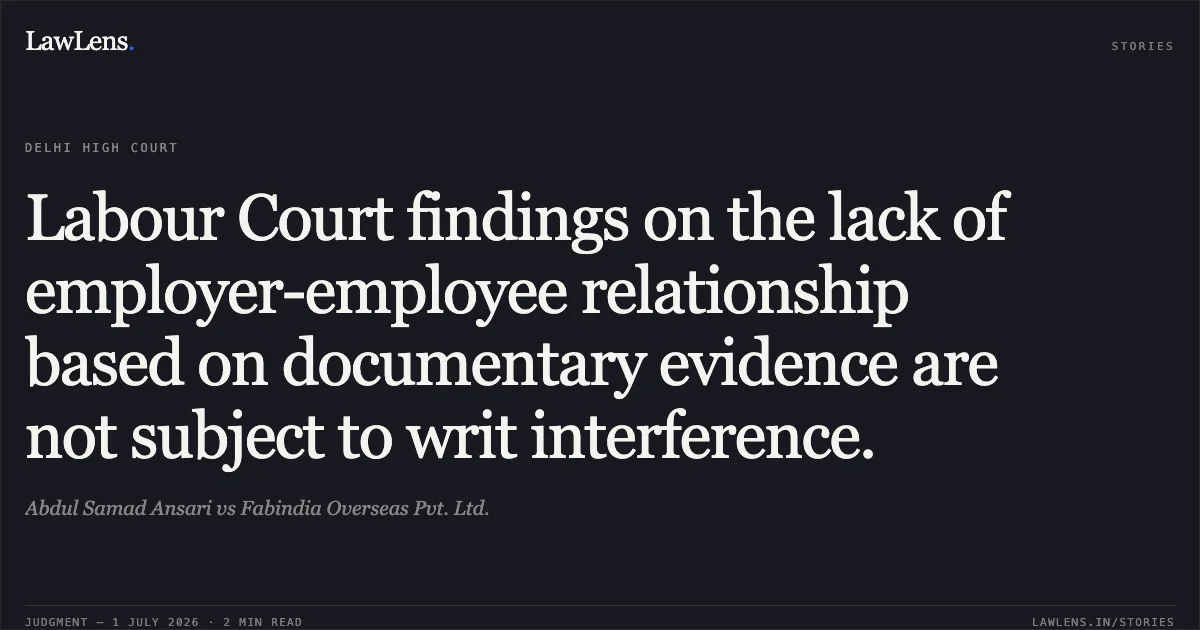
The High Court answered that no employer-employee relationship was established and held that it cannot sit as an appellate court to re-weigh evidence handled by a fact-finding tribunal
The Court found no manifest error of law or perversity in the Labour Court’s awards; consequently, the writ petitions were dismissed, affirming the Labour Court's decision that the petitioners were consultants and not employees
Source reference: p. 11, 12Acts & Sections Cited
4 provisions across 2 statutes referred to in this judgment. Linked provisions open on LawLens.
Industrial Disputes Act, 19473
Income Tax Act, 19611
Original Court PDF
Abdul Samad AnsarivsFabindia Overseas Pvt. Ltd.
Click to open original judgment
Original judgment, available to read, download and summarize on LawLens.in


