Facts
The respondent-workman was allegedly employed as a Safai Kamdar with the petitioner-Gram Panchayat from 1 January 2008.
Source reference: no citationHer services were orally terminated on 1 July 2015, following which she approached the Additional Labour Commissioner.
Source reference: no citationUpon failure of settlement, the dispute was referred to the Labour Court, Bhuj, as Reference (T) No. 5 of 2016 on 7 January 2016.
Source reference: p.2Although the petitioner was duly served and represented by counsel, it did not file a written statement or effectively contest the proceedings.
Source reference: p.2The Labour Court consequently passed an award dated 23 February 2024 directing reinstatement with full back wages and 30% payment in lieu of ancillary benefits.
Source reference: p.2The petitioner’s application under Rule 26(A) of the Gujarat Industrial Disputes Rules, 1966, seeking restoration and setting aside of the award, was rejected on 2 August 2025.
Source reference: pp.2, 4The petitioner thereafter invoked Articles 226 and 227 of the Constitution, contending that the workman was an outsourced temporary employee and that the petitioner deserved an opportunity to contest the reference.
Source reference: p.3Issues
Whether the Labour Court’s award was an ex parte award capable of being set aside under Rule 26(A) of the Gujarat Industrial Disputes Rules, 1966, on the ground of sufficient cause?
Source reference: pp.4–6Whether the petitioner had shown sufficient cause for failing to contest the reference proceedings and for seeking restoration of the reference?
Source reference: pp.4–6Whether, in the interests of justice, the High Court should permit the petitioner to defend the reference proceedings subject to payment of costs?
Source reference: p.6Law Applied
The Court exercised its supervisory and constitutional jurisdiction under Articles 226 and 227 of the Constitution of India.
Source reference: p.1It applied Rule 26(A) of the Gujarat Industrial Disputes Rules, 1966, under which restoration or setting aside of an order requires the applicant to establish sufficient cause.
Source reference: p.4The Court distinguished a genuinely ex parte award from proceedings in which the party was duly served, represented, but failed to participate or file pleadings.
Source reference: pp.4–6Mere negligence, inaction, or a general explanation unsupported by specific pleadings does not ordinarily constitute sufficient cause.
Source reference: pp.4–6However, the Court retained discretion to adopt a liberal approach in the interests of justice and to provide an opportunity to contest, subject to appropriate terms and costs.
Source reference: p.6Reasoning
The Court found that the award could not strictly be characterised as an ex parte award because notice of the reference had been duly served and the petitioner was represented by counsel.
Source reference: p.6The petitioner nevertheless remained negligent for approximately eight years, failed to file a written statement, and allowed the workman’s oral deposition to go unchallenged.
Source reference: pp.5–6The restoration application contained only general and vague averments and did not plead the alleged mistake or negligence of the former Sarpanch as the reason for non-contestation.
Source reference: pp.4–6Thus, the petitioner failed to establish sufficient cause under Rule 26(A).
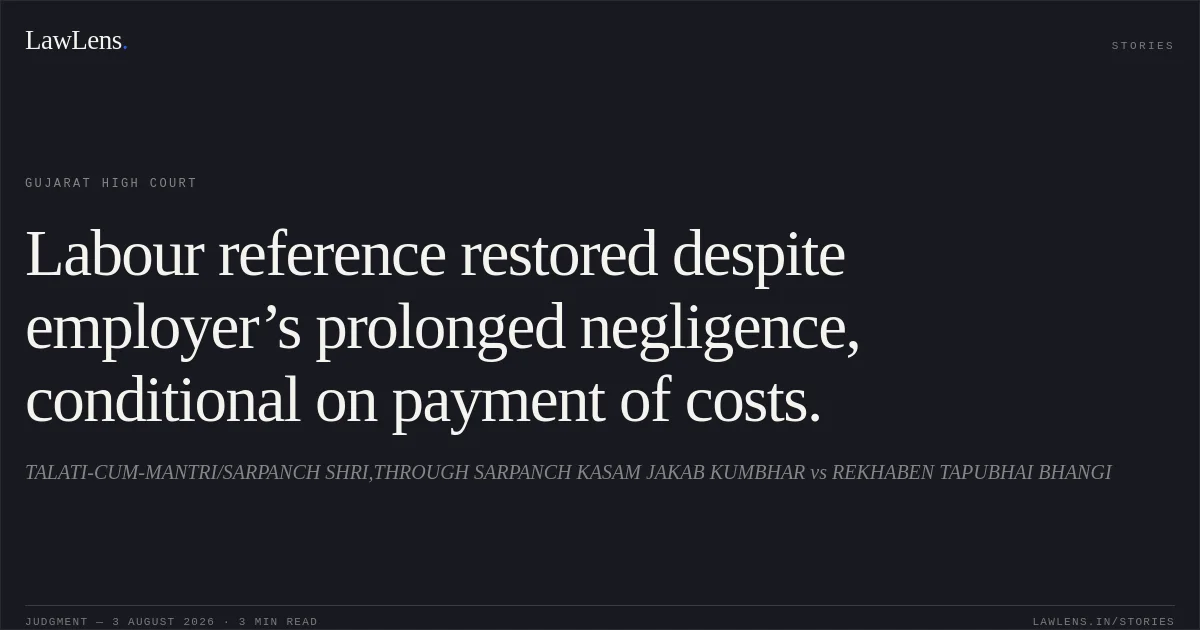
Source reference: no citationNevertheless, considering the petitioner’s specific contention that the workman was an outsourced temporary employee and was never appointed by the Gram Panchayat, the Court adopted a liberal approach and granted one opportunity to defend the reference, conditional upon payment of ₹75,000 as costs to the workman.
Source reference: p.6Holding
The petition was allowed and the Rule was made absolute.
The Labour Court’s award dated 23 February 2024 and the order dated 2 August 2025 rejecting restoration were quashed and set aside.
Source reference: p.6Reference (T) No. 5 of 2016 was directed to be restored to its original file upon the petitioner paying ₹75,000 to the respondent-workman within six weeks from receipt of the order.
Source reference: pp.6–7The petitioner was permitted, if so advised, to recover the costs from the former Sarpanch responsible for the non-contestation.
Source reference: p.7In default of payment within the stipulated period, the original award would stand restored, with no extension of time permitted.
Source reference: p.8Upon payment, the Labour Court was directed to decide the reference within two months, with both parties required to cooperate and unnecessary adjournments prohibited.
Source reference: pp.8Original Court PDF
TALATI-CUM-MANTRI/SARPANCH SHRI,THROUGH SARPANCH KASAM JAKAB KUMBHARvsREKHABEN TAPUBHAI BHANGI
Click to open original judgment
Original judgment, available to read, download and summarize on LawLens.in