01Facts
The petitioners, siblings born in Bilaspur, Chhattisgarh, applied for verification of their "Gond" (Schedule Tribe) caste certificates.
¶ 2Their father had been employed in Chhattisgarh under the ST quota since 1989.
¶ 2The District Level Caste Scrutiny Committee (Respondent No. 2) refused verification on 13.04.2021, stating that since the petitioners' forefathers were permanent residents of Bhopal, Madhya Pradesh, verification could not be conducted based on records from another state.
¶ 5This was upheld by the Additional Commissioner via an order dated 31.01.2022.
¶ 5The petitioners challenged these orders, contending that the authorities were erroneously insisting on land records prior to 1950 and ignoring their permanent residency in Chhattisgarh.
¶ 2, 10.302Issues
i.1. Whether the District Level Caste Scrutiny Committee can mandate the production of land records prior to the year 1950 as a prerequisite for caste certificate verification
¶ 10.3ii.2. Whether the petitioners are entitled to verification of their social status in Chhattisgarh despite their ancestral origins being in Madhya Pradesh
¶ 2, 903Law Applied
Chhattisgarh Scheduled Castes, Scheduled Tribes Other Backward Classes (Regulation of Social Status Certification) Rules, 2013, which provide the mechanism for issuing and verifying social status certificates.
¶ 6Kiran Mesharm v. State of Chhattisgarh (WPC No. 2102 of 2020), which established that if an applicant lacks documents prior to 1950, they may submit an "Inability Certificate" and other possessory records to establish caste status.
¶ 7The principle that records prior to 1950 are not essential/mandatory for caste verification.
¶ 904Reasoning
The Court observed that the respondent authorities failed to utilize the mechanism provided under the Rules of 2013.
¶ 6, 9It noted that the authorities summarily rejected the petitioners' claims solely because their forefathers originated from Madhya Pradesh, ignoring the petitioners' lifelong residency and the father's long-standing employment in Chhattisgarh.
¶ 2, 5The Court reasoned that the absence of pre-1950 land records should not be fatal to a claim of social status if the applicant can provide an "Inability Certificate" along with other corroborative evidence.
¶ 7, 9By aligning the present case with the Kiran Mesharm precedent, the Court emphasized that the Scrutiny Committee has a duty to conduct a substantive inquiry into the current status and possession of records rather than dismissing applications on technical/historical grounds.
¶ 905Holding
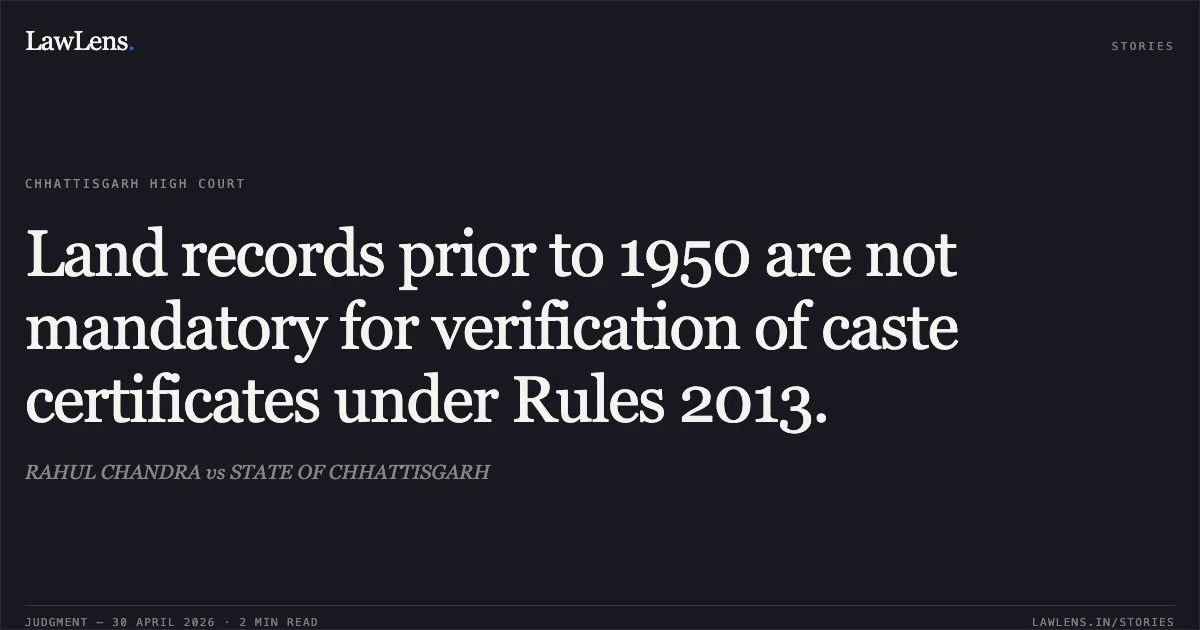
The Court answered the issues in favor of the petitioners, ruling that pre-1950 records are not mandatory for verification.
¶ 9It quashed the impugned orders dated 31.01.2022 and 13.04.2021.
¶ 11The Court directed the petitioners to file a fresh application before the District Level Caste Scrutiny Committee with an "Inability Certificate" (regarding pre-1950 documents) and available supporting records; The Committee was directed to verify the claim and pass a reasoned order within 60 days of the application.
¶ 9Original Court PDF
RAHUL CHANDRAvsSTATE OF CHHATTISGARH
Click to open original judgment
Original judgment, available to read, download and summarize on LawLens.in