01Facts
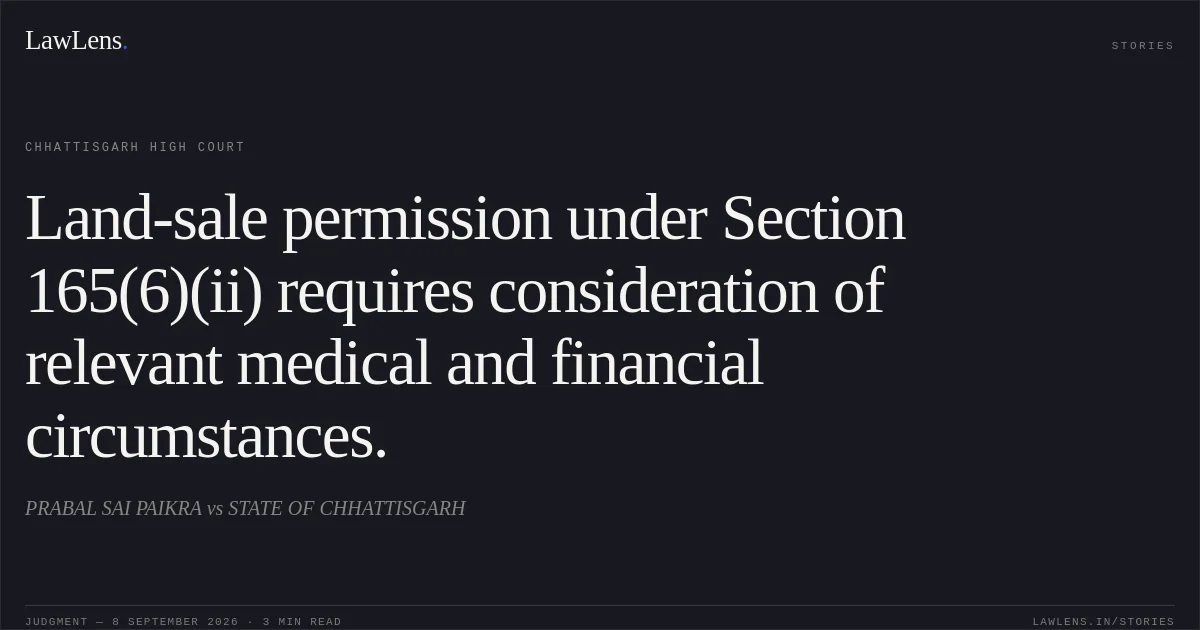
The petitioner, aged about 68 years, sought permission under Section 165(6)(ii) of the Chhattisgarh Land Revenue Code, 1959 to sell land bearing Khasra No. 294/8 situated at Village Pamgarh, District Janjgir-Champa.
¶ 1The Collector rejected the application by order dated 30 July 2026 on the ground that, after the proposed sale, the petitioner would not retain any other land at Pamgarh.
¶ 1Before the High Court, the petitioner contended that he was suffering from paralysis and required funds for medical treatment and other financial needs. He also claimed to possess ancestral property at Village Gaarighat, District Jashpur.
¶ 2The State opposed the petition on the ground that the petitioner had not produced documents proving either the alleged ancestral property or his medical condition and treatment requirements.
¶ 302Issues
i.Whether the Collector’s order rejecting the petitioner’s application under Section 165(6)(ii) of the Chhattisgarh Land Revenue Code, 1959 was sustainable when the petitioner’s medical condition, financial requirements, and alleged ancestral property had not been properly considered?
¶ 1–4ii.Whether the matter should be remanded to the competent authority for fresh consideration upon permitting the petitioner to produce supporting documents?
¶ 5–903Law Applied
The Court applied Section 165(6)(ii) of the Chhattisgarh Land Revenue Code, 1959, which governs the requirement of permission for the proposed sale of the subject land.
¶ 1The Court held that, while deciding such an application, the competent authority must consider all relevant facts and materials, including circumstances concerning the applicant’s medical condition, financial necessity, and availability of other property.
¶ 4The Court further applied the procedural principles of fair consideration, reasonable opportunity of hearing, and the requirement that the administrative decision be supported by a reasoned and speaking order.
¶ 6–8Provisions in the judgment · 1
Chhattisgarh Land Revenue Code, 1959 Section 165
04Reasoning
The High Court found that the petitioner’s alleged medical condition, need for treatment expenses, and ownership of ancestral property at Village Gaarighat were potentially relevant to the determination of his application under Section 165(6)(ii).
¶ 4Although the petitioner had not produced adequate supporting documents before the Collector, the Court considered that these matters had not been examined in their proper perspective. Consequently, the Court did not decide whether permission to sell should ultimately be granted; instead, it held that the application required fresh consideration on the basis of all relevant documents and submissions.
¶ 4–5The remand was therefore directed to enable a lawful, independent, and reasoned determination after providing the petitioner an opportunity of hearing.
¶ 6–805Holding
The writ petition was allowed to the limited extent that the Collector’s order dated 30 July 2026 was set aside, and the matter was remanded to the Collector, Janjgir-Champa, for fresh adjudication.
¶ 5, 10The petitioner was permitted to file a fresh or revised application within 15 days of receiving the certified copy of the order and to produce documents relating to his alleged ancestral property, medical condition, treatment, and financial requirements.
¶ 6The Collector was directed to decide the matter independently, after granting a reasonable opportunity of hearing, and to pass a fresh reasoned and speaking order preferably within 30 days of receiving the fresh application.
¶ 7The Court clarified that the remand did not amount to a direction to grant permission for sale, and that the merits of the petitioner’s claim remained open.
¶ 8–9No order as to costs was made.
¶ 11Original Court PDF
PRABAL SAI PAIKRAvsSTATE OF CHHATTISGARH
Click to open original judgment
Original judgment, available to read, download and summarize on LawLens.in