Facts
The respondent was granted permission under Section 118 of the H.P. Tenancy & Land Reforms Act, 1972, to purchase 06-11 bighas of land in District Solan to set up an industrial unit within two years
Source reference: p. 1-2The respondent obtained a one-year extension in 2009 but failed to fully establish the industry within that period, leading to a rejection of further extensions and the initiation of vestment proceedings in 2011
Source reference: p. 2The respondent contended that they had commenced development, leveled land, dug a bore-well, and constructed an industrial shed
Source reference: p. 2The Collector ordered the vestment of land in the State in 2016, but this was set aside by the Divisional Commissioner in 2019
Source reference: p. 2The Financial Commissioner (Appeals) subsequently remanded the matter for a fresh decision in 2021
Source reference: p. 2The State challenged these orders before the High Court.
Source reference: p. 2Issues
1. Whether the failure to make an industrial unit fully operational within the statutory period results in automatic vestment of land in the State under the second proviso to Section 118(2) of the Act.
Source reference: p. 11-122. Whether the expression "shall put the land to such use" implies the completion of the project or merely the commencement of meaningful steps toward its utilization.
Source reference: p. 7-8Law Applied
Section 118 of the H.P. Tenancy and Land Reforms Act, 1972, which restricts land transfers to non-agriculturists and mandates that land must be put to its permitted use within a specific timeframe or vest in the State
Source reference: p. 3-5Precedent Ravinder Chauhan v. State of H.P. (AIR 1999 HP 43), which established that vestment is not automatic and requires evidence of conscious default or negligence
Source reference: p. 7, 11State Government instructions dated 15.02.2016, which state that periods of delay caused by statutory hindrances or government action should be excluded from the statutory timeline
Source reference: p. 9-11Reasoning
The Court reasoned that the phrase "shall put the land to such use" in Section 118(2) must be interpreted meaningfully rather than myopically
Source reference: p. 14It held that the legislature did not intend for a project to be "A to Z" complete or fully operational within two years, given the complexities of obtaining various NOCs, electricity connections, and clearances
Source reference: p. 8, 14The court noted that the respondent had secured numerous approvals, including pollution control consents, fire NOCs, and GST enrollment between 2014 and 2022
Source reference: p. 6Applying the Ravinder Chauhan principle, the court found that since the respondent had taken "cogent and meaningful steps" and had not diverted the land for an unauthorized purpose, there was no "conscious default" justifying confiscation
Source reference: p. 14-15The court further observed that the revenue records already classified the land as "Gher mumkin Factory," contradicting the State's claim of non-utilization
Source reference: p. 12Holding
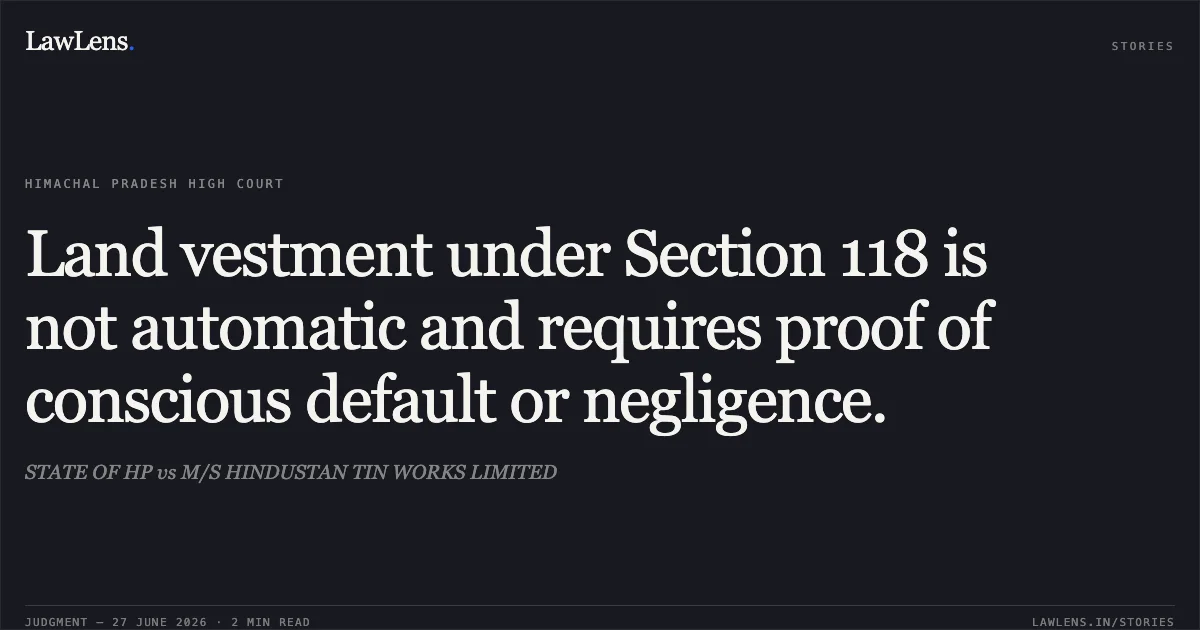
The Court answered that vestment is not automatic and "putting land to use" signifies demonstrating intent through significant preparatory steps rather than total project completion
The High Court upheld the orders of the Divisional Commissioner and Financial Commissioner, dismissing the State's petition
Source reference: p. 15It held that the Collector’s initial vestment order was mechanical and failed to consider statutory hindrances as per the 2016 government instructions
Source reference: p. 12-15The petition was dismissed without costs
Source reference: p. 15Acts & Sections Cited
2 provisions across 2 statutes referred to in this judgment. Linked provisions open on LawLens.
H.P. Tenancy and Land Reforms Act, 19721
Companies Act, 19561
Original Court PDF
STATE OF HPvsM/S HINDUSTAN TIN WORKS LIMITED
Click to open original judgment
Original judgment, available to read, download and summarize on LawLens.in


