01Facts
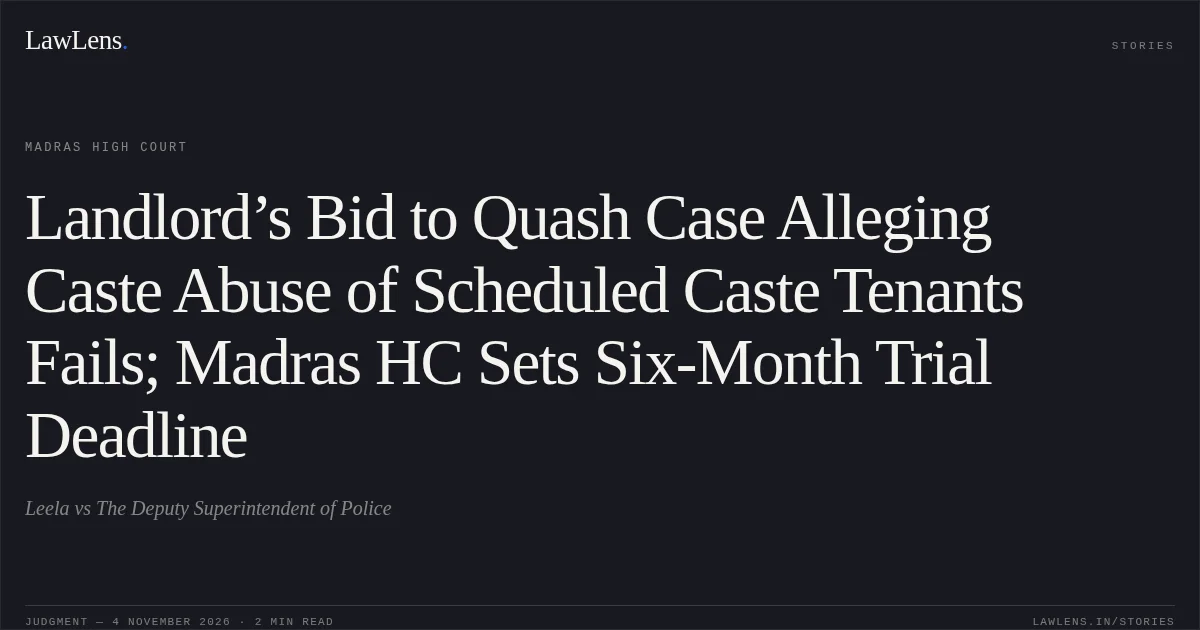
The third respondent, a retired nurse, and her minor daughter lived as tenants in the petitioner’s premises. The prosecution alleged that the petitioner harassed them, including by caste-based abuse, trespass, locking the house, disconnecting electricity, removing household articles and preventing their entry.
p. 2Following the third respondent’s complaint, the police registered a case and, after investigation, filed a charge sheet. The case was taken on file as S.C. No. 4 of 2025. The petitioner sought to quash the proceedings under Section 528 of the BNSS, contending that the dispute was a landlord–tenant dispute arising from unpaid rent and that the complaint was false
pp. 2–302Issues
i.1. Whether the charge-sheet proceedings in S.C. No. 4 of 2025 should be quashed under Section 528 of the BNSS on the petitioner’s claim that the complaint was a false offshoot of a landlord–tenant dispute.
pp. 3–4, 6ii.2. Whether the allegations and materials could be assessed at the quashing stage, or whether their truth and the petitioner’s defence should be determined at trial.
pp. 4–603Law Applied
The Court considered its quashing jurisdiction under Section 528 of the BNSS and applied the principle that, at this stage, the Court examines whether the allegations, accepted in their entirety, disclose the ingredients of the alleged offences; it does not assess the sufficiency or validity of the evidence or decide disputed questions of fact.
pp. 4–5Relying on Devendra Prasad Singh v. State of Bihar & Anr., 2019 (4) SCC 351, and Central Bureau of Investigation v. Arvind Khanna, 2019 (10) SCC 686, the Court held that witness statements and disputed factual defences are not to be evaluated in quashing proceedings. It also relied on M. Jayanthi v. K.P. Meenakshi & Anr., Crl. A. No. 1817 of 2019, decided 2 December 2019, for the rule that the Court should determine whether the allegations disclose the offences alleged, leaving questions of proof to trial.
pp. 4–5The offences identified in the charge sheet included Sections 341 and 448 of the IPC, Sections 3(1)(z) and 3(2)(va) of the SC/ST (Prevention of Atrocities) Act, 1989, and Section 4 of the Tamil Nadu Prohibition of Harassment of Women Act, 1998.
pp. 3–4Provisions in the judgment · 7 · Linked ones open on LawLens
Bharatiya Nagarik Suraksha Sanhita, 2023 Section 528
Indian Penal Code, 1860 Section 294Section 323Section 506Section 341Section 448
Scheduled Castes and the Scheduled Tribes (Prevention of Atrocities) Act, 1989 Section 3
04Reasoning
The Court found that the final report and witness statements contained specific allegations against the petitioner, which, on their face, were sufficient to attract the identified offences.
pp. 4–6The petitioner’s contention that the complaint was motivated by a rent dispute raised factual matters requiring evidence; deciding whether the allegations were true or malicious would involve an impermissible assessment of disputed facts at the quashing stage. Those matters were therefore left for the trial court.
pp. 4–605Holding
The Court declined to quash S.C. No. 4 of 2025 and dismissed the Criminal Original Petition, leaving the petitioner at liberty to raise all available grounds before the trial court.
p. 6It directed the trial court to complete the trial within six months from receipt of a copy of the order; the connected miscellaneous petitions were closed.
p. 6Original Court PDF
LeelavsThe Deputy Superintendent of Police
Click to open original judgment
Original judgment, available to read, download and summarize on LawLens.in