Facts
The petitioners challenged the acquisition of their lands for two railway projects in Gujarat: (i) the 4th railway line between Barejadi-Nandej (Geratpur) and Sanand, measuring approximately 38.20 km; and (ii) five railway intersections between Geratpur–Sanand and Botad–Ahmedabad, measuring approximately 16.51 km. The projects were notified as “Special Railway Projects” under Section 2(37A) of the Railways Act, 1989, by notifications dated 02.02.2023. Notifications under Section 20A(1) declaring the intention to acquire the lands were thereafter published in October 2023.
Source reference: paras. 2–6; pp. 8–10The petitioners filed objections under Section 20D, seeking, among other things, the project proposal, feasibility and survey reports, relevant files and notings, minutes of meetings, details regarding the requirement of land, and information concerning alternative alignments. The Railways supplied certain responses but stated that some documents were not warranted or were unrelated to the statutory proceedings.
Source reference: paras. 9–14; pp. 10–19Hearings were held on 29.12.2023, 02.01.2024 and 30.01.2024, though the petitioners contended that no effective hearing had taken place and that the requested documents had not been supplied. The Competent Authority rejected the objections by order dated 27.09.2024. Subsequently, declarations under Section 20E were issued, resulting in the vesting of the lands in the Central Government.
Source reference: paras. 19–29, 50–65; pp. 20–28, 40–46Issues
Whether the notifications dated 02.02.2023 declaring the two railway projects as “Special Railway Projects” under Section 2(37A) of the Railways Act, 1989 were issued by a competent authority and satisfied the statutory requirements of national infrastructure, public purpose and execution within a specified time frame?
Source reference: paras. 96–136, 146–209; pp. 55–67, 70–110Whether the notifications under Section 20A(1) were invalid because they did not contain a sufficiently detailed description of the lands or an accompanying map?
Source reference: paras. 137–145; pp. 67–70Whether the Competent Authority violated Section 20D and the principles of natural justice by failing to provide relevant documents, afford an effective hearing, independently consider the objections, and examine the proposed alternative alignment?
Source reference: paras. 210–245; pp. 111–125Whether the subsequent declarations under Section 20E and the consequential acquisition and vesting of the petitioners’ lands were liable to be quashed?
Source reference: paras. 154–157, 247–249; pp. 76–77, 125–126Law Applied
The Court applied Section 2(37A) of the Railways Act, 1989, defining a “Special Railway Project” as a project notified by the Central Government for providing national infrastructure for a public purpose within a specified time frame and covering one or more States or Union Territories.
Source reference: para. 147; pp. 70–74Sections 20A–20F prescribe the special acquisition procedure, including publication of the intention to acquire land, hearing of objections, declaration of acquisition, vesting and compensation.
Source reference: paras. 147–157; pp. 70–77Relying on Railway Corridor Virodh Kishan Sangh v. Union of India, the Court recognised that objections must be considered by the Competent Authority through an independent and reasoned exercise.
Source reference: paras. 35–45, 94–95, 194–197, 234–238; pp. 33–38, 54–55, 103–107, 121–123It also considered Nareshbhai Bhagubhai v. Union of India on the scope of Section 20D, Kolkata Municipal Corporation v. Bimal Kumar Shah on procedural safeguards forming part of the constitutional right to property under Article 300A, and Patel Pasabhai Amabhai v. Union of India on the authority of the Ministry of Railways and Railway Board to issue and authenticate acquisition notifications.
Source reference: paras. 35–45, 94–95, 194–197, 234–238; pp. 33–38, 54–55, 103–107, 121–123Reasoning
The Court held that the Section 20A notification sufficiently complied with the statute because it gave a brief description of the project and lands and expressly stated that the land plans and further details were available for inspection at the office of the Competent Authority. The Act did not require the entire map or detailed land records to be reproduced in the notification itself.
Source reference: paras. 140–145; pp. 68–70On the validity of the Section 2(37A) notifications, the Court found that the Ministry of Railways had adopted an in-principle policy treating important railway infrastructure projects involving land acquisition as Special Railway Projects. The Railway Board had authorised the General Managers of Zonal Railways to approve individual projects falling within that policy and to facilitate issuance of the Gazette notifications. This was treated as authorisation to implement an existing policy decision, rather than an impermissible sub-delegation of the essential statutory function.
Source reference: paras. 157–198; pp. 77–107The Court further held that the requirement of the Central Government’s “satisfaction” under Section 20A could not be imported into Section 2(37A), whose language merely required notification by the Central Government from time to time.
Source reference: paras. 199–207; pp. 107–110The projects served to reduce congestion, bypass Ahmedabad and Sabarmati stations, improve freight movement and enhance railway infrastructure; therefore, they fell within the statutory concept of Special Railway Projects.
Source reference: paras. 159–164, 207–209; pp. 91–93, 109–110Regarding Section 20D, the Court found from the original records that the petitioners and their representatives had appeared at the hearings, submitted written and oral objections, sought further information and were given responses by the Railways. The Competent Authority had considered the objections and recorded reasons addressing the principal grounds raised.
Source reference: paras. 222–233, 243–245; pp. 114–125The Court held that the right under Section 20D is limited to objections concerning whether the land is required for the public purpose and for execution of the Special Railway Project. It does not confer a general right to require the Railways to alter a technically finalised alignment. Questions of alignment, feasibility, curvature, cost and engineering requirements fall primarily within the domain of technical experts, absent mala fides or manifest illegality.
Source reference: paras. 234–242; pp. 121–124The proposed alternative alignment, raised after the statutory objection period and seeking alteration of only a portion of a much larger project, therefore did not invalidate the acquisition.
Source reference: paras. 219–242; pp. 113–124Holding
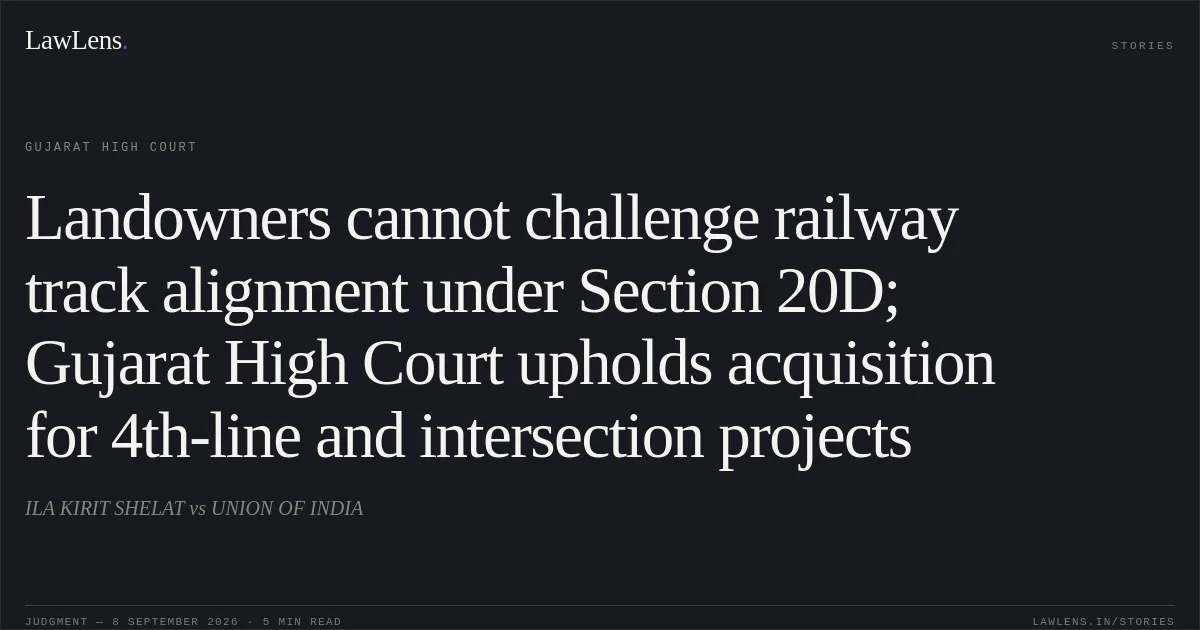
The Gujarat High Court dismissed all connected writ petitions challenging the notifications under Sections 2(37A), 20A and 20E of the Railways Act, 1989. It held that the projects were validly notified as Special Railway Projects, the Section 20A notifications contained the legally required description of the lands, and the proceedings under Section 20D complied with the statutory and natural-justice requirements.
The connected civil applications were also disposed of, with no order as to costs. However, after pronouncement of judgment, the Court granted interim protection against dispossession for four weeks from the date of judgment.
Source reference: “Further Order,” p. 126Acts & Sections Cited
1 provisions across 1 statute referred to in this judgment. Each provision opens on LawLens.
Railways Act, 19891
Original Court PDF
ILA KIRIT SHELATvsUNION OF INDIA
Click to open original judgment
Original judgment, available to read, download and summarize on LawLens.in