Facts
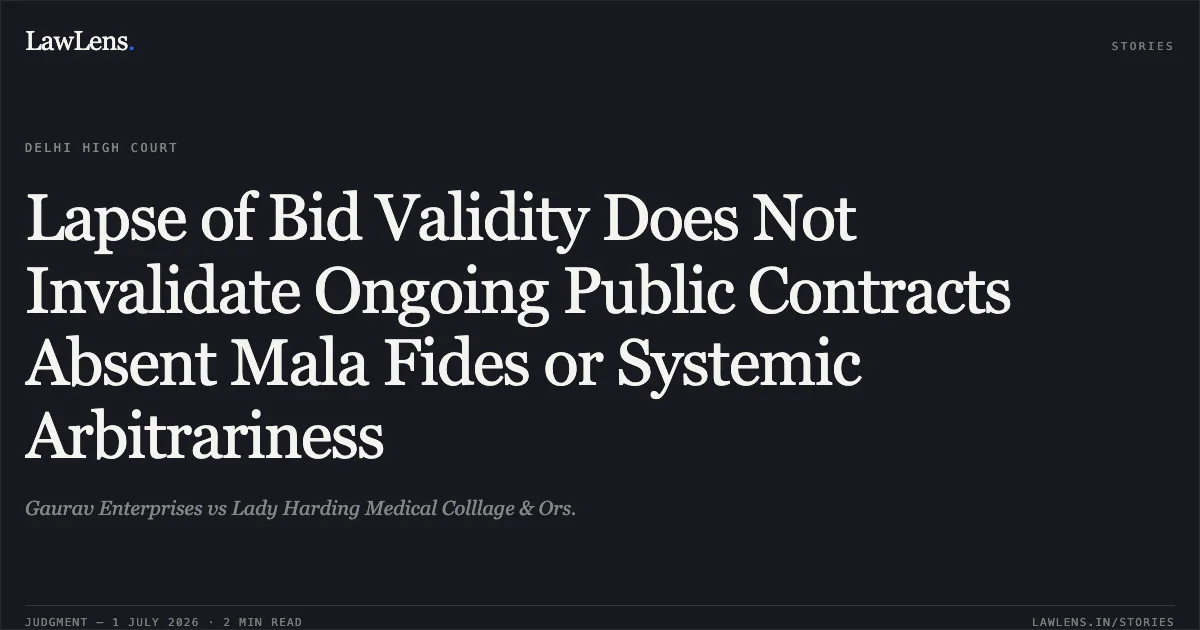
The Petitioner challenged a GeM Bid (dated 16.07.2024) and a subsequent contract (dated 03.11.2025) awarded to Respondent No. 3 for outsourcing security manpower services at Lady Hardinge Medical College
Source reference: p. 1-2190 bidders participated; 16 were found technically qualified and all quoted an identical L-1 price
Source reference: p. 2Respondent No. 3 was selected via the GeM "Auto Run L-1" functionality on 02.01.2025
Source reference: p. 2Because the tender value exceeded ₹20 Crores, ministerial approval was required, which was granted on 24.10.2025, leading to the formal contract generation on 03.11.2025
Source reference: p. 3The Petitioner alleged that the contract was invalid as it was issued after the 180-day bid-validity period (which expired on 25.01.2025) and initially failed to meet the statutory supervisor-to-guard ratio
Source reference: p. 2, 4Issues
1. Whether the generation of the GeM contract on 03.11.2025, after the expiry of the original bid-offer validity period, warrants judicial interference under Article 226
Source reference: p. 7 / para. 23(i)2. Whether the initial deficiency in the number of supervisors under Rule 10 of the Delhi Private Security Agencies (Regulation) Rules, 2023, requires quashing the contract despite subsequent corrective measures
Source reference: p. 8 / para. 23(ii)Law Applied
Clause 4(xiii)(f) of the General Terms and Conditions on GeM 4.0, which allows for the extension of bid validity through mutual consent between buyer and seller
Source reference: p. 8-9Rule 10 of the Delhi Private Security Agencies (Regulation) Rules, 2023, which mandates a ratio of one supervisor for every 15 guards (or one to six in dispersed premises)
Source reference: p. 13The court relied on Tata Motors Ltd. v. BEST and Agmatel India Pvt. Ltd. v. Resoursys Telecom, establishing that courts must exercise restraint in tender matters unless there is evidence of arbitrariness, mala fides, or procedural impropriety that affects the public interest
Source reference: p. 16-17Reasoning
The court reasoned that although the formal contract was generated after the 180-day validity period, Respondent No. 3 was selected via an automated system within the original validity period on 02.01.2025
Source reference: p. 10The subsequent delay was attributed to necessary administrative approvals from the Ministry of Health, not favoritism or mala fides
Source reference: p. 11Under GeM clauses, validity can be extended by mutual consent, and since Respondent No. 3 accepted the late award, the contract was validly formed
Source reference: p. 10-11Regarding the supervisor ratio, the court noted that while the original bid was deficient under Rule 10, the Respondents issued a corrective work order on 11.05.2026 to redistribute manpower (35 supervisors for 524 guards), bringing it into statutory compliance
Source reference: p. 14The court emphasized that the security contract for a medical college is a vital public service, and quashing it midway for technical or corrected defects would be contrary to the public interest
Source reference: p. 11-12, 17Holding
the expiry of the bid validity did not invalidate the award as the selection happened within time and the delay was administrative
the initial deficiency in supervisors was cured by a subsequent work order during the pendency of the litigation
Source reference: p. 14-15The court dismissed the Writ Petition and declined to interdict the ongoing contract, noting the lack of evidence regarding lower market rates or mala fides. All pending applications were closed
Source reference: p. 12, 17, 18Acts & Sections Cited
3 provisions across 3 statutes referred to in this judgment. Linked provisions open on LawLens.
Employees1
Payment Of Bonus Act, 19651
Employees’ Provident Funds And Miscellaneous Provisions Act, 19521
Original Court PDF
Gaurav EnterprisesvsLady Harding Medical Colllage & Ors.
Click to open original judgment
Original judgment, available to read, download and summarize on LawLens.in