Facts
On May 26, 2016, at approximately 11:00 p.m., the Appellant and co-accused Subhash Kengar allegedly took the deceased, Suraj @ Bablu, from his residence on a motorcycle after calling him for a "program"
Source reference: para. 2a/16At 4:00 a.m. the following morning, the deceased was found in a pool of blood near Renuka Mata Temple with fatal head and chest injuries
Source reference: para. 2b/2dThe prosecution’s case rested on circumstantial evidence, primarily the "last seen together" theory deposed by the deceased's mother (PW1) and brother (PW2), and a watchman (PW3)
Source reference: para. 14-18The Additional Sessions Judge, Pune, convicted the Appellant under Section 302 r/w 34 of the IPC on December 18, 2019, sentencing him to life imprisonment
Source reference: para. 1/5The co-accused died during the pendency of the appeal, resulting in the abatement of his challenge
Source reference: para. 7The Appellant challenged the conviction on the grounds that the chain of circumstances was incomplete
Source reference: para. 9Issues
1. Whether the prosecution established a complete chain of circumstantial evidence, specifically the "last seen together" theory, to exclude every hypothesis of innocence
Source reference: para. 12-132. Whether the "last seen together" circumstance can form the sole basis of conviction in the absence of a narrow time gap and corroborative evidence such as motive or forensic links
Source reference: para. 19-23Law Applied
The court applied Section 302 read with Section 34 of the Indian Penal Code regarding murder and common intention
Source reference: para. 1It relied on the established principles of circumstantial evidence, which require that the facts established must be consistent only with the hypothesis of guilt and exclude all others
Source reference: para. 12The court applied the "last seen together" doctrine, referencing Kanhaiyalal vs. State of Rajasthan, which holds that "last seen" does not necessarily lead to an inference of guilt without established connectivity to the crime
Source reference: para. 22Furthermore, it cited Nazim & Ors. vs. The State of Uttarakhand and State of U.P. v. Satish to emphasize that a wide time gap between the "last seen" event and the discovery of the body allows for the possibility of third-party intervention, weakening the link
Source reference: para. 23Reasoning
The court found the prosecution's chain of circumstances to be broken and inconclusive.
Source reference: para. 21Although the "last seen" evidence of PW1 and PW2 established that the Appellant took the deceased at 11:00 p.m., the body was discovered four hours later, which the court deemed a wide enough gap to permit third-party intervention
Source reference: para. 21The testimony of PW3, the watchman, was rejected as he admitted to identifying the accused only at the instance of the police, rendering him a "got-up" witness
Source reference: para. 20Regarding motive, the court noted that the alleged prior quarrel from months ago was never reported to the police and lacked evidentiary support
Source reference: para. 24-25Forensic evidence failed to connect the Appellant to the crime: the Chemical Analyser (CA) report regarding bloodstains on the Appellant’s clothes and the recovered stone was "inconclusive," and no fingerprints were found on the beer bottles at the scene
Source reference: para. 19/21/27While Call Detail Records (CDR) proved the Appellant contacted the deceased, the court held this merely established a meeting but not the commission of murder
Source reference: para. 26Holding
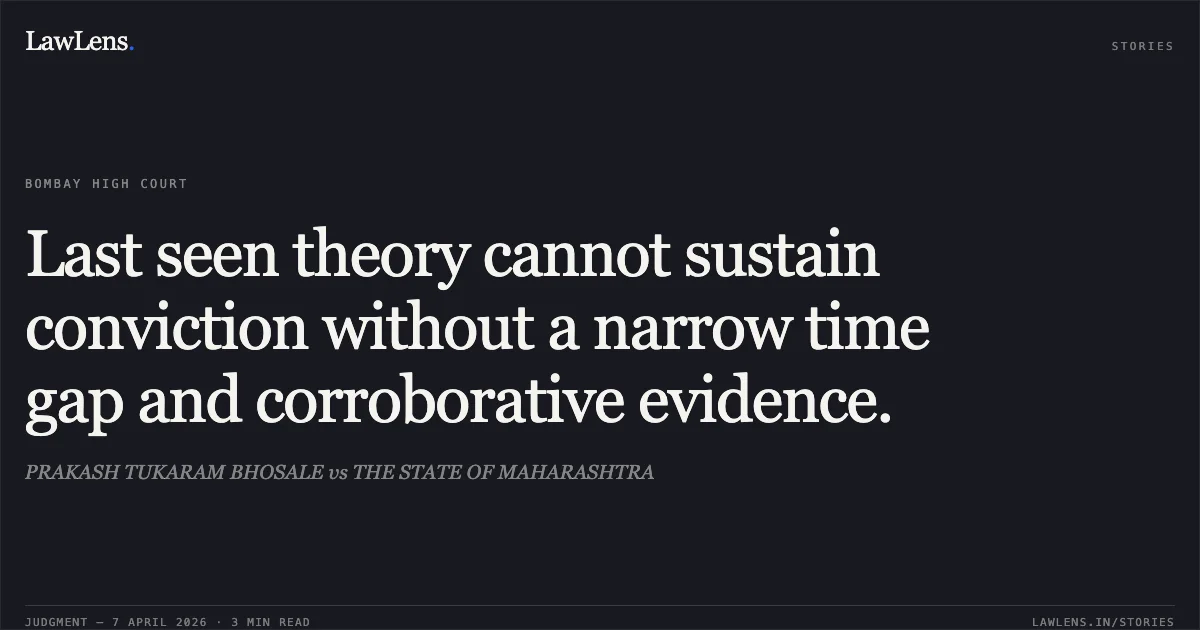
The Court held that the prosecution failed to prove the guilt of the Appellant beyond a reasonable doubt, noting that suspicion, however strong, cannot substitute for legal proof
The "last seen" theory was found insufficient as a singular piece of evidence in the absence of a narrow time gap or forensic corroboration
Source reference: para. 21-22Consequently, the High Court allowed the appeal, quashed the conviction and life sentence dated December 18, 2019, and acquitted the Appellant of all charges
Source reference: para. 31The court ordered the Appellant's immediate release upon the execution of a PR Bond under Section 481 of the Bhartiya Nagrik Suraksha Sanhita, 2023
Source reference: para. 31Acts & Sections Cited
5 provisions across 3 statutes referred to in this judgment. Each provision opens on LawLens.
Indian Penal Code, 18602
Code of Criminal Procedure, 19732
Bharatiya Nagarik Suraksha Sanhita, 20231
Original Court PDF
PRAKASH TUKARAM BHOSALEvsTHE STATE OF MAHARASHTRA
Click to open original judgment
Original judgment, available to read, download and summarize on LawLens.in


