Facts
The Appellant was convicted under Section 302 of the Indian Penal Code (IPC) for the murder of a co-worker and sentenced to life imprisonment.
Source reference: para. 2The prosecution alleged that on March 3, 2022, PW-1 (a social worker) witnessed the Appellant and the deceased quarreling over money.
Source reference: para. 4In the early hours of March 4, 2022, the deceased was found dead with head injuries from a blood-stained stone, while the Appellant was found sleeping nearby with blood-stained clothes.
Source reference: para. 5PW-1’s wife (PW-9) claimed to have seen the Appellant hurriedly leaving the scene.
Source reference: para. 6The prosecution relied on circumstantial evidence, including the "last seen together" theory, the presence of blood group ‘A’ on the Appellant’s clothes matching the victim, and CCTV footage.
Source reference: para. 9, 18The Appellant pleaded not guilty, challenging the sufficiency and consistency of the circumstantial chain.
Source reference: para. 7, 9Issues
Whether the prosecution established an unbroken chain of circumstantial evidence sufficient to prove the Appellant's guilt beyond a reasonable doubt.
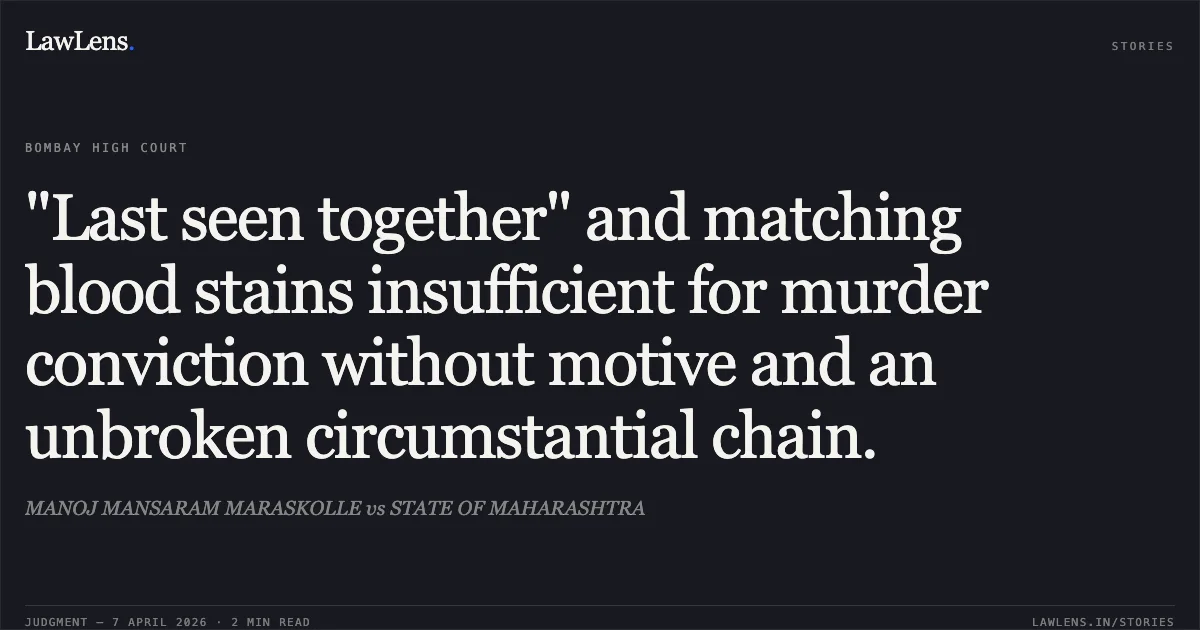
Source reference: para. 18, 24Whether the "last seen together" circumstance and the presence of matching bloodstains on the Appellant’s clothing are sufficient for conviction in the absence of a proved motive or corroborative evidence.
Source reference: para. 19, 23Law Applied
Section 302 of the IPC regarding the punishment for murder.
Source reference: para. 2The principles of circumstantial evidence established in Sharad Birdhichand Sarda v. State of Maharashtra, which requires a complete, unbroken chain of events pointing solely to the accused’s guilt.
Source reference: para. 19The "last seen together" doctrine as interpreted in Padman Bibhar v. State of Odisha (2025) and Rambraksh v. State of Chhattisgarh (2016), holding it to be a weak piece of evidence requiring independent corroboration.
Source reference: para. 19Mustkeem v. State of Rajasthan (2011), which dictates that a blood group match on clothing is insufficient for conviction unless a direct nexus to the crime is proved.
Source reference: para. 23Reasoning
The Court found the prosecution’s case rested largely on presumptions rather than proof.
Source reference: para. 12The alleged motive regarding a quarrel over money was deemed speculative, as PW-1 failed to disclose the basis for this assertion or provide evidence of overheard conversation.
Source reference: para. 12, 14The Court observed that the Appellant's conduct—remaining asleep 3 to 10 feet from the victim after the alleged crime—was inconsistent with ordinary human behavior for a murderer.
Source reference: para. 13, 15The Court noted significant investigative lacunae: the CCTV footage was too unclear to identify the assailant, and the Investigating Officer failed to examine other laborers sleeping in the open vicinity who might have witnessed the event.
Source reference: para. 16, 17, 18The presence of blood group ‘A’ on the Appellant’s clothes was insufficient to connect him to the crime because the prosecution failed to rule out the involvement of third parties or establish an unbroken chain of events.
Source reference: para. 18, 24Holding
The Court held that the prosecution miserably failed to prove motive or establish the necessary chain of events to disprove the Appellant's innocence.
Suspicion, however strong, cannot substitute for legal proof.
Source reference: para. 19The Court allowed the appeal, quashed and set aside the impugned judgment dated November 8, 2024, and acquitted the Appellant of all charges.
Source reference: para. 26The Jail Authorities were directed to release the Appellant forthwith, provided he is not required in any other case.
Source reference: para. 27Acts & Sections Cited
1 provisions across 1 statute referred to in this judgment. Each provision opens on LawLens.
Indian Penal Code, 18601
Original Court PDF
MANOJ MANSARAM MARASKOLLEvsSTATE OF MAHARASHTRA
Click to open original judgment
Original judgment, available to read, download and summarize on LawLens.in


