01Facts
The petitioner sought promotion to the post of Assistant Conservator of Forest (ACF) from 27.12.1975, when his juniors were promoted, and challenged the review DPC proceedings dated 02.09.2013 and the order dated 01.10.2013.
¶ 1His first challenge, O.A. No. 648/1994, was allowed by the Madhya Pradesh Administrative Tribunal on 03.09.1997, directing a DPC for 1975 to consider him per the 1975 DPC criteria.
¶ 2 · ¶ 12His claim was rejected on 13.11.1998.
¶ 2Upon transfer of O.A. No. 97/1999, the matter was registered as W.P. No. 24156/2003 and disposed of on 28.06.2012, directing reconsideration "adopting the same norms" as the 1975 DPC.
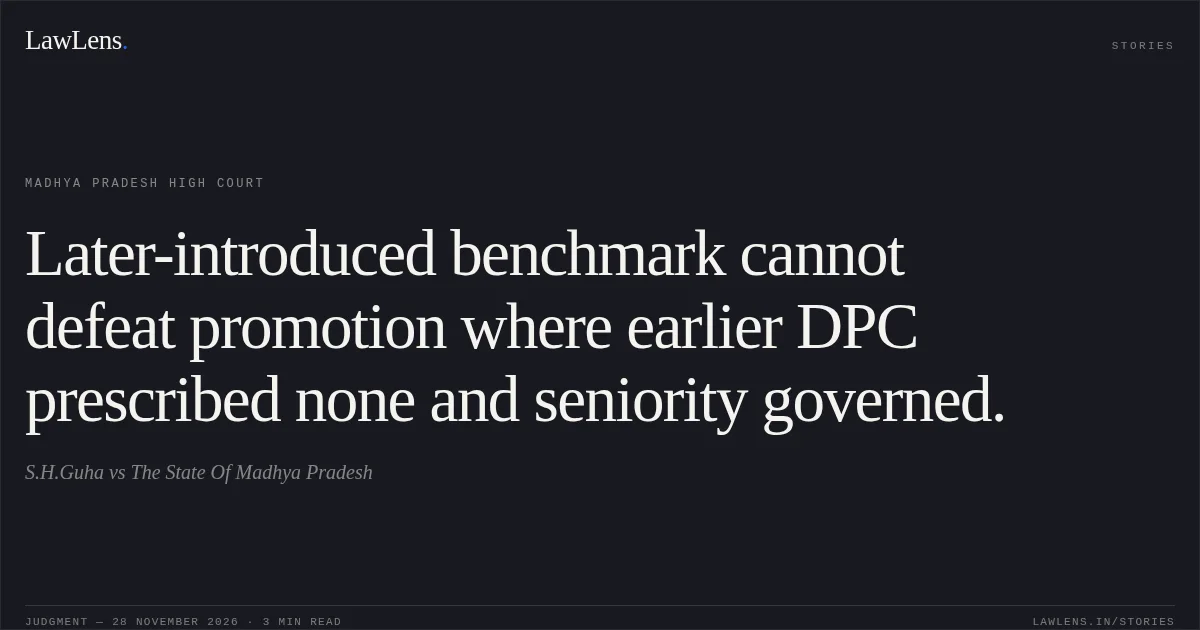
¶ 3 · ¶ 13The DPC proceedings of August 1974 prescribed no specific benchmark, and seniority was the sole criterion.
¶ 4 · ¶ 16The petitioner was not considered earlier due to a pending departmental enquiry, in which he was later exonerated.
¶ 4A grading system (A–D) for ACRs was introduced by GAD Circular dated 05.09.1974.
¶ 5Juniors L.N. Sharma and B. Prasad Chourasiya were promoted in December 1975.
¶ 6In the 2013 review DPC, the petitioner secured 23 marks against a minimum benchmark of 30 and was declared unfit.
¶ 7 · ¶ 14The State supported the impugned orders.
¶ 1002Issues
i.1. Whether the review DPC of 2013 could apply a minimum benchmark of 30 marks, not prescribed in the 1974 DPC, while reconsidering the petitioner's case pursuant to the 2012 direction to apply the 1975 DPC norms.
¶ 7 · ¶ 8 · ¶ 14–15ii.2. Whether the petitioner is entitled to promotion with effect from the date his juniors were promoted, and whether the matter should be remanded for fresh consideration or promotion should be directly ordered in the writ jurisdiction.
¶ 16–19 · ¶ 20–2203Law Applied
The Court's reasoning rests on the directions of the Tribunal and this Court, which required consideration on the basis of the criteria evolved by the 1975 DPC.
¶ 12 · ¶ 13A reconsideration must follow the norms of the original DPC, and subsequently introduced criteria cannot be applied contrary to a court's direction.
¶ 15Principle of non-discrimination: where juniors have been promoted under the same criteria, a senior who is otherwise eligible cannot be denied the same benefit.
¶ 16–17Division Bench decision in W.A. No. 613/2007, as reproduced in the judgment, holds that although courts generally direct consideration rather than promotion, a direct mandamus for promotion is permissible where the employee was not found unsuitable and discrimination is established.
¶ 20The High Court under Article 226 may grant consequential relief where the facts so warrant.
¶ 22The petitioner's reliance on Ashok Kumar Vajpayee v. State of M.P. (decided 03.01.2008) was noted as a submission, not expressly adopted as the basis of decision.
¶ 904Reasoning
The 2012 order required the respondents to apply the 1975 DPC norms, and the 1974 DPC proceedings disclosed no benchmark and used seniority as the sole criterion.
¶ 15–16The 30-mark benchmark used in the 2013 review DPC was therefore extraneous to the governing criteria, and the rejection based on 23 marks could not stand.
¶ 15 · ¶ 18Since the State's return did not show that the petitioner was unsuitable on any other ground, and the DPC recorded no finding of unfitness, the petitioner's exoneration in the disciplinary proceedings removed the earlier impediment.
¶ 4 · ¶ 21–22Given that no benchmark existed and promotion was seniority-based, the Court found remand to be futile and applied the Division Bench approach to grant relief directly.
¶ 19–20 · ¶ 22The petitioner's juniors had already been promoted, so denying him the same benefit would amount to discrimination.
¶ 16–1705Holding
The review DPC dated 02.09.2013 and the order dated 01.10.2013 were unsustainable and are quashed.
¶ 18Because no benchmark was prescribed in the 1974 DPC and promotion was based on seniority, remand was unnecessary, and the petitioner was entitled to promotion from the date his juniors were promoted.
¶ 19 · ¶ 22The writ petition was allowed with the following directions: (i) promotion to ACF with effect from 27.12.1975, with all consequential benefits, including seniority, senior grade, and revision of pay; (ii) consideration of further promotions in light of those granted to juniors; (iii) interest at 6% per annum from the date of entitlement until payment; and (iv) default interest at 12% per annum if the directions are not complied with within two months.
¶ 23Original Court PDF
S.H.GuhavsThe State Of Madhya Pradesh
Click to open original judgment
Original judgment, available to read, download and summarize on LawLens.in