Facts
The Applicants (Lessors) executed a registered lease deed on 14.04.1966 in favor of 'Raja Steel Industries' for 35 years at Rs.150/month
Source reference: para. 3.1The Respondent later acquired leasehold rights via a Deed of Assignment in 1994
Source reference: para. 3.4The lease expired on 13.04.2001
Source reference: para. 3.3A renewal clause allowed for a further 35 years provided the lessee gave three months' notice and the parties "mutually agreed" on fresh rent
Source reference: para. 3.2Although the Respondent expressed a desire to extend the lease in December 2000, no mutual agreement on rent was reached; the Applicants proposed an increased rent of Rs. 1,65,000/month, which was not accepted
Source reference: para. 3.7, 14The Trial Court decreed eviction, but the District Court (Appellate Court) set it aside, holding the lease stood automatically extended
Source reference: para. 1, 5During the pendency of the Revision, the Respondent inducted a third party into the premises via a leave and license agreement despite a court injunction
Source reference: para. 7-8, 30Issues
1. Whether the lease stood automatically extended for a further period of 35 years in the absence of a mutual agreement on rent.
Source reference: para. 16, 222. Whether the Respondent's continued possession after the expiry of the lease constituted "tenant holding over" under Section 116 of the Transfer of Property Act.
Source reference: para. 10, 253. Whether the Respondent committed contempt of court by parting with possession of the suit premises during the pendency of the revision.
Source reference: para. 7, 31Law Applied
Section 111(a) of the Transfer of Property Act, 1882, regarding the determination of lease by efflux of time
Source reference: para. 26Section 107 of the Act, which requires leases of more than one year to be made by registered instruments
Source reference: para. 26The principles of "tenant holding over" under Section 116, requiring the lessor's assent for such status
Source reference: para. 25, 27The standard of revision under Section 115 of the CPC as clarified in Hindustan Petroleum Corporation Limited v. Dilbahar Singh, allowing intervention where findings are based on perverse interpretation of documents
Source reference: para. 28Reasoning
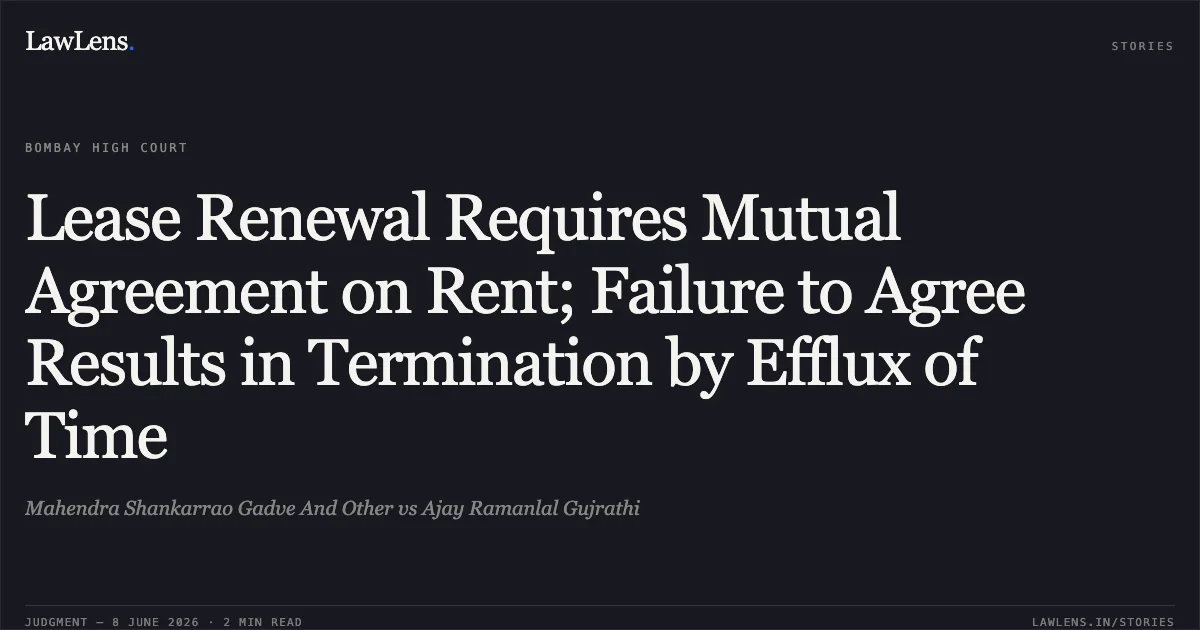
The Court found the Appellate Court's interpretation of the lease deed perverse, as the deed explicitly made "mutual agreement on rent" a condition precedent for extension.
Source reference: para. 19, 22Since no such agreement occurred, the lease expired by efflux of time on 13.04.2001.
Source reference: para. 22The Court rejected the "holding over" argument, noting that the Applicants' letters (proposing high rent or stating the lease had expired) did not constitute "assent" to the Respondent's continued stay; rather, the Respondent became a "tenant at sufferance".
Source reference: para. 25, 27, 29Regarding the contempt, the Court analyzed the 2021 leave and license agreement and concluded that granting "exclusive possession" to a licensee constituted "parting with possession," directly violating the interim injunction order dated 08.02.2016.
Source reference: para. 31Holding
The High Court allowed the Civil Revision Application and set aside the Appellate Court's judgment; it held that the lease determined by efflux of time and no notice under Section 106 of the TP Act was necessary.
The Court restored the Trial Court’s eviction decree, directing the Respondent to handover vacant possession within 8 weeks; it found a prima facie case for contempt and directed the Registry to issue notice under the Contempt of Courts Act, while granting liberty to apply for mesne profits.
Source reference: para. 31, 32, 34, 35Acts & Sections Cited
6 provisions across 3 statutes referred to in this judgment. Each provision opens on LawLens.
Code of Civil Procedure, 19081
Transfer of Property Act, 18824
Contempt of Courts Act, 19711
Original Court PDF
Mahendra Shankarrao Gadve And OthervsAjay Ramanlal Gujrathi
Click to open original judgment
Original judgment, available to read, download and summarize on LawLens.in