01Facts
The plaintiff had brought a suit for declaration, partition, permanent injunction and mesne profits concerning property allegedly belonging to his grandparents.
After the evidence had concluded and the suit was listed for final arguments, the plaintiff applied under Order XXIII Rule 1(3) of the Code of Civil Procedure (CPC) to withdraw the suit with liberty to file a fresh suit.
¶ 4The trial court allowed the application, finding that the plaint had defects, including the omission of persons to whom properties had been transferred and the absence of necessary averments.
¶ 3, 9The petitioner challenged that order, contending that the application was a belated attempt to cure deficiencies, that non-joinder was not a formal defect, and that the plaintiff was seeking a second opportunity to present the case.
¶ 502Issues
i.Whether the trial court properly exercised its discretion under Order XXIII Rule 1(3) CPC by permitting withdrawal of the suit with liberty to institute a fresh suit.
¶ 7, 9ii.Whether the trial court’s order warranted interference under Article 227 of the Constitution of India.
¶ 8–1003Law Applied
Order XXIII Rule 1(3) CPC permits a court, on such terms as it considers appropriate, to allow withdrawal of a suit with liberty to bring a fresh suit where the suit must fail because of a formal defect or where sufficient grounds justify a fresh suit.
¶ 7Article 227 of the Constitution confers supervisory jurisdiction over subordinate courts.
¶ 8The petitioner relied on Vinod Kumar Gupta v. Smt. Ramamdevi Shivhare and Another, 2008(1) M.P.H.T. 83, for the contention that non-joinder is not a formal defect.
¶ 504Reasoning
The High Court accepted that the application had been made at a belated stage and that the plaintiff had remained negligent.
¶ 9–10However, it found that the suit involved declaration and partition, that co-sharers and subsequent transferees were required for effective adjudication, and that relevant averments concerning the transfers were missing from the plaint.
¶ 9In those circumstances, the trial court could allow withdrawal with liberty to file afresh rather than proceed with a suit in which effective relief could not be granted.
The plaintiff’s negligence, by itself, did not justify setting aside the order, particularly because the defendants would have an opportunity to contest any fresh suit on its merits.
¶ 10The High Court considered whether the impugned discretionary order was perverse, illegal or otherwise affected by a serious error.
¶ 1005Holding
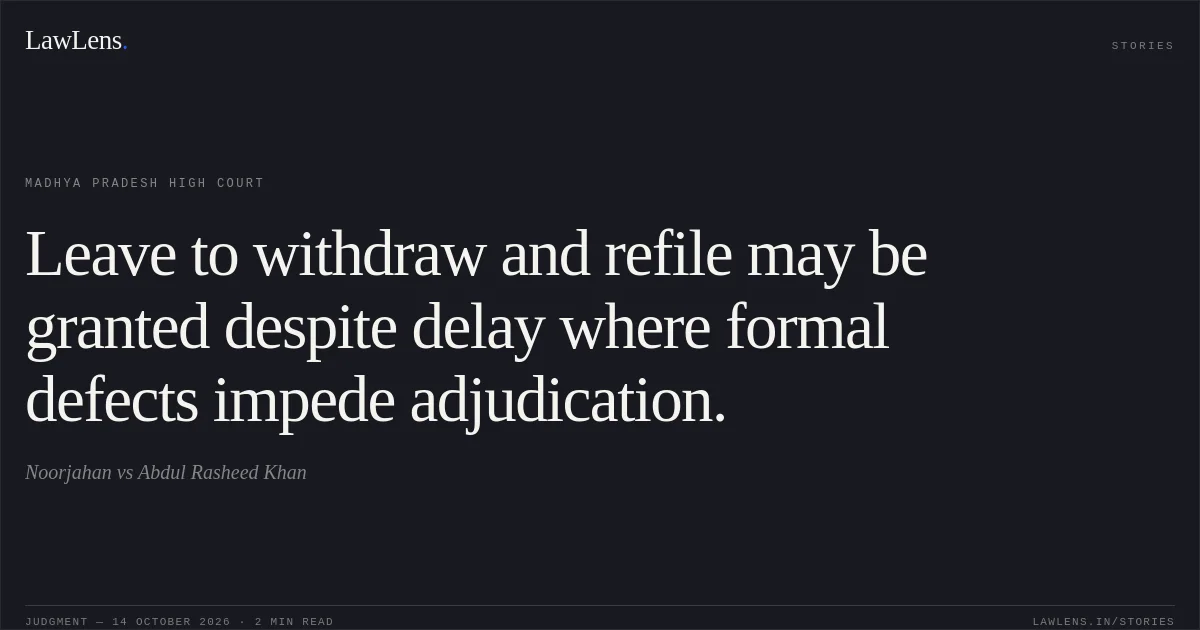
The High Court held that the trial court had not committed a serious error in allowing withdrawal with liberty to institute a fresh suit, and that its order could not be characterised as perverse or illegal.
¶ 9–10Finding no ground for interference under Article 227, the Court dismissed the miscellaneous petition.
¶ 10–11Original Court PDF
NoorjahanvsAbdul Rasheed Khan
Click to open original judgment
Original judgment, available to read, download and summarize on LawLens.in