Facts
The petitioner’s father died in service on January 1, 1998, when the petitioner was approximately eight years old.
Source reference: para. 2Upon attaining majority, the petitioner applied for compassionate appointment. Following a high court direction in a previous petition (WP. No. 13313/2018), the respondents rejected his representation on August 4, 2018, primarily relying on a 2008 policy.
Source reference: para. 2The petitioner challenged this rejection, arguing that the policy in force at the time of death (1994) should apply.
Source reference: para. 2The State contended that even under the 1994 policy, there is no provision for a minor to apply after attaining majority and that the 28-year lapse since the death frustrated the purpose of the scheme.
Source reference: para. 3Issues
1. Whether a petitioner is entitled to compassionate appointment after a lapse of nearly 28 years from the date of the employee's death.
Source reference: para. 52. Whether the norms prevailing on the date of death or the date of consideration of the application should govern the claim.
Source reference: para. 6, citing N.C. SantoshLaw Applied
The court applied the principle that compassionate appointment is an exception to Article 14 and 16, intended only to tide over immediate financial crises following the death of a breadwinner.
Source reference: para. 7, 9It relied on Secretary to Govt. Deptt. of Education (Primary) v. Bheemesh (2021) to establish that the policy in force at the time of death generally governs unless a subsequent policy specifically covers pending applications.
Source reference: para. 6Per The State of West Bengal v. Debabrata Tiwari (2023), the court held that "endless compassion" is impermissible and that inordinate delay in approaching the court (laches) or a long survival of the family without the appointment suggests the absence of financial indigence.
Source reference: para. 8It cited Canara Bank v. Ajithkumar G.K. (2025), which mandates that there can be no reservation of vacancies for minors until they reach majority unless specifically provided for by the scheme.
Source reference: para. 9Reasoning
The court reasoned that the primary objective of compassionate appointment—providing immediate solace to a family in distress—is defeated when a family survives for a substantial period (28 years in this case) without such assistance.
Source reference: para. 7, 10Relying on Supreme Court precedents, the court observed that even if the 1994 policy were applicable, it contained no provision allowing a minor to seek appointment years later upon attaining majority.
Source reference: para. 3The court highlighted that indeterminate factors like the date of attaining majority cannot be used to demand the application of specific rules over fixed factors like the date of death.
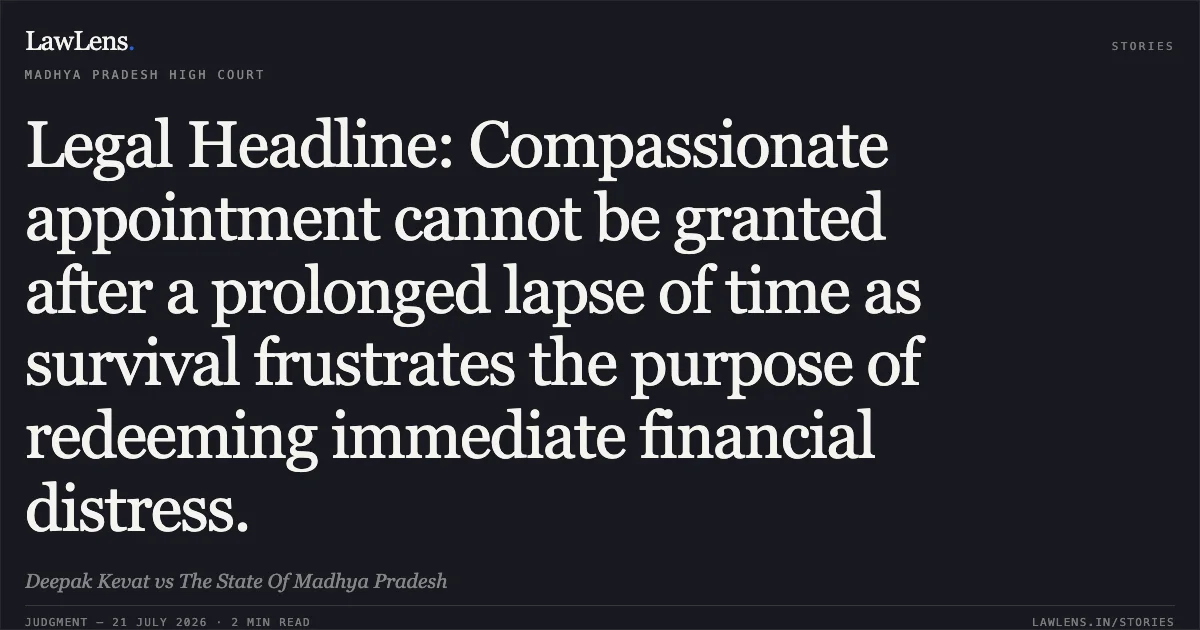
Source reference: para. 19The court concluded that the petitioner's survival for nearly three decades proved that the "immediacy of need" no longer existed, rendering the grant of appointment a violation of the general rule of merit-based recruitment under Article 14.
Source reference: para. 10-11Holding
The court answered the core issue in the negative, holding that the passage of 28 years frustrated the object of the compassionate appointment scheme.
The petition was dismissed, affirming that compassionate appointment is a concession for immediate distress, not a vested right that can be claimed after a prolonged period.
Source reference: para. 10-12Original Court PDF
Deepak KevatvsThe State Of Madhya Pradesh
Click to open original judgment
Original judgment, available to read, download and summarize on LawLens.in