Facts
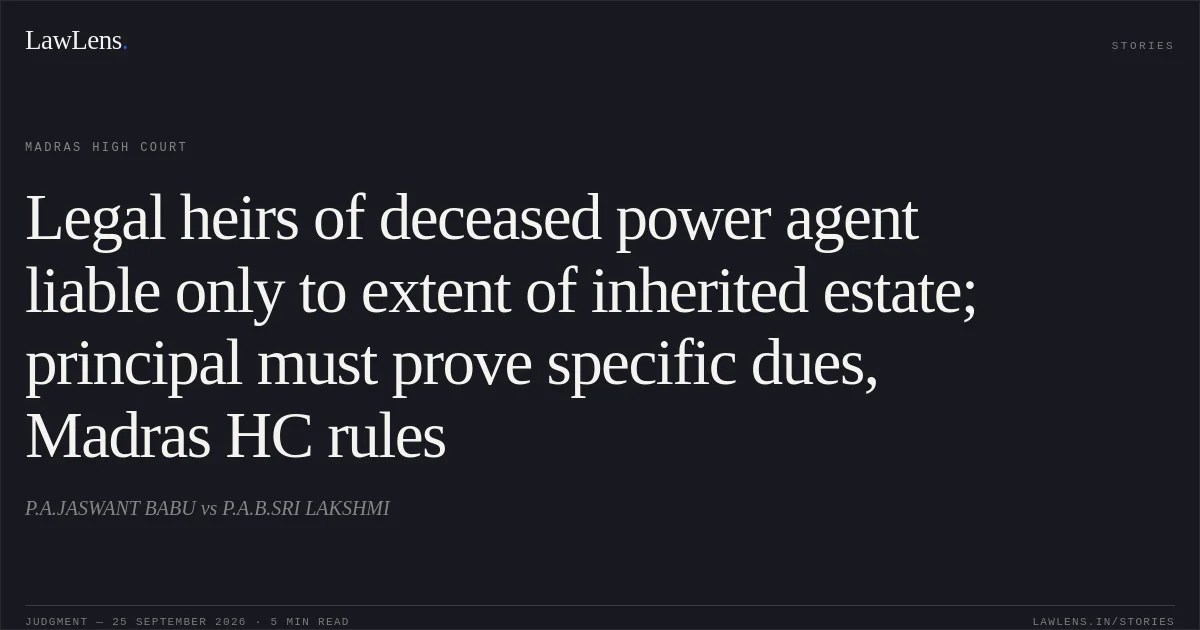
The appellant-plaintiff and the deceased P.A. Bansidhar were brothers. The plaintiff executed a registered power of attorney in favour of Bansidhar on 12 March 1998 to manage and alienate the plaintiff’s properties. Bansidhar subsequently sold several properties belonging to the plaintiff between 2002 and 2006. The plaintiff alleged that the sale proceeds were neither paid to him nor properly accounted for by Bansidhar. Bansidhar died on 13 June 2008, leaving his widow and son—the respondents—as his legal heirs.
Source reference: paras. 2–3The plaintiff claimed that, on the basis of accounts prepared by his auditors, the respondents were liable for Rs.1,47,18,233/-, together with interest, and instituted a suit for recovery of Rs.2,47,04,020/- before the VI Additional District Court, Madurai. The trial court dismissed the suit on 30 November 2017, principally on the grounds of limitation and failure to establish the alleged liability. The plaintiff preferred the present appeal under Section 96 of the Code of Civil Procedure.
Source reference: paras. 2–4The evidence showed that the sale consideration under the relevant sale deeds had been paid through demand drafts in the plaintiff’s name and credited to his bank account. The plaintiff nevertheless alleged that Bansidhar had subsequently withdrawn or misappropriated the amounts.
Source reference: paras. 15, 25–27Issues
Whether the legal heirs of a deceased power-of-attorney holder or agent are liable for amounts allegedly due from the agent to the principal, and if so, whether such liability is limited to the estate inherited from the deceased agent?
Source reference: para. 7(a); para. 18(a)Whether the burden of proving the specific monetary liability rests on the principal or on the legal heirs of the deceased agent?
Source reference: para. 7(b); paras. 9–10, 18(b)Whether the legal heirs of a deceased agent can be compelled to render accounts, or are their obligations limited to producing accounts and records available with them?
Source reference: para. 7(c); paras. 8–10, 18(b)Whether a suit for recovery of a specified sum is maintainable without a prior or concurrent prayer for general rendition and settlement of accounts between the principal and agent?
Source reference: para. 7(d); paras. 11–18Whether the plaintiff’s suit, instituted in February 2011 in respect of transactions occurring between 2002 and 2006, was barred by limitation?
Source reference: para. 7(e); paras. 20–25Law Applied
Section 213 of the Indian Contract Act, 1872 requires an agent to render proper accounts to the principal on demand. Rights and liabilities arising from the agency may survive against the deceased agent’s legal representatives, but the legal heirs are liable only to the extent of the estate inherited from the deceased and do not incur personal liability.
Source reference: paras. 8–10The obligation to explain and render accounts is personal to the agent; the legal heirs’ duty is ordinarily confined to producing books, vouchers and documents available with them. The burden lies on the principal to prove the specific amount payable when the suit is brought against the legal heirs of the deceased agent.
Source reference: paras. 9–10, 18(b)Order XX Rule 16 of the CPC contemplates a preliminary decree for taking accounts where necessary to ascertain the amount due.
Source reference: para. 14Relying on N.N.Rm. Narayan Chettiar v. Arunachalam Pillai, T.K.P. Rajagopala Chettiar v. A.P.S. Palani Chettiar, and Loonkaren Sethia v. Ivan E. John, the Court held that, where accounts have not been settled and liability is disputed, the proper course is ordinarily to seek rendition of general accounts; the court may either direct such accounting or dismiss a money suit framed without that relief.
Source reference: paras. 11–18Article 4 of the Limitation Act, 1963 applies where the claim arises from the agent’s neglect or misconduct, while Article 3 applies to a claim by the principal against the agent for movable property received and not accounted for, with limitation running from termination of agency or refusal.
Source reference: paras. 21–25The Court also applied the principle that acquiescence or condonation, inferred from the principal’s conduct after knowledge of the transactions, may bar a subsequent accounting claim.
Source reference: para. 23Reasoning
The Court held that although liability arising from the deceased agent’s dealings could, in principle, be enforced against his legal heirs, such liability was restricted to the estate inherited by them and did not make them personally responsible.
Source reference: paras. 8–10Since Bansidhar was deceased, the respondents could not be expected to explain transactions in which they had not participated; their role was limited to producing relevant records in their possession. The plaintiff therefore retained the burden of proving that a definite sum remained due and that the respondents had received or inherited the relevant assets.
Source reference: paras. 9–10, 18(b), 24The plaintiff’s unilateral statement of accounts was not a bilateral settlement of accounts. The claim involved several categories—including sale consideration, alleged withdrawals, agricultural expenses and a purported cash balance—which could not be determined without examining the entire course of dealings between the principal and agent. The plaintiff had not sought general rendition of accounts, nor had he established that the accounts had been settled. Consequently, a decree for the quantified amount could not be granted on the basis of the plaintiff’s self-prepared computation.
Source reference: paras. 15–18, 26–27On limitation, the plaintiff admitted that he became aware of the 2002 and 2004 alienations by 2003–2004 and had questioned Bansidhar about them. He nevertheless took no effective legal action during Bansidhar’s lifetime and did not make a concrete demand for rendition of accounts. The Court treated the alleged conduct as misconduct or dereliction by the agent, attracting Article 4, and held that the limitation period commenced when the plaintiff acquired knowledge of the transactions. The 2011 suit was therefore beyond time in respect of the earlier transactions.
Source reference: paras. 20–25Further, the sale consideration had been deposited into the plaintiff’s own bank account, undermining his assertion that the agent had retained the proceeds. The plaintiff also failed to prove that the respondents possessed any of the alleged amounts after Bansidhar’s death.
Source reference: paras. 20–25, 27–28Holding
The appeal was dismissed and the trial court’s dismissal of the suit was affirmed.
The Court held that the legal heirs of a deceased agent may be proceeded against only to the extent of the estate inherited from the agent; they are not personally liable to render or explain the agent’s accounts.
Source reference: para. 18Where the accounts between principal and agent have not been settled and liability is disputed, a suit for a specified sum without a prayer for general rendition of accounts is ordinarily unsustainable.
Source reference: para. 18The plaintiff failed both to establish the claimed liability and to overcome limitation, as the relevant transactions were known to him several years before institution of the suit.
Source reference: paras. 21–25No costs were awarded, and the connected miscellaneous petition was closed.
Source reference: para. 28Acts & Sections Cited
6 provisions across 5 statutes referred to in this judgment. Each provision opens on LawLens.
Code of Civil Procedure, 19081
Indian Trust Act, 18821
Indian Contract Act, 18721
Indian Partnership Act, 19321
Original Court PDF
P.A.JASWANT BABUvsP.A.B.SRI LAKSHMI
Click to open original judgment
Original judgment, available to read, download and summarize on LawLens.in