Facts
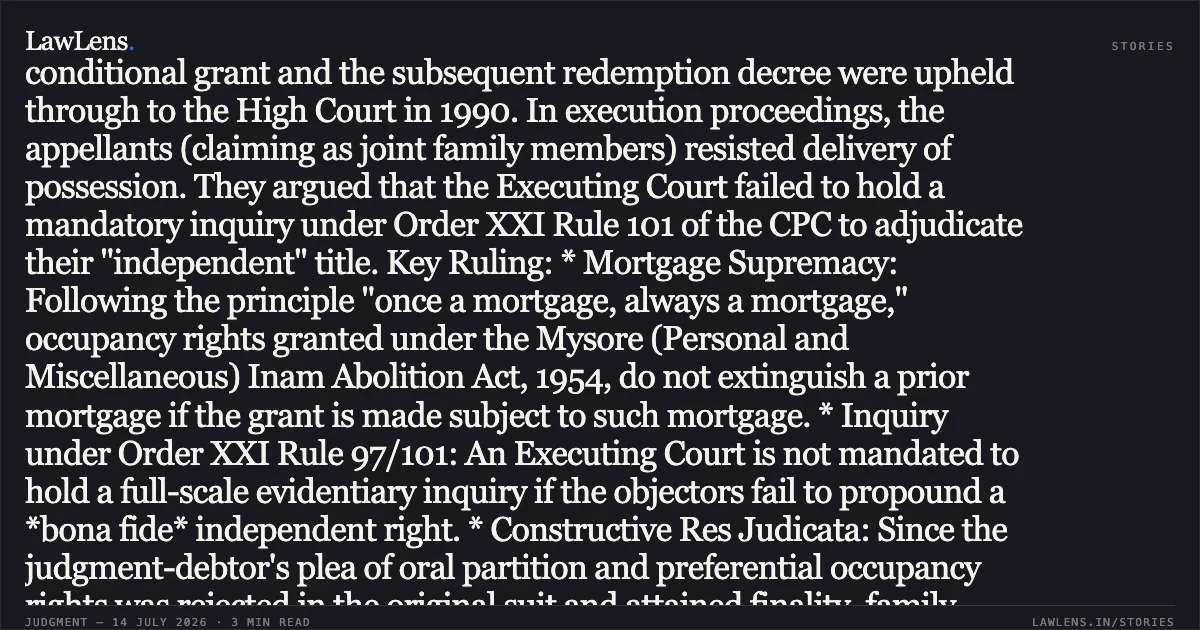
The dispute originated from a 1975 suit (O.S. No. 74/1975) for the redemption of a mortgage executed in 1951 by Gururayachar in favor of Shankarappa.
Source reference: para 3.1During the mortgage, the Mysore Inam Abolition Act, 1954, took effect. The Deputy Commissioner granted occupancy rights to Shankarappa but explicitly made them "subject to the mortgage rights".
Source reference: para 3.3, 28Shankarappa challenged the redemption through multiple tiers of litigation, losing finally in the High Court in 1990 (RSA No. 551/1978).
Source reference: para 5, 37During execution (Ex. Case No. 2/1993), the Appellants (joint family members of Shankarappa) resisted delivery of possession.
Source reference: para 8They claimed an independent title based on an oral partition (1969/70) and a registered partition deed dated 12.12.2003.
Source reference: para 15, 59The Executing Court allowed the Decree Holders' application under Order XXI Rule 97 CPC for removal of obstruction without holding a full evidentiary enquiry, which was affirmed by the First Appellate Court (R.A. No. 13/2021).
Source reference: para 10, 12Issues
1. Whether the Executing Court was mandated to hold a formal evidentiary enquiry under Order XXI Rule 101 CPC when the objectors failed to prima facie establish an "independent" right.
Source reference: para 14, 422. Whether the occupancy rights granted under the Inam Abolition Act extinguished the mortgagor's right to redeem when the grant was specifically made subject to the mortgage.
Source reference: para 32, 583. Whether the Appellants’ claims were barred by the principle of constructive res judicata given the prior finality of the redemption decree against their predecessor-in-interest.
Source reference: para 23, 46Law Applied
The Court applied Order XXI Rules 97 and 101 of the Code of Civil Procedure (CPC), which constitute a complete code for adjudicating all questions of right, title, and interest arising between the decree-holder and an objector.
Source reference: para 18(ii), 61It relied on the doctrine of "Once a mortgage, always a mortgage," affirming that occupancy rights granted to a mortgagee under agrarian reforms do not necessarily extinguish the equity of redemption if the grant is conditional.
Source reference: para 3.4, 59The Court also applied the principle of Constructive Res Judicata, holding that findings at interlocutory stages or in prior concluded litigation bind the parties and their privies in subsequent execution stages.
Source reference: para 46, 52Precedents cited include Jini Dhanrajgir v. Shibu Mathew regarding the necessity of enquiry only when independent rights are pleaded and Bangalore Development Authority v. Nanjappa.
Source reference: para 18(ii), 48, para 18(i)Reasoning
The Court reasoned that while Order XXI Rule 101 generally requires adjudication of title, an enquiry is not a mandatory ritual if the objectors fail to propound a right "independent" of the Judgment Debtor.
Source reference: para 47, 50The Appellants’ claim was rooted in an alleged family partition of the very occupancy rights held by Shankarappa. Since Shankarappa’s own defense—that his occupancy rights superseded the mortgage—was explicitly rejected by the High Court in 1990, the Appellants, claiming through him, could not possess a superior or independent status.
Source reference: para 52, 59The Court noted that the 1990 judgment in RSA No. 551/1978 had already attained finality on the fact that the occupancy grant was subject to the mortgage.
Source reference: para 54, 57Furthermore, the Appellants had previously failed to challenge interlocutory orders in the execution proceedings that rejected their requests for a formal enquiry, thereby attracting constructive res judicata.
Source reference: para 23, 46The Court observed that the litigation was an abuse of process intended to deprive the decree-holders of the fruits of a 50-year-old decree.
Source reference: para 65-67Holding
The High Court dismissed the Second Appeal and declined admission, holding that no substantial question of law arose.
The Court held that the lower courts correctly dispensed with a formal enquiry as the Appellants failed to demonstrate any title independent of the original Judgment Debtor.
Source reference: para 60, 68The decree for redemption passed in 1975 remains valid and executable against the Appellants.
Source reference: para 68No order as to costs was made.
Source reference: para 74Acts & Sections Cited
3 provisions across 2 statutes referred to in this judgment. Each provision opens on LawLens.
Code of Civil Procedure, 19082
Transfer of Property Act, 18821
Original Court PDF
SMT. LAKSHMAMMAvsSMT. K. S. JAYAVANI
Click to open original judgment
Original judgment, available to read, download and summarize on LawLens.in