Facts
The Petitioners, private operators who have provided specialized crane services to the Delhi Traffic Police for over two decades, challenged two tenders (Bid Nos. GEM/2025/B/6017183 and GEM/2025/B/6017369) floated in March 2025
Source reference: para. 1These tenders seek the outright procurement of 92 recovery vehicles by the State at an estimated cost of Rs. 29.54 crores, marking a policy shift from the existing outsourcing model to a capital ownership model
Source reference: para. 2, 5Although the Petitioners did not participate in the tender process, they sought its annulment on the grounds that they had a "legitimate expectation" of contract continuity, having invested heavily in customized equipment in 2018-2019
Source reference: para. 2-4The Letter of Award (LoA) was granted to Respondent No. 5 on 16.01.2026
Source reference: para. 1The Petitioners further alleged that the shift was economically imprudent and lacked a proper cost-benefit analysis
Source reference: para. 5, 8Issues
1. Whether the Petitioners possess a "legitimate expectation" that the Respondents would continue the outsourcing model for crane services indefinitely
Source reference: para. 11-122. Whether the State’s policy decision to transition from outsourcing to capital procurement is subject to judicial review under Article 226
Source reference: para. 17-183. Whether the writ petition is maintainable given the Petitioners' non-participation in the tender and the delay in approaching the Court
Source reference: para. 9, 24Law Applied
The Court primarily applied the doctrine of "legitimate expectation" as defined in Ram Pravesh Singh v. State of Bihar, which clarifies that such expectations must be reasonable, logical, and based on consistent conduct, rather than casual acts
Source reference: para. 13It further relied on Sivanandan C T & Ors. v. High Court of Kerala and Sethi Auto Service Station v. DDA, establishing that legitimate expectation must yield to the larger public interest and does not hinder a public authority's power to change policy
Source reference: para. 14-15Regarding judicial review of economic policy, the Court applied the "trial and error" and "high deference" principles from BALCO Employees Union (Regd.) v. Union of India and Villianur Iyarkkai Padukappu Maiyam v. Union of India, which hold that courts should not sit in appeal over the economic wisdom of the State unless the policy is patently arbitrary or unconstitutional
Source reference: para. 19-21Reasoning
The Court rejected the Petitioners' claim of legitimate expectation, noting that their previous contracts were for fixed terms (2+1 years) and were currently subsisting only on a month-to-month basis, which negates any assurance of permanence.
Source reference: para. 16The Court reasoned that a unilateral expectation of contract renewal to cover the lifespan of equipment does not constitute a legal right
Source reference: para. 16Regarding the policy shift, the Court held that the decision to own recovery cranes involves considerations of operational efficiency and administrative control, which fall within the executive's domain
Source reference: para. 22The Petitioners failed to provide cogent material to prove that the decision was arbitrary or lacked a nexus with public interest; the Court emphasized that it cannot perform a comparative analysis of competing economic models
Source reference: para. 17, 22the Court noted that the Petitioners approached the Court only after the LoA was issued in January 2026, despite the tenders being public since March 2025. This delay and the subsequent progress of the contract with Respondent No. 5 made judicial interference contrary to public interest
Source reference: para. 24Holding
The Court dismissed the writ petition, holding that the Petitioners failed to establish an enforceable legitimate expectation
The Court ruled that the decision to procure vehicles is a valid policy choice made in the public interest and does not suffer from arbitrariness or mala fides
Source reference: para. 23It held that the wisdom of public expenditure is subject to audit by the Comptroller Auditor General, not judicial scrutiny under Article 226
Source reference: para. 22The petition was also found to be belated and potentially disruptive to concluded contractual processes
Source reference: para. 24All pending applications were dismissed
Source reference: para. 25Original Court PDF
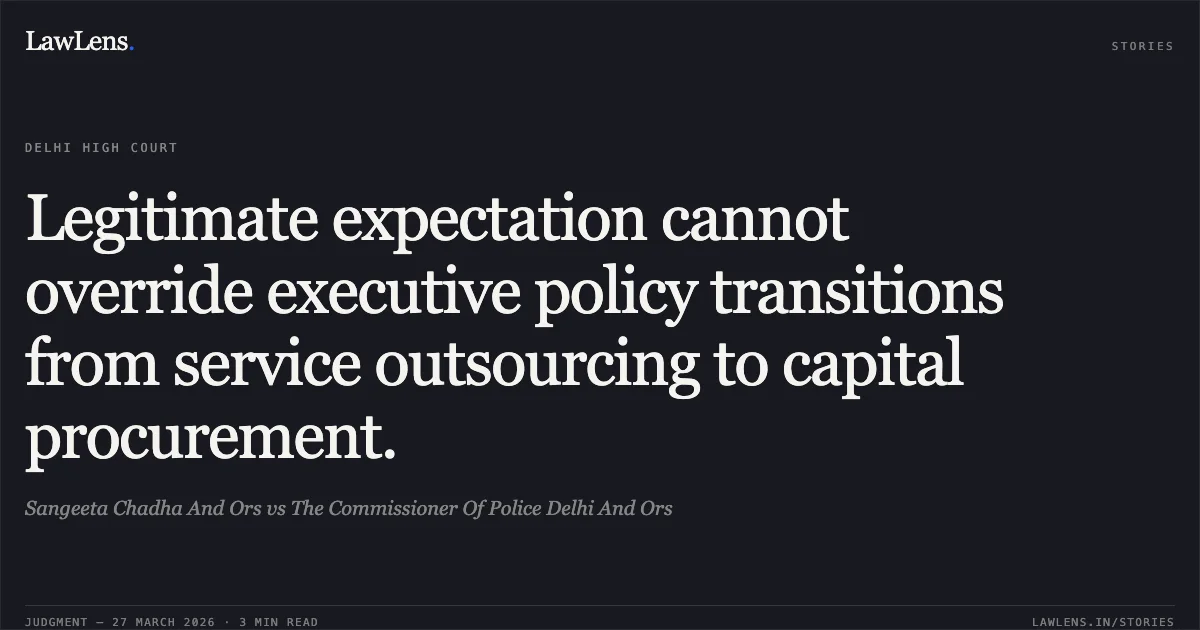
Sangeeta Chadha And OrsvsThe Commissioner Of Police Delhi And Ors
Click to open original judgment
Original judgment, available to read, download and summarize on LawLens.in