Facts
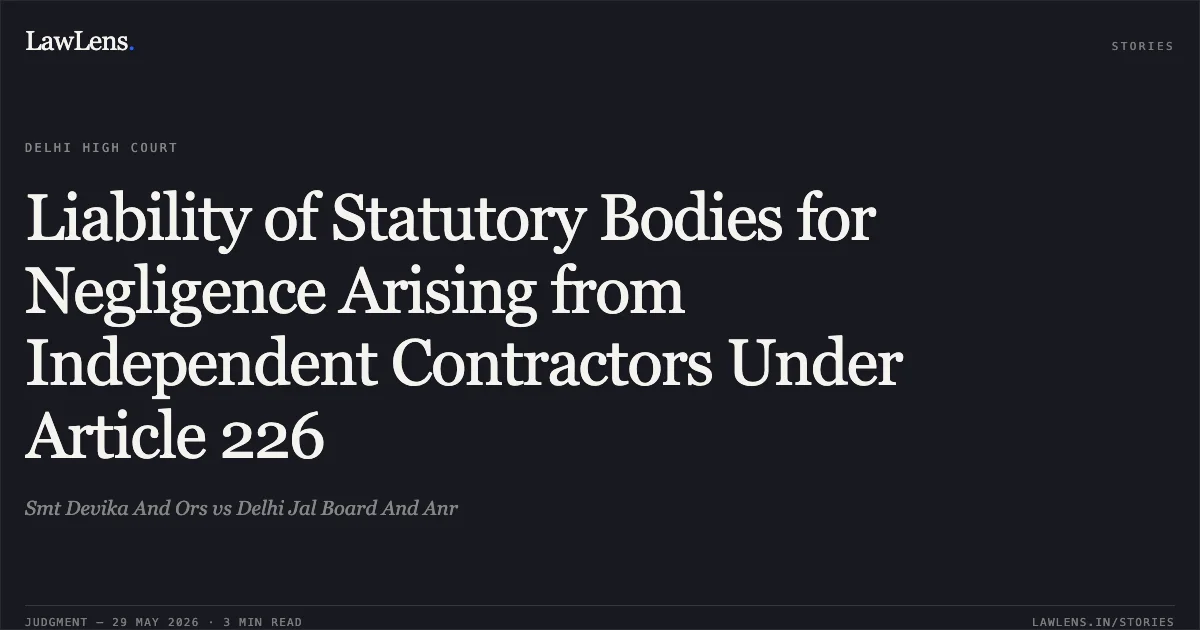
The petitioners, the legal heirs of late Mr. Dinesh Kumar, sought compensation of Rs. 50,00,000/- for his death due to alleged negligence
Source reference: para. 1On the night of 17/18 April 2019, the deceased fell into an open excavation/ditch dug by the Delhi Jal Board (DJB) for pipeline repair on Main Hiran Kudna Road
Source reference: para. 3-4He remained in the ditch overnight until discovered at 6:07 AM; he succumbed to his injuries on 27.04.2019
Source reference: para. 5-6The DJB contended it was not liable as the work was outsourced to a third-party contractor who was responsible for safety and indemnity
Source reference: para. 8DJB further alleged contributory negligence, claiming the deceased was blinded by truck headlights, and argued the petition was barred by a three-year delay
Source reference: para. 9-10Issues
1. Whether the petitioners are disentitled to relief on account of delay in approaching the Court?
Source reference: para. 152. Whether the Court has the power to grant compensation under Article 226 of the Constitution of India in cases of negligence?
Source reference: para. 193. Whether negligence is attributable to the Delhi Jal Board (DJB) despite the involvement of a third-party contractor?
Source reference: para. 274. Whether a third-party contractor is a necessary party to the proceedings?
Source reference: para. 36Law Applied
The court applied the principle that the right to life under Article 21 of the Constitution includes the right to claim compensation for "Constitutional Torts" through public law remedies
Source reference: para. 19-20It relied on Nilabati Behera v. State of Orissa and D.K. Basu v. State of West Bengal to establish that state immunity does not apply to fundamental rights violations
Source reference: para. 20The court applied the doctrine of res ipsa loquitur (the thing speaks for itself) from Shyam Sunder v. State of Rajasthan, allowing for an inference of negligence when facts are undisputed
Source reference: para. 21-22Regarding vicarious liability for contractors, it followed Lakhan Singh v. DDA, which holds that statutory bodies cannot delegate their non-delegable duty of care to private contractors
Source reference: para. 30For compensation, it applied the formula from Kamla Devi v. GNCTD, comprising "standard compensation" adjusted for inflation via CPI(IW) and "pecuniary compensation" using the multiplier method
Source reference: para. 38-39Reasoning
The Court first condoned the two-year delay, noting the COVID-19 pandemic and the petitioners' bereavement
Source reference: para. 16-17Applying res ipsa loquitur, the Court found the DJB's negligence manifest: a deep ditch was left on a public road directly in front of a DJB office without adequate safeguards, and the victim lay there unattended for hours
Source reference: para. 32-34The Court rejected the "third-party contractor" defense, holding that the DJB’s statutory duty to ensure public safety is non-delegable; any inter-se indemnity contract does not affect the victim's right to claim against the State
Source reference: para. 31, 37The Court dismissed the claim of contributory negligence, stating that the primary duty to safeguard hazardous sites remains with the authority
Source reference: para. 31It calculated pecuniary loss based on the deceased's salary (Rs. 16,770), applied a unit system for personal expenses (deducting 2/9ths), and used a multiplier of 16 as per the MV Act
Source reference: para. 45-47Standard compensation was adjusted using the CPI(IW) linking factor of 4.63 to reflect 2019 values
Source reference: para. 42-43Holding
The Court held the DJB liable for the death of Dinesh Kumar due to gross negligence
It ruled that the contractor was not a necessary party, though DJB may seek recovery from them separately
Source reference: para. 37The Court awarded a total rounded-off compensation of Rs. 30,00,000/-. After deducting the interim payment of Rs. 50,000/-, the respondents were directed to pay Rs. 29,50,000/- with 6% simple interest from the date of the accident until realization. Failure to pay within three months results in an increased interest rate of 10%
Source reference: para. 49The Court concluded with observations urging the Executive to formulate a policy for the efficient disbursal of compensation to avoid prolonged litigation for vulnerable families
Source reference: para. 52Acts & Sections Cited
4 provisions across 3 statutes referred to in this judgment. Each provision opens on LawLens.
Indian Penal Code, 18602
Code of Civil Procedure, 19081
Motor Vehicles Act, 19881
Original Court PDF
Smt Devika And OrsvsDelhi Jal Board And Anr
Click to open original judgment
Original judgment, available to read, download and summarize on LawLens.in