01Facts
The appellant husband filed an appeal under Section 19 of the Family Courts Act, 1984, against the order dated 30.11.2021 of the Family Court, West District, Tis Hazari, in HMA No. 90178/2016, which dismissed his petition under Section 13(1)(ia) of the Hindu Marriage Act, 1955.
p. 2 / para. 2The appeal was filed 973 days late, and the appellant filed an application under Section 5 of the Limitation Act, 1963 seeking condonation.
p. 1 / para. 1The application attributed the delay to the illness of his counsel from an old-age ailment, with the complete file in counsel's possession, and to the appellant's work in Raipur.
p. 2 / para. 2The application's ground paragraph states "943 Days," which is inconsistent with the 973-day figure in the prayer.
p. 2 / para. 2The application further asserted that the delay was neither intentional nor deliberate, that the marriage had irretrievably broken down, and that no prejudice would be caused to the respondent.
pp. 2 / paras. 3–4On 13.12.2024 the Court found that the application disclosed no justifiable reason for the delay and granted six weeks, at the appellant's request, to file an affidavit explaining it.
pp. 2–3 / para. 4 · pp. 3 / paras. 5–6Further time was granted on 14.02.2025 (six weeks, as a "last opportunity") and on 19.05.2025 (four weeks).
p. 3 / para. 5On 10.12.2025 the affidavit was still under office objections, and the appellant was directed to remove them.
p. 3 / para. 6As of the hearing date, no explanatory affidavit had been filed, approximately two years after the first grant of time.
p. 4 / para. 702Issues
i.1. Whether the appellant has shown "sufficient cause" under Section 5 of the Limitation Act, 1963 to condone a delay of 973 days in filing the appeal.
p. 7 / para. 11 · pp. 8 / paras. 12–13ii.2. Whether the liberal, pragmatic and justice-oriented approach to condonation can justify condoning the delay where no explanation has been placed on record.
pp. 6–7 / para. 10 · p. 8 / para. 1303Law Applied
Section 5 of the Limitation Act, 1963 permits condonation of delay on showing sufficient cause.
p. 1 / para. 1In Shivamma (Dead) by LRs v. Karnataka Housing Board (2025 SCC OnLine SC 1969), "sufficient cause" is elastic but bounded; the burden lies on the applicant to show a real, bona fide cause free of negligence, judged on the totality of circumstances, and courts will not condone gross negligence or casual indifference.
pp. 3–4 / para. 8In Union of India v. Jahangir Byramji Jeejeebhoy (D) through LRs (2024 SCC OnLine SC 489), the court must first ascertain the bona fides of the explanation before considering the merits, and delay caused by a party's own inaction cannot be treated as non-deliberate.
pp. 5–6 / para. 9In Lanka Venkateswarlu v. State of A.P. ((2011) 4 SCC 363), the concepts of liberal and substantial justice cannot override the law of limitation where the delay is found unjustified and unexplained, and discretion must be exercised within reasonable bounds.
pp. 6–7 / para. 10Provisions in the judgment · 3 · Linked ones open on LawLens
Limitation Act, 1963 Section 5
Family Courts Act, 1984 Section 19
Hindu Marriage Act, 1955 Section 13
04Reasoning
The Court first tested the application on its own terms and found it deficient: the ground for delay was a bare assertion that did not state when counsel fell ill, for how long, or with any supporting document, and it did not account for any of the 973 days. The pleas of irretrievable breakdown and the appeal being at an initial stage addressed the merits or prejudice, not the delay itself.
p. 7 / para. 11Applying Jahangir Byramji Jeejeebhoy, the Court held that the bona fides of the explanation must be examined before any merits consideration; since no explanation existed, there was nothing to weigh against the respondent's position.
pp. 5–6 / para. 9 · p. 8 / para. 13The Court then gave the appellant repeated opportunities, at his own request, to file an affidavit over roughly two years. Its non-filing, despite the Court's directions, was treated as a lack of diligence that undermined bona fides, which Shivamma identifies as disqualifying.
p. 8 / para. 12 · pp. 3–4 / para. 8Because the delay was unexplained, the Court held that the liberal approach to condonation (and the appellant's plea of substantial justice) could not be invoked to override limitation, following Lanka Venkateswarlu.
pp. 6–7 / para. 10 · p. 8 / para. 1305Holding
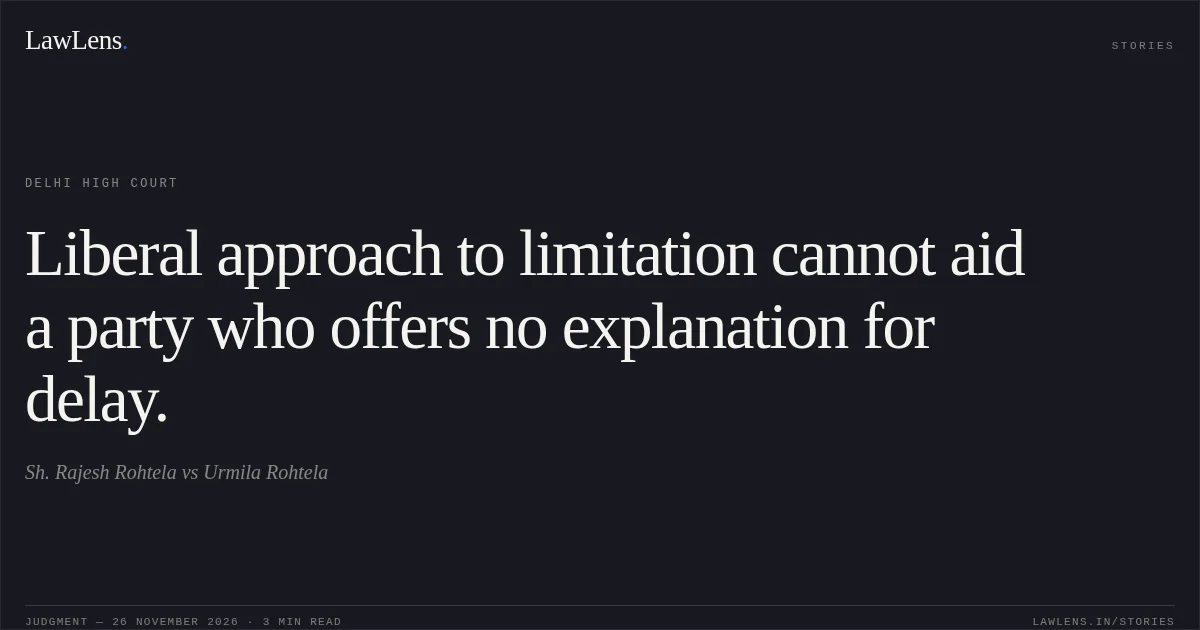
The appellant failed to show sufficient cause for the 973-day delay, and the application under Section 5 is dismissed. The Court held that a liberal approach can benefit only a party who places an explanation before the court.
p. 8 / para. 13The appeal under Section 19 of the Family Courts Act, being barred by limitation, is dismissed along with the pending application. The challenge to the Family Court's order dated 30.11.2021 in HMA No. 90178/2016 therefore does not proceed on merits.
p. 8 / para. 14Original Court PDF
Sh. Rajesh RohtelavsUrmila Rohtela
Click to open original judgment
Original judgment, available to read, download and summarize on LawLens.in