Facts
The petitioner challenged the validity of Rule-6 of Resolution No. 970, dated 31.08.2013, which stipulated that teachers appointed against vacancies on or after 15.02.2011 would receive contributions based on a fixed salary instead of a regular pay scale
Source reference: p. 2The petitioner sought a declaration that the rule is ultra vires or, in the alternative, that it should not be applied retrospectively from 15.02.2011, given that the resolution itself became effective on 01.04.2013
Source reference: p. 2During the proceedings, the petitioner cited several precedents (CWJC No. 985 of 2015, CWJC No. 4517 of 2021, and CWJC No. 696 of 2025) where similarly situated persons were granted relief or allowed to approach the authorities
Source reference: p. 2-3It was admitted during the hearing that the petitioner had not yet filed a formal representation before the relevant administrative authorities
Source reference: para. 3Issues
1. Whether Rule-6 of Resolution No. 970 dated 31.08.2013 is ultra vires or illegally retrospective in its application
Source reference: p. 22. Whether the petitioner is entitled to seek a Writ of Mandamus without first exhausting the administrative remedy of filing a representation before the concerned authority
Source reference: para. 3-5Law Applied
The Court followed the principle of administrative exhaustion, which requires a party to approach the concerned executive authority for the redressal of grievances before seeking judicial intervention under Article 226
Source reference: para. 3-5The Court also acknowledged the principle of parity, noting that the petitioner sought relief based on identical orders passed in previous writ petitions such as CWJC No. 696 of 2025
Source reference: para. 2Reasoning
The Court focused on the procedural maturity of the writ petition.
Source reference: para. 3Upon questioning, the petitioner’s counsel conceded that no representation had been submitted to the Education Department regarding the grievance
Source reference: para. 3The Court observed that in similar previous matters, specifically CWJC No. 696 of 2025, the Court had disposed of the petitions by granting liberty to the petitioners to approach the executive authorities first
Source reference: para. 2Consequently, the Bench determined that rather than adjudicating on the constitutional validity of Rule-6 or the merits of the pay scale claim at this stage, the petitioner should be directed to ventilate his grievances through the proper administrative channels by annexing the relevant court orders to a fresh representation
Source reference: para. 4-5Holding
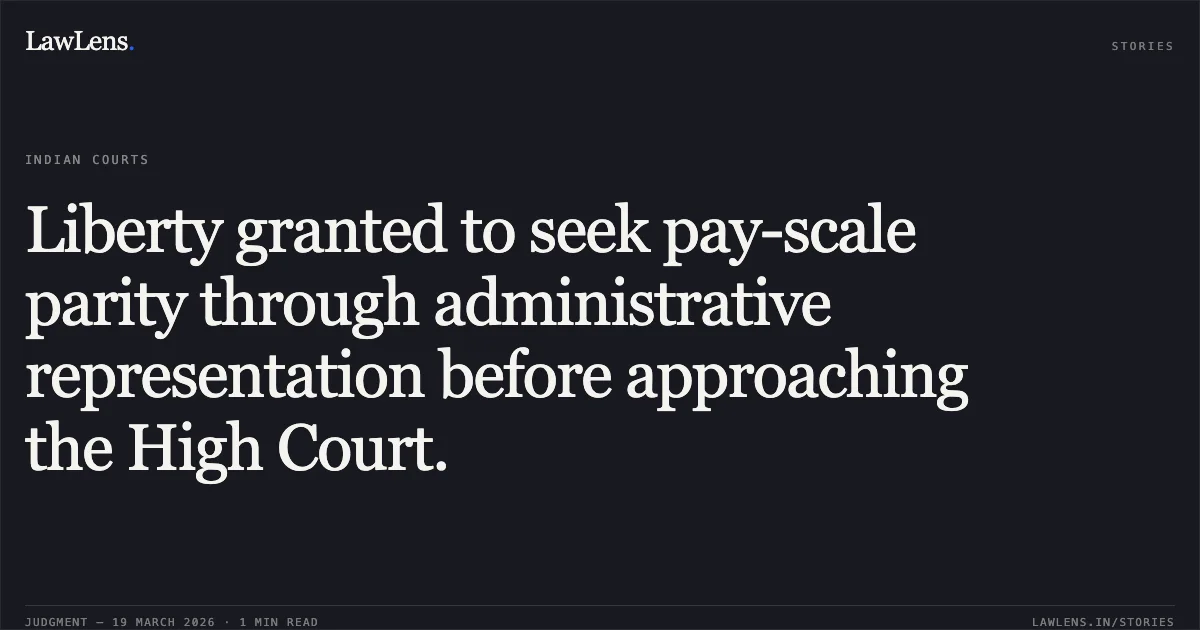
The Court disposed of the writ petition by granting the petitioner liberty to approach the concerned authority with a formal representation to ventilate his grievances
The Court explicitly stated that it expressed no opinion on the merits of the petitioner's claim
Source reference: para. 6The petitioner was further permitted to annex copies of the orders from the cited identical writ petitions to his representation for consideration by the authority
Source reference: para. 4-5Original Court PDF
Mohd. Shahid Alam @ Md. Shahid AlamvsThe State of Bihar
Click to open original judgment
Original judgment, available to read, download and summarize on LawLens.in