Facts
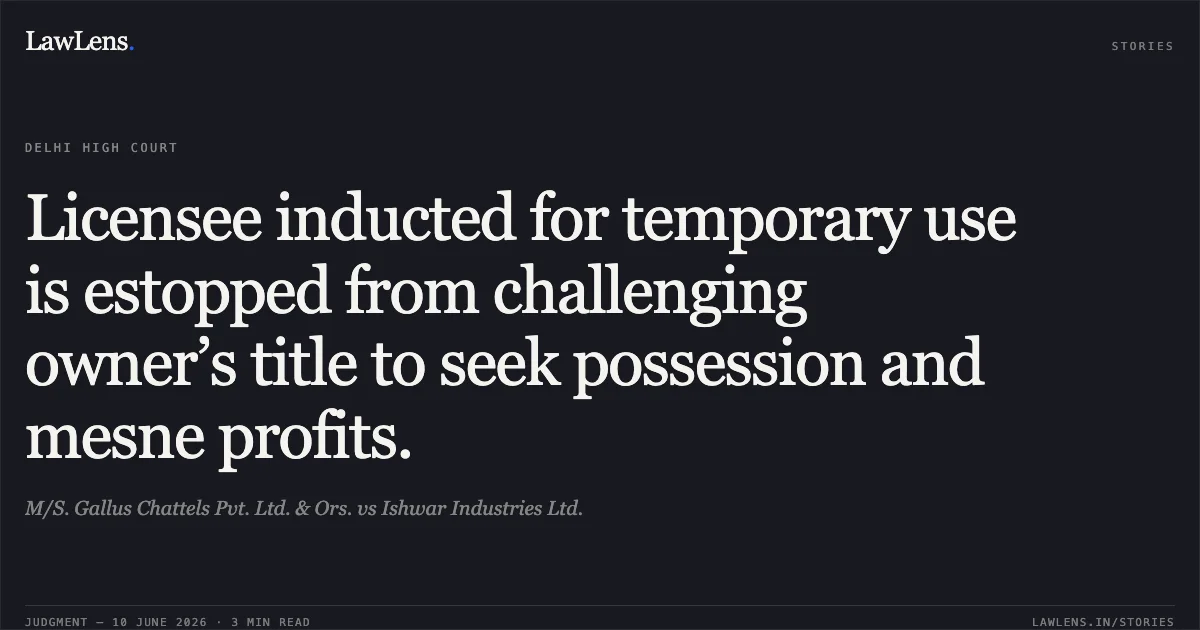
The Respondent (Plaintiff) filed a suit for possession and mesne profits claiming to be the absolute owner of "Tribhuvan Complex".
Source reference: p. 3In 1986, the Plaintiff entered into a development agreement with M/s Growth Techno Projects Ltd. (GTPL) to construct eight blocks.
Source reference: p. 3The Appellants (Defendants) were allotted Block No. 5, but were permitted temporary use of 2,500 sq. yards in Block No. 4 (the suit property) as licensees for nine months via a letter dated 17.03.1994, pending completion of Block 5.
Source reference: p. 3The Appellants failed to vacate despite the expiry of the license and subsequent revocation notices sent between 1996 and 2005.
Source reference: p. 4-5The Appellants contended that the Plaintiff lacked title, that they occupied the property as owners via GTPL, and that the suit was improperly valued.
Source reference: p. 5-7The Trial Court decreed the suit in favor of the Plaintiff on 19.02.2020.
Source reference: p. 9Issues
1. Whether the Plaintiff had a valid right, title, or interest in the suit property to maintain a suit for possession.
Source reference: p. 7 / Issue 12. Whether the Appellants were licensees whose license had been validly revoked.
Source reference: p. 8 / Additional Issue3. Whether the suit was bad for misjoinder/non-joinder of parties or improper valuation.
Source reference: p. 8 / Issues 2 34. Whether the Plaintiff was entitled to mesne profits at the rate of Rs. 75/- per sq. foot from 1996 onwards.
Source reference: p. 8 / Issue 6-8Law Applied
The court applied Section 96 and Order XLI Rule 1 of the Code of Civil Procedure (CPC) regarding first appeals.
Source reference: p. 10It relied on the principle of "better title" in possessory suits and the doctrine of Estoppel under Section 116 of the Indian Evidence Act, 1872, which prevents a licensee or tenant from denying the title of the person who inducted them into the property.
Source reference: p. 16, 22Regarding pleadings, the court applied Order VI Rule 15 of the CPC, holding that technical defects in verification do not defeat substantive rights.
Source reference: p. 14For mesne profits, the court applied the law of limitation, restricting claims to three years prior to the institution of the suit.
Source reference: p. 24Reasoning
The Court found that the Plaintiff established ownership through a Release Deed dated 08.06.1962.
Source reference: p. 16-17The court dismissed the Appellants' challenge to the Plaintiff’s title, noting that the Appellants admitted in their written statement and evidence (DW-1, DW-5) that they were inducted into possession via the letter dated 17.03.1994.
Source reference: p. 19-20Consequently, the Appellants were estopped from challenging the Plaintiff's title.
Source reference: p. 22The court rejected the plea of misjoinder, clarifying that directors are not necessary parties when the company is sued.
Source reference: p. 15On mesne profits, while the court accepted the rate of Rs. 75/- per sq. foot based on the unrebutted testimony of PW-1 and admissions regarding nearby rentals, it found a legal error in the Trial Court’s timeline.
Source reference: p. 23-24Since the suit was filed in 2005, the Plaintiff could only claim arrears for three years prior to the filing (from September 2002) rather than from 1996.
Source reference: p. 24Holding
The High Court upheld the decree for possession and the rate of mesne profits at Rs. 75/- per sq. foot.
The court modified the judgment to limit the recovery of mesne profits to the period starting from 01.09.2002 instead of 23.11.1996.
Source reference: p. 24The punitive costs of Rs. 3,00,000/- and interest rates of 12% to 15% were sustained, and the appeal was partly allowed only to the extent of this temporal modification of damages.
Source reference: p. 24Acts & Sections Cited
4 provisions across 1 statute referred to in this judgment. Each provision opens on LawLens.
Code of Civil Procedure, 19084
Original Court PDF
M/S. Gallus Chattels Pvt. Ltd. & Ors.vsIshwar Industries Ltd.
Click to open original judgment
Original judgment, available to read, download and summarize on LawLens.in


