01Facts
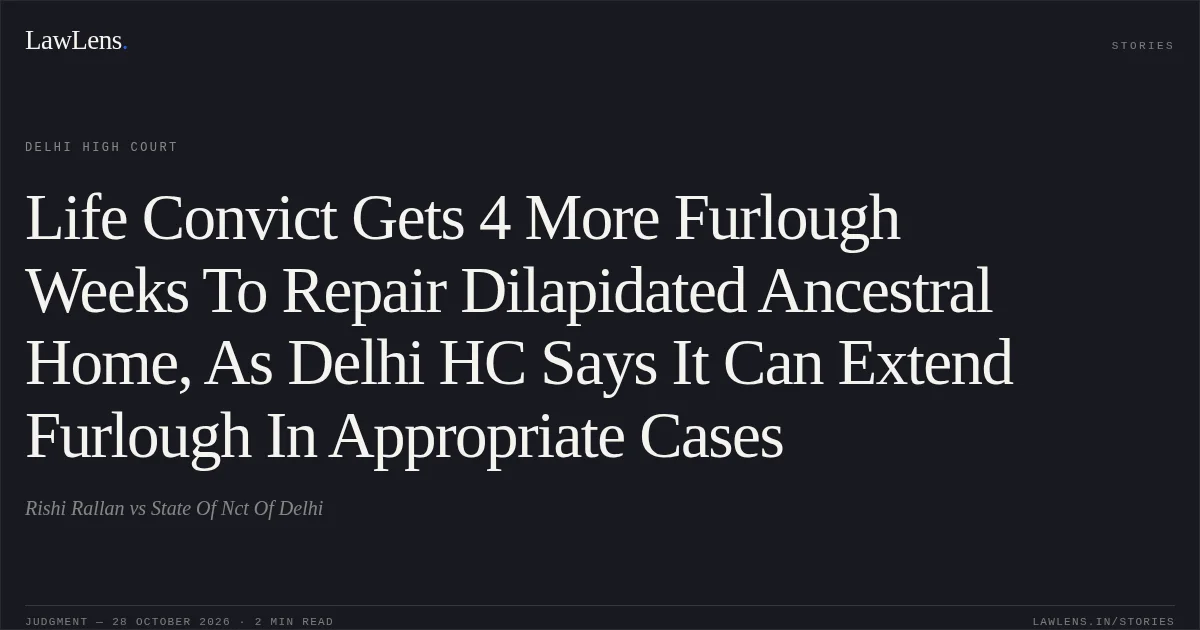
The petitioner, serving a life sentence following conviction under Sections 302/120B of the Indian Penal Code, 1860, had been granted 21 days’ furlough by an earlier order after the rejection of his first-spell application was set aside
p. 1 · ¶ 3–4Released on 7 October 2026 and due to surrender on 28 October 2026, he sought a four-week extension, stating that his residential and ancestral house was severely dilapidated and required repairs that he could not arrange without his presence; his representation seeking extension or a further furlough spell was pending
pp. 1–2 · ¶ 5–6The State opposed the request, arguing that the Delhi Prison Rules, 2018 did not provide for extension of a furlough spell
p. 2 · ¶ 702Issues
i.Whether the Court could extend the petitioner’s existing furlough spell despite the asserted absence of a provision for extension under the Delhi Prison Rules, 2018
pp. 2–4 · ¶ 7–11ii.Whether the petitioner’s stated need to repair his dilapidated home justified a four-week extension, to be adjusted against his furlough entitlement for the current conviction year
pp. 1–2 · ¶ 6 · p. 5 · ¶ 1303Law Applied
The Court treated furlough as a humanistic and rehabilitative measure intended to preserve prisoners’ family and community ties, support their well-being, and aid reintegration, relying on Asfaq v. State of Rajasthan, (2017) 15 SCC 55
pp. 2–3 · ¶ 8It referred to Rules 1197 and 1200 of the Delhi Prison Rules, 2018, which identify the corrective purpose and objectives of parole and furlough, including maintaining family continuity, self-confidence, and psychological health
p. 3 · ¶ 9The Court also considered Dinesh Kumar v. State of NCT of Delhi, W.P. (Crl.) 684/2025 (21 July 2025), concerning the absence of an express furlough-extension provision and the possibility of relaxation of the interval between spells in emergent circumstances, as well as coordinate-bench decisions granting extensions and Bahadur Singh v. State of UT Chandigarh, 2025:PHHC:149797
pp. 3–5 · ¶ 10–12Provisions in the judgment · 1 · Linked ones open on LawLens
Indian Penal Code, 1860 Section 302
04Reasoning
Although the State relied on the absence of an express provision for extending furlough, the Court held that this did not create an embargo on judicial relief in appropriate circumstances.
pp. 2–5 · ¶ 8–12It considered the rehabilitative purpose of furlough, the availability of relaxation of the cooling period in emergent circumstances, and prior decisions in which furlough had been extended
pp. 2–5 · ¶ 8–12In light of the petitioner’s stated need to arrange repairs to his dilapidated home, the Court allowed the requested extension and directed that it be counted against his entitlement for the conviction year ending 13 February 2027
p. 5 · ¶ 1305Holding
The petition was allowed. The petitioner’s furlough was extended by four weeks on the same conditions as previously imposed, with the extended period to be adjusted against his entitlement for the conviction year ending 13 February 2027.
p. 5 · ¶ 13He was directed to surrender to the prison authorities upon expiry of the extended period
p. 5 · ¶ 13The petition and accompanying application were disposed of accordingly
p. 6 · ¶ 14Original Court PDF
Rishi RallanvsState Of Nct Of Delhi
Click to open original judgment
Original judgment, available to read, download and summarize on LawLens.in