Facts
Savita married the appellant Deshraj in June 2014
Source reference: p. 2On April 28, 2016, she died an unnatural death due to "asphyxia due to ante mortem throttling" at her matrimonial home
Source reference: p. 3-4The prosecution alleged that the appellants (husband Deshraj and father-in-law Ram Sajeevan) harassed and murdered her following unmet demands for ₹5,00,000 in dowry
Source reference: p. 2-3The Trial Court convicted both appellants under Sections 304B and 498A of the IPC and Section 4 of the Dowry Prohibition Act, sentencing them to life imprisonment for the dowry death
Source reference: p. 1-2The appellants challenged the conviction, citing delayed FIR filing, general/vague allegations, and their impoverished socio-economic status
Source reference: p. 6-7Issues
1. Whether the general allegations against the father-in-law (Ram Sajeevan) were sufficient to sustain a conviction under Section 304B IPC
Source reference: para. 21, 292. Whether the award of life imprisonment under Section 304B IPC was proportionate given the socio-economic background of the parties and the lack of brutal circumstances
Source reference: para. 24-25Law Applied
The court applied Section 304B of the IPC, which defines dowry death and prescribes a sentencing range from seven years to life imprisonment
Source reference: para. 26It further applied Section 113-B of the Indian Evidence Act regarding the presumption of dowry death
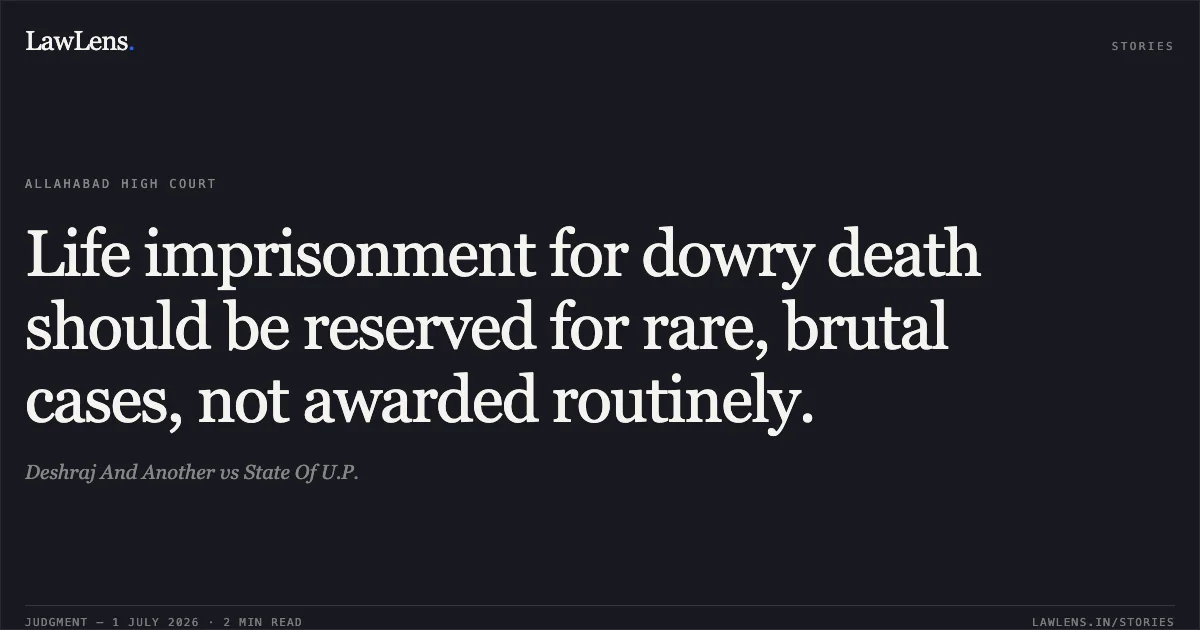
Source reference: para. 26the precedent Hem Chand v. State of Haryana (1994), which establishes that life imprisonment for dowry death should be reserved for "rare cases" and is not a default sentence
Source reference: para. 26the principle of "proportionate sentencing," necessitating a balance between the gravity of the crime and the socio-economic status of the accused
Source reference: para. 25, 31Reasoning
The High Court found the evidence against the father-in-law, Ram Sajeevan, to be based on vague, general allegations
Source reference: para. 20, 29It noted that as a rickshaw puller frequently away from home for work, his involvement was "doubtful and suspicious," and the Trial Court erred by convicting him without cogent evidence
Source reference: para. 20-21Regarding the husband, Deshraj, the court upheld the conviction as the death occurred within seven years of marriage in the matrimonial home
Source reference: para. 15the court found the life sentence "too harsh and severe" reasoning that both families were from the "lower strata" and "weaker section of society"
Source reference: para. 22, 25following Hem Chand, since there was no evidence of extreme brutality or a "rarest of rare" scenario, the maximum penalty was unwarranted
Source reference: para. 26-27Holding
The Court partly allowed the appeal, set aside the conviction and sentence of the father-in-law, Ram Sajeevan, and sustained the conviction of the husband, Deshraj, while reducing it to ten years of rigorous imprisonment.
The Court held that while the crime was established against the husband, the sentence must be proportionate to the socio-economic realities of the parties
Source reference: para. 31-32Acts & Sections Cited
6 provisions across 3 statutes referred to in this judgment. Each provision opens on LawLens.
Indian Penal Code, 18601
Code of Criminal Procedure, 19733
Original Court PDF
Deshraj And AnothervsState Of U.P.
Click to open original judgment
Original judgment, available to read, download and summarize on LawLens.in