Facts
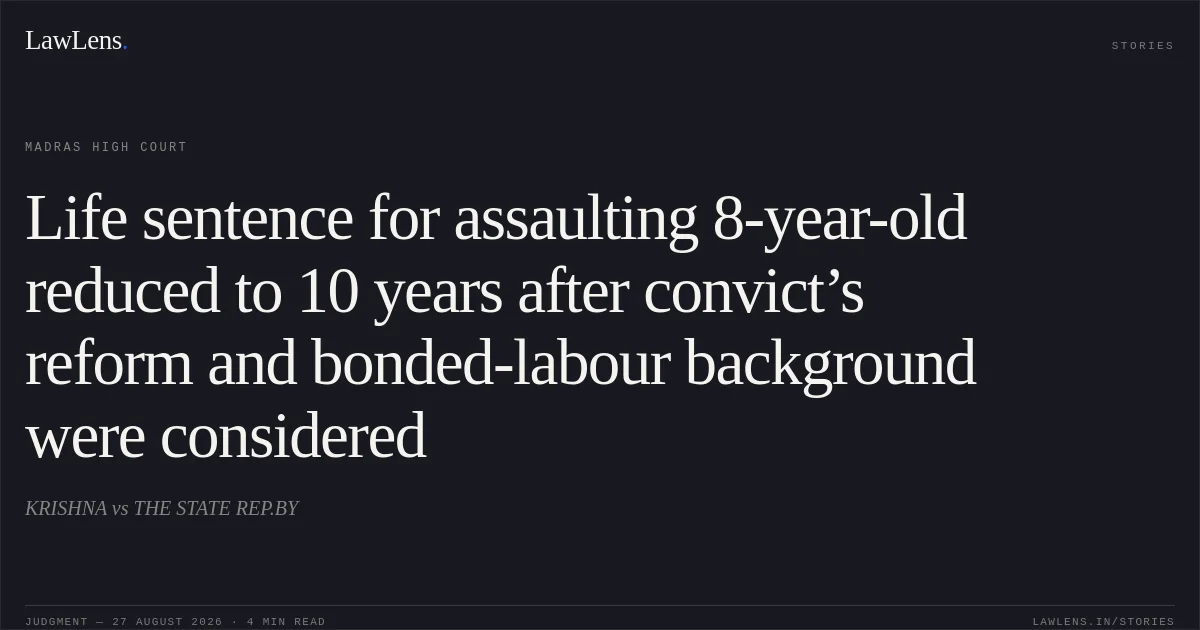
The appellant was convicted by the Sessions Judge, Magalir Neethimandram, Tiruvallur, under Section 450 IPC and Sections 5(i) and 5(m) read with Section 6 of the POCSO Act for committing penetrative sexual assault upon an eight-year-old child on 20.02.2018.
Source reference: p.2, para.1He was sentenced to life imprisonment on two counts under the POCSO Act and five years’ rigorous imprisonment under Section 450 IPC, with the sentences to run concurrently.
Source reference: p.2, para.1The conviction was imposed on 22.08.2019, but the appeal was filed in 2024.
Source reference: p.2, paras.2–4Before filing the appeal, the appellant claimed juvenility, asserting that his date of birth was 05.05.2001 and that he was 16 years, 9 months and 15 days old on the date of occurrence.
Source reference: p.2, paras.2–4The Juvenile Justice Board accepted the claim on the basis of a school certificate, and the Writ Court found that the appellant was a juvenile at the time of the offence; however, the prosecution subsequently produced a State Board examination certificate recording his date of birth as 01.08.1999.
Source reference: pp.3–5, paras.6–13The appellant challenged the conviction primarily on juvenility and alternatively sought reduction of sentence on the grounds of his difficult background, good conduct, remorse, educational progress and prospects of reformation.
Source reference: pp.3, 8–10, paras.5, 22–27Issues
Whether the appellant’s plea of juvenility, based on conflicting date-of-birth records, established that he was a child in conflict with law on 20.02.2018 and thereby invalidated the trial conducted by the Sessions Court.
Source reference: pp.3–7, paras.5–19Whether, notwithstanding the uncertainty regarding the appellant’s age, the conviction could be sustained on the merits of the victim’s evidence and the corroborative medical and documentary evidence.
Source reference: p.8, paras.20–21Whether the sentences imposed under Sections 5(i) and 5(m) read with Section 6 of the POCSO Act warranted reduction in light of the appellant’s age-related circumstances, background, conduct in custody and prospects of reformation.
Source reference: pp.8–11, paras.22–28Law Applied
The Court applied Section 94(2) of the Juvenile Justice (Care and Protection of Children) Act, 2015, under which age is to be determined, in cases of doubt, primarily from the school date-of-birth certificate or the matriculation/equivalent certificate issued by the concerned examination Board, followed by a birth certificate from the competent local authority and, in the absence of such documents, medical age determination.
Source reference: pp.6–7, paras.14–15It relied on Vinod Katara v. State of Uttar Pradesh, (2023) 15 SCC 210, for the principle that a plea of juvenility may be raised at any stage.
Source reference: p.5, para.10Relying on Karan alias Fatiya v. State of Madhya Pradesh, (2023) 5 SCC 504, and Soman v. State of Kerala, (2013) 11 SCC 382, the Court held that uncertainty or non-consideration of age does not necessarily vitiate an otherwise established conviction, though age may constitute a mitigating factor in sentencing.
Source reference: p.10, para.25The Court further applied the sentencing principles of proportionality, the offender’s age, antecedents, remorse, conduct, social and family background, and prospects of reformation.
Source reference: p.10, para.26Since the offence occurred before the 2019 amendment, the minimum sentence applicable under Sections 5(i) and 5(m) read with Section 6 of the POCSO Act was ten years’ imprisonment.
Source reference: p.11, para.28Reasoning
The Court found the age determination inconclusive.
Source reference: pp.6–7, paras.16–19The appellant’s school certificate, issued years after he left the school and without supporting records, was considered unreliable, while the prosecution’s State Board certificate and prison records, though more contemporaneous, also lacked independent material conclusively proving the recorded date of birth.
Source reference: pp.6–7, paras.16–19Consequently, the Court declined to treat juvenility as established for the purpose of setting aside the conviction.
Source reference: pp.6–7, paras.16–19On the merits, the victim’s clear and credible testimony was supported by the prompt complaint lodged by her mother, the accident register, discharge summary and other medical evidence; therefore, no interference with the finding of guilt was warranted.
Source reference: p.8, paras.20–21However, while considering sentence, the Court took into account the appellant’s harsh childhood, alleged sale as bonded labour, satisfactory prison conduct, remorse, completion of education up to Class XII, absence of adverse material and prospects of reform.
Source reference: pp.10–11, paras.26–28Balancing these mitigating factors against the grave nature of the offence, it reduced the POCSO sentences to the statutory minimum of ten years’ rigorous imprisonment on each count.
Source reference: pp.10–11, paras.26–28Holding
The appeal was partly allowed.
The Court declined to interfere with the appellant’s conviction, including the conviction under Sections 5(i) and 5(m) read with Section 6 of the POCSO Act and Section 450 IPC.
Source reference: p.11, paras.28–29The life sentences imposed for the two POCSO offences were reduced to ten years’ rigorous imprisonment each, while the five-year sentence under Section 450 IPC was confirmed.
Source reference: p.11, paras.28–29All sentences were directed to run concurrently.
Source reference: p.11, paras.28–29Acts & Sections Cited
6 provisions across 5 statutes referred to in this judgment. Each provision opens on LawLens.
Bharatiya Nagarik Suraksha Sanhita, 20231
Code of Criminal Procedure, 19731
Indian Penal Code, 18601
Juvenile Justice (Care and Protection of Children) Act, 2015.1
Original Court PDF
KRISHNAvsTHE STATE REP.BY
Click to open original judgment
Original judgment, available to read, download and summarize on LawLens.in
![Courts will not interfere with transfers absent mala fides or violation of statutory rules.. M Ramya vs EMPLOYEES STATE INSURANCE CORPORATION (ESIC). CAT - ['Chennai']. LawLens](/stories/thumbnails/courts-will-not-interfere-with-transfers-absent-mala-fides-or-violation-of-statutory-rules-a6845e9ca6f548fca284c51c8351957f.webp)
![Courts cannot direct one-time recruitment age relaxation absent authority in the governing rules or advertisement.. UT OF PUDUCHERRY vs M ANDAL. CAT - ['Chennai']. LawLens](/stories/thumbnails/courts-cannot-direct-one-time-recruitment-age-relaxation-absent-authority-in-the-governing-895d78fde47143e2a8ed0207c4b6a44f.webp)
![A review cannot correct an allegedly erroneous decision absent an error apparent on the record.. Ajit Kumar Jha vs RAILWAY BOARD. CAT - ['Delhi']. LawLens](/stories/thumbnails/a-review-cannot-correct-an-allegedly-erroneous-decision-absent-an-error-apparent-on-the-re-8ac952fd4eba470c92f7da20af72a220.webp)