Facts
Students of Apeejay School filed a complaint under Section 29(2) of the Juvenile Justice (Care and Protection of Children) Act, 2015, alleging discriminatory treatment of fee-defaulting students during examinations, including segregation, intimidation, denial of official answer sheets, reduction of examination time, and confiscation of question papers and answer sheets.
Source reference: pp.2–3The Child Welfare Committee dismissed the complaint on 5 March 2024 after noting that the students had subsequently been permitted to appear for their examinations.
Source reference: pp.2–3The students challenged that order in Criminal Appeal No. 283/2024, along with an application seeking condonation of a stated delay of 125 days.
Source reference: p.3The appellate court condoned the delay and held that the appeal was effectively filed within the prescribed limitation period.
Source reference: p.3The school challenged the condonation order under Section 101(5) read with Section 103(2) of the JJ Act, contending that the actual delay was 148 days, that 23 days remained unexplained, and that the students had knowledge of the CWC’s disposal by 20 June 2024.
Source reference: pp.3–5Despite the school’s non-appearance on repeated dates, the High Court proceeded to decide the appeal on merits, relying on Bani Singh v. State of U.P.
Source reference: p.6Issues
Whether the appellate court was justified in condoning the delay in filing the students’ appeal against the CWC’s order upon a finding of sufficient cause under the proviso to Section 101(1) of the JJ Act.
Source reference: pp.6–8Whether the limitation period should be computed from 20 June 2024, when a parent allegedly knew that the complaint had been disposed of, or from 2 August 2024, when the respondents obtained the copy of the CWC’s order.
Source reference: pp.9–12Whether any further delay remained unexplained between receipt of the order, execution of affidavits, electronic filing, and receipt of the appeal by the appellate court.
Source reference: pp.8–9, 12Law Applied
The Court applied the proviso to Section 101(1) of the JJ Act, which permits an appeal to be entertained after the prescribed period of 30 days if the appellant establishes that sufficient cause prevented timely filing.
Source reference: pp.6–8It considered the statutory appellate framework under Sections 101(5) and 103(2) of the JJ Act.
Source reference: p.1Relying on Maniben Devraj Shah v. Municipal Corpn. of Brihan Mumbai, (2012) 5 SCC 157, the Court held that “sufficient cause” must be assessed through a liberal but justice-oriented approach, while examining the bona fide nature of the explanation and the absence of negligence or concoction.
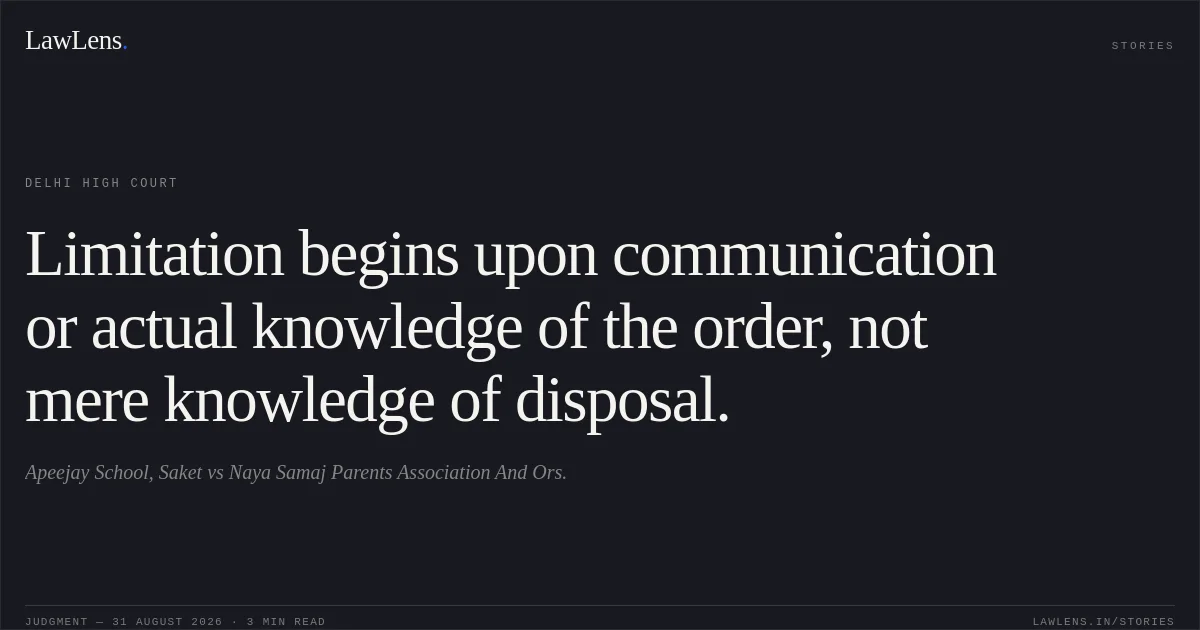
Source reference: pp.7–8Under D. Saibaba v. Bar Council of India, (2003) 6 SCC 186, limitation ordinarily runs from the date of communication or actual or constructive knowledge of the order, not merely from the date on which the order was passed.
Source reference: pp.10–11The Court also relied on Bani Singh v. State of U.P., (1996) 4 SCC 720, to proceed with consideration of the appeal on merits despite the appellant’s absence.
Source reference: p.6Reasoning
The Court found that the respondents’ explanation was bona fide: although the CWC order was dated 5 March 2024, the material record indicated that they obtained a copy only on 2 August 2024, after receiving the school’s reply to the DCPCR enclosing the order.
Source reference: pp.8–10The parent’s 20 June 2024 remark established only awareness that the complaint had been disposed of; it did not prove that the parent or the students had received or knew the contents of the CWC’s order.
Source reference: pp.9–12Mere knowledge of disposal was therefore insufficient to commence limitation.
Source reference: pp.9–12The Court also rejected the alleged unexplained 23-day delay, noting that the appeal was electronically filed on 14 August 2024 and was received by the appellate court on 31 August 2024; the relevant filing date was the e-filing date, not the later date of receipt by the court.
Source reference: pp.8–9, 12Accordingly, the appellate court had properly exercised its discretion in condoning the delay.
Source reference: pp.12–13Holding
The High Court held that the respondents had shown sufficient cause for the delayed filing of their appeal and that limitation could not be computed merely from their knowledge of the complaint’s disposal on 20 June 2024.
The challenge to the appellate court’s order was found meritless, and the appeal was dismissed.
Source reference: pp.12–13All pending applications were also closed.
Source reference: p.13Acts & Sections Cited
4 provisions across 2 statutes referred to in this judgment. Each provision opens on LawLens.
Juvenile Justice (Care and Protection of Children) Act, 2015.3
Limitation Act, 19631
Original Court PDF
Apeejay School, SaketvsNaya Samaj Parents Association And Ors.
Click to open original judgment
Original judgment, available to read, download and summarize on LawLens.in