Facts
The petitioner sought appointment of a sole arbitrator under Section 11(6) of the Arbitration and Conciliation Act, 1996, relying on an arbitration clause in a work order dated 1 July 2011.
Source reference: p. 1He claimed that the respondent had withheld approximately ₹7,50,000 in retention amounts.
Source reference: p. 2After the petitioner filed a recovery suit, the Gurugram court referred the disputes to arbitration under Section 8 on 16 May 2023. The petitioner later issued arbitration notices and pursued Section 11 proceedings in Gurugram, which he withdrew with liberty to approach the appropriate forum; he then issued a fresh notice on 8 April 2026 and filed the present petition.
Source reference: p. 2–3The respondent opposed the petition on limitation grounds, arguing that the underlying claim was stale and that Section 14 of the Limitation Act did not apply. Both parties agreed to mediation and, if it failed, to arbitration.
Source reference: p. 3–4Issues
1. Whether the Court should appoint a sole arbitrator despite the respondent’s objection that the underlying claims and arbitration invocation were time-barred.
Source reference: p. 3–42. Whether the disputes should be referred to mediation before arbitration proceeds.
Source reference: p. 4Law Applied
Under Section 11 of the Arbitration and Conciliation Act, 1996, the Court’s enquiry is confined to examining the prima facie existence of an arbitration agreement, as stated in SBI General Insurance Co. Ltd. v. Krish Spinning, 2024 SCC OnLine SC 1754.
Source reference: p. 4The Act also requires the arbitrator to furnish the requisite disclosure under Section 12(2).
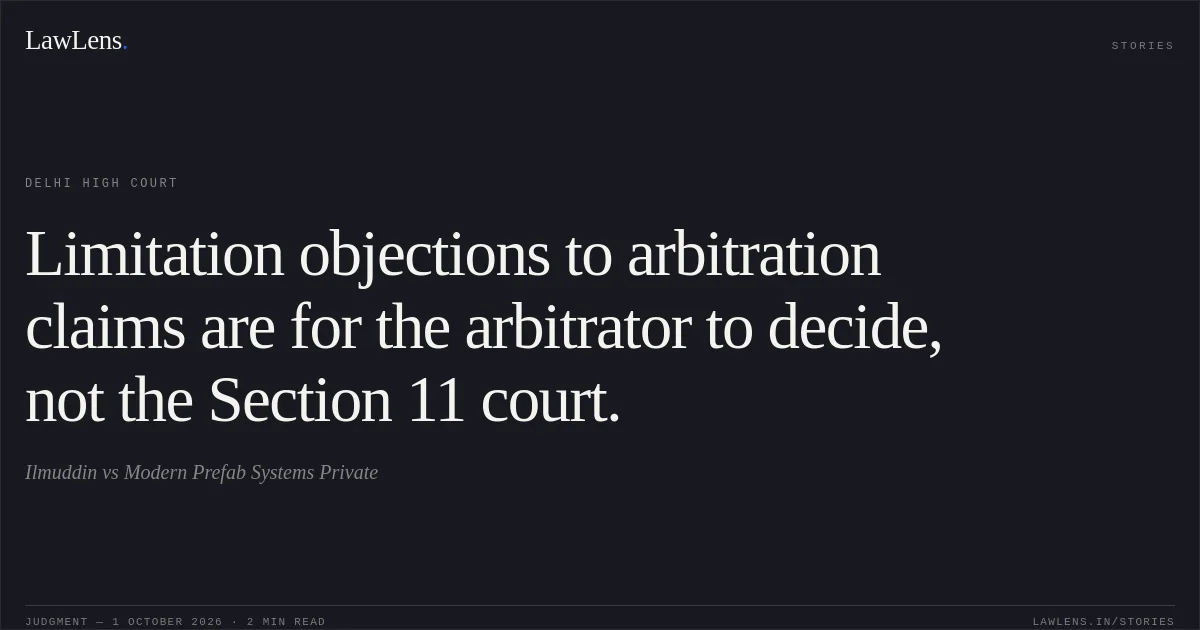
Source reference: p. 5The respondent invoked limitation principles, including the availability of exclusion of time under Section 14 of the Limitation Act, 1963; however, the Court did not decide those questions and left the parties at liberty to raise them before the arbitrator.
Source reference: p. 3, p. 5Reasoning
The Court noted that the existence of a valid arbitration agreement was undisputed and that both parties agreed to arbitration if mediation failed.
Source reference: p. 4Applying the limited Section 11 enquiry, the Court found no impediment to appointing a sole arbitrator, without deciding whether the claims or invocation were time-barred. It referred the parties to the Delhi High Court Mediation and Conciliation Centre and reserved limitation, arbitrability, and jurisdiction objections for determination by the arbitrator in accordance with law.
Source reference: p. 4–5Holding
The petition was disposed of by referring the parties to mediation for three weeks, with directions to appear on 7 October 2026.
If mediation failed, Mr. Anshul K. Bishnoi was appointed sole arbitrator, with the arbitration to be conducted under the aegis of the Delhi International Arbitration Centre. The respondent was permitted to raise limitation objections, and both parties could raise all other pleas before the arbitrator; the Court expressed no final view on their merits.
Source reference: p. 4–5Acts & Sections Cited
5 provisions across 2 statutes referred to in this judgment. Each provision opens on LawLens.
Arbitration and Conciliation Act, 19964
Limitation Act, 19631
Original Court PDF
IlmuddinvsModern Prefab Systems Private
Click to open original judgment
Original judgment, available to read, download and summarize on LawLens.in