Facts
The Applicants sought appointment of an arbitrator under Section 11 of the Arbitration and Conciliation Act, 1996, pursuant to Clause 14 of an Agreement to Transfer dated 25/28 August 2004 concerning property at Chembur, Mumbai.
Source reference: paras. 1–2; pp. 1–2The agreement contemplated that the Respondents would secure mutation of the property, obtain vacant possession from occupants/tenants, and execute the necessary conveyance, while the Applicants were to pay the balance consideration of Rs. 24,51,000 by 31 December 2004.
Source reference: paras. 3, 15, 17; pp. 2–3, 8–9The Applicants alleged that the Respondents only partially performed their obligations.
Source reference: paras. 3–5; pp. 2–3The Applicants claimed to have paid approximately Rs. 40,05,741 between 2004 and 2024, including payments to the owners and tenants, settlement of tenancy claims, and property taxes.
Source reference: paras. 3–5; pp. 2–3In 2012, the Applicants instituted Suit No. 2311 of 2012 for specific performance.
Source reference: para. 6; p. 3The suit was withdrawn on 25 April 2024 with liberty to pursue arbitration, and the relevant order was subsequently reviewed on 31 August 2024, with adverse observations deleted and the parties’ rights kept open.
Source reference: paras. 6, 19–21; pp. 3, 10–11The Applicants invoked arbitration by notice dated 21 June 2024 and subsequently relied upon a further notice dated 6 November 2025.
Source reference: paras. 6–7, 33; pp. 3–5, 17The Respondents refused the request for appointment of an arbitrator.
Source reference: paras. 6–7, 33; pp. 3–5, 17The Respondents contended that the substantive claim was ex facie barred by limitation because the agreement required completion of the transaction in 2004 and the arbitration notice was issued nearly twenty years later.
Source reference: paras. 12–14; pp. 6–7Issues
Whether the Section 11 application was barred by limitation under Article 137 of the Limitation Act, 1963.
Source reference: para. 33; p. 17Whether the underlying claims arising from the 2004 Agreement to Transfer were so plainly time-barred and “dead” that the Court should refuse reference to arbitration at the Section 11 stage.
Source reference: paras. 15, 23–24, 34; pp. 8, 12–13, 18Whether questions concerning subsequent payments or acknowledgments under Section 19 of the Limitation Act, exclusion of time under Section 14, and the effect of the earlier suit and related orders required determination by the arbitral tribunal.
Source reference: paras. 18–21, 28–32; pp. 9–12, 14–16Law Applied
Under Sections 11(6) and 11(6A) of the Arbitration and Conciliation Act, 1996, the referral court’s inquiry is limited, principally, to the existence of an arbitration agreement and whether the Section 11 application is within limitation; it should not undertake an intricate evidentiary examination of the limitation of the substantive claims.
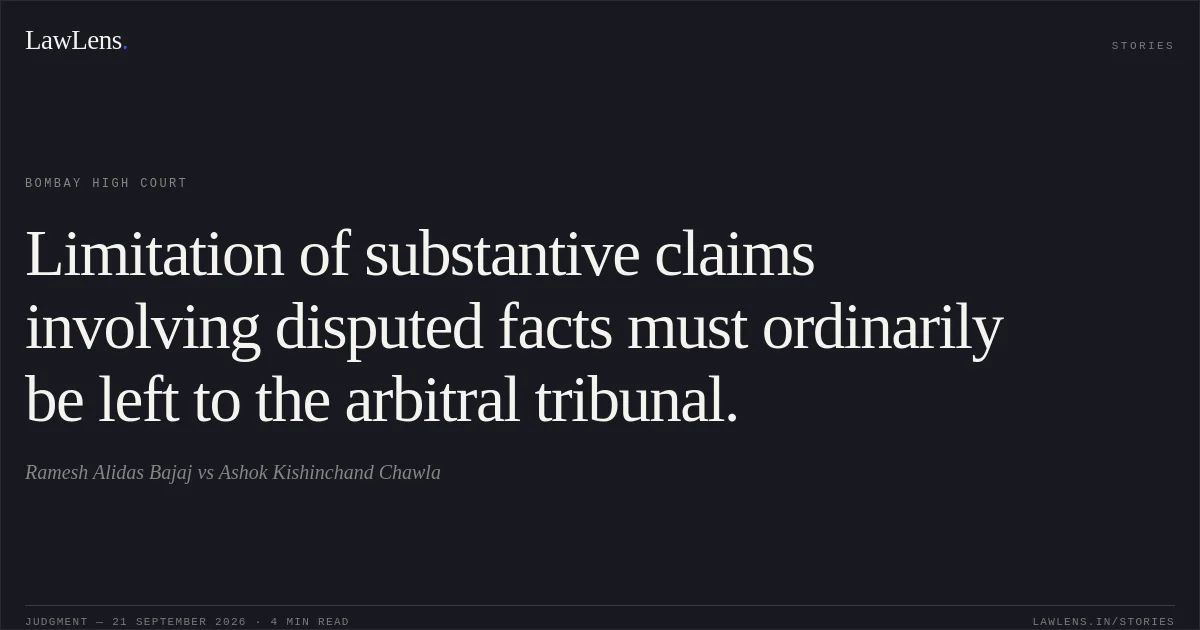
Source reference: para. 22; p. 12Applying SBI General Insurance Co. Ltd. v. Krish Spg., (2024) 12 SCC 1, and Aslam Ismail Khan Deshmukh v. ASAP Fluids (P) Ltd., (2025) 1 SCC 502, the Court held that substantive limitation ordinarily falls for determination by the arbitral tribunal.
Source reference: para. 22; p. 12Under Vidya Drolia, a court may refuse reference only where the claim is manifestly, ex facie time-barred and dead, or where no subsisting dispute exists.
Source reference: para. 23; p. 12The Court also considered Sections 14 and 19 of the Limitation Act, 1963, concerning exclusion of time spent prosecuting a proceeding in good faith before a forum unable to entertain it and extension of limitation through qualifying part-payment or acknowledgment.
Source reference: paras. 10–11, 18, 21, 30; pp. 5–6, 9, 11, 15State of West Bengal v. B.B.M. Enterprises, 2026 SCC OnLine SC 980, and Vishram Varu and Company v. Union of India, (2023) 12 SCC 588, establish that a subsequent notice invoking arbitration cannot revive an already-barred claim; however, refusal at the referral stage is justified only where the claim is clearly dead on undisputed material.
Source reference: paras. 25–26, 29; pp. 13–15Reasoning
The Court accepted that the agreement contemplated completion of the transaction by 2004 and that this circumstance supported the Respondents’ limitation objection.
Source reference: paras. 15, 17; pp. 8–9However, the Applicants relied on disputed subsequent events, including payments allegedly made up to 2024, settlement of tenant claims, payment of property taxes, prosecution of the 2012 suit, withdrawal with liberty to arbitrate, and the review order deleting adverse observations.
Source reference: paras. 17–21, 27–31; pp. 9–12, 13–16Whether those payments constituted legally relevant part-payments under Section 19, whether the earlier suit could be excluded under Section 14, and what legal effect followed from the civil court’s orders required examination of pleadings, documents, and surrounding circumstances.
Source reference: paras. 18, 20–21, 28, 30–32; pp. 9–12, 14–16Consequently, the claim was not shown to be manifestly dead on the material available at the referral stage.
Source reference: no citationThe Court clarified that the later arbitration notice itself did not revive the claim; the issue of substantive limitation remained open for the tribunal.
Source reference: para. 29; p. 15Since the Respondents had not shown that the Section 11 application was filed more than three years after refusal or failure to appoint an arbitrator, the application was held to be within limitation under Article 137.
Source reference: para. 33; p. 17Holding
The Court held that the Section 11 application was within limitation and that the underlying claims were not so plainly or manifestly dead as to justify refusal of reference.
All objections concerning substantive limitation, including Sections 14 and 19 of the Limitation Act, the effect of Suit No. 2311 of 2012, the orders dated 25 April 2024 and 31 August 2024, and the alleged payments, were left open for determination by the arbitral tribunal.
Source reference: paras. 34–35; pp. 18–19The Court appointed Mr. Ashish Venugopal, Advocate, as the sole arbitrator to adjudicate the disputes, claims, and counterclaims arising from the Agreement to Transfer dated 25/28 August 2004.
Source reference: para. 36(A); p. 19The parties were directed to share arbitral costs and fees equally in the first instance, subject to the final award on costs, and all pending interlocutory applications were disposed of.
Source reference: paras. 36(B)–(F), 39; pp. 19–21Acts & Sections Cited
6 provisions across 2 statutes referred to in this judgment. Each provision opens on LawLens.
Arbitration and Conciliation Act, 19963
Limitation Act, 19633
Original Court PDF
Ramesh Alidas BajajvsAshok Kishinchand Chawla
Click to open original judgment
Original judgment, available to read, download and summarize on LawLens.in