Facts
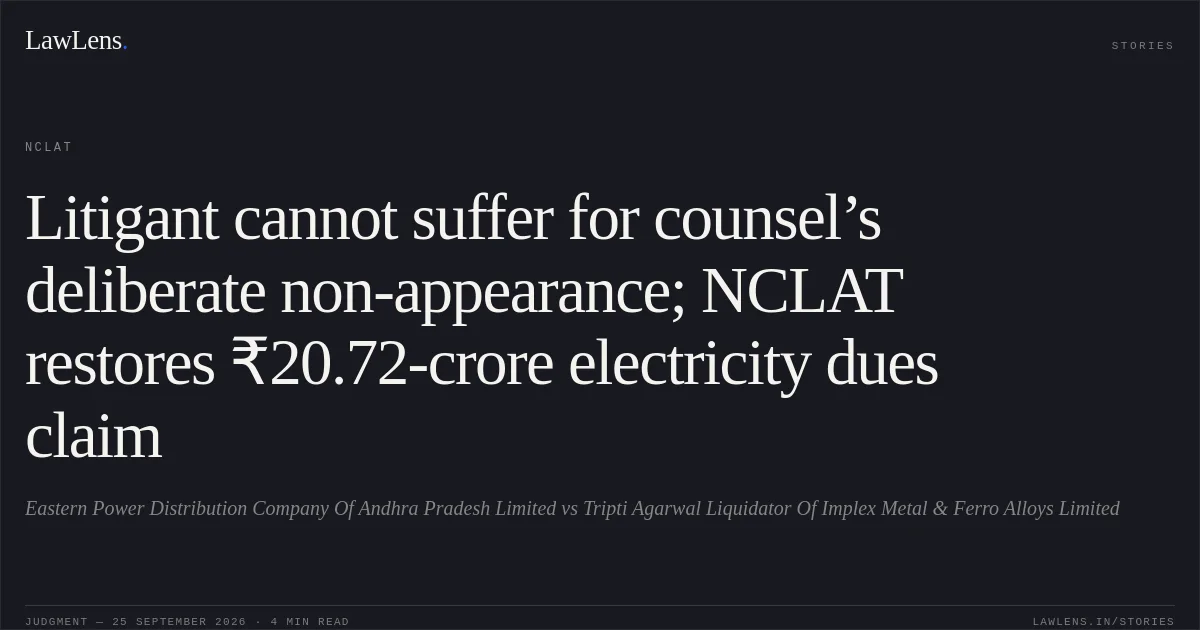
The Appellant, an electricity distribution licensee, supplied electricity to Impex Metal & Ferro Alloys Ltd., the Corporate Debtor, during its CIRP.
Source reference: paras. 3–12The Corporate Debtor consumed electricity between 1 March 2018 and 24 April 2019, resulting in outstanding consumption charges of ₹20,72,84,722, which the Appellant claimed as CIRP costs under the Insolvency and Bankruptcy Code, 2016.
Source reference: paras. 3–12The Appellant filed I.A. No. 1061 of 2021 seeking payment of the outstanding electricity charges. That application was dismissed for non-prosecution on 8 November 2023 because the Appellant’s counsel was absent.
Source reference: para. 13The Appellant subsequently filed I.A. No. 1570 of 2024 seeking recall/restoration of I.A. No. 1061 of 2021.
Source reference: paras. 15–19, 22–29The NCLT rejected the restoration application on 13 November 2025, holding that it was filed beyond the thirty-day period contemplated under Rule 48(2) of the NCLT Rules, 2016.
Source reference: paras. 20–21Issues
Whether the Appellant’s restoration application could be rejected solely because it was filed beyond the thirty-day period under Rule 48(2) of the NCLT Rules, 2016, despite the explanation that the delay resulted from the earlier counsel’s deliberate non-appearance and failure to provide an NOC?
Source reference: paras. 21–29, 35–52Whether a litigant should be made to suffer for the deliberate or negligent non-appearance of its counsel, resulting in dismissal of its application for non-prosecution?
Source reference: paras. 23–30, 35, 48–49Whether the Appellant was legally required to obtain the previous counsel’s consent/NOC before engaging a new counsel, and whether the absence of such consent justified the delay in seeking restoration?
Source reference: paras. 27–34Whether I.A. No. 1061 of 2021, concerning electricity charges allegedly incurred during CIRP, should be restored for adjudication on merits?
Source reference: paras. 7–12, 51–52Law Applied
The Court applied Section 14(2) and Section 14(2A) of the Insolvency and Bankruptcy Code, 2016, under which essential supplies and supplies necessary for preserving the Corporate Debtor as a going concern generally cannot be terminated during moratorium, subject to payment of post-commencement dues.
Source reference: paras. 4–5It considered Rule 48(2) of the NCLT Rules, 2016, concerning restoration of applications dismissed for non-prosecution, and held that the thirty-day period was not an absolute bar where the delay could be considered under Section 238A of the Code read with Section 5 of the Limitation Act, 1963.
Source reference: paras. 41–47, 51–52Rule 39 of the Bar Council of India Rules requires a subsequent advocate to obtain the earlier advocate’s consent or seek the court’s permission before entering appearance where a vakalatnama is already on record.
Source reference: paras. 27–29Order III Rule 4 CPC was relied upon for the principle that a vakalatnama continues until determined by the client or advocate with the leave of the court.
Source reference: paras. 32–34The Court relied on Rafiq v. Munshilal, (1981) 2 SCC 788, for the principle that an innocent litigant should not suffer because of the advocate’s default.
Source reference: para. 30The Court relied on Metalrod Pvt. Ltd. v. Harshit Finvest Pvt. Ltd., (2025) ibclaw.in 563, regarding the applicability of Article 137 and the Tribunal’s inherent powers in restoration matters.
Source reference: para. 35Reasoning
The NCLAT held that the dismissal of I.A. No. 1061 of 2021 was not a decision on merits but a dismissal for non-prosecution resulting from counsel’s absence.
Source reference: paras. 13–14, 50–51The record indicated that the earlier counsel had not personally appeared for several dates and had allegedly withdrawn from effectively pursuing the matter without informing the Appellant.
Source reference: paras. 23–26In these circumstances, the Appellant’s reliance on Rafiq was justified, since a litigant who has engaged counsel and entrusted the matter to him cannot ordinarily be expected to monitor every listing or compel counsel to appear.
Source reference: para. 30The Court further held that the Appellant’s explanation regarding the delayed restoration was sufficient.
Source reference: no citationRule 39 of the Bar Council of India Rules and Order III Rule 4 CPC created a practical impediment to immediately engaging new counsel without obtaining the earlier counsel’s consent or seeking leave of the Tribunal.
Source reference: paras. 27–34The delay therefore had to be assessed with reference to the circumstances, rather than mechanically applying Rule 48(2).
Source reference: no citationSection 238A, read with Section 5 of the Limitation Act, empowered the Tribunal to condone the delay where sufficient cause was shown, particularly because the underlying application had not been adjudicated on merits.
Source reference: paras. 41–47, 50–52The Court concluded that the alleged deliberate conduct of the earlier counsel constituted sufficient cause and that the Appellant should not lose its substantive claim merely because of that conduct.
Source reference: paras. 48–49Holding
The appeal was allowed.
The NCLAT quashed the NCLT’s order dated 13 November 2025, recalled the order dated 8 November 2023 dismissing I.A. No. 1061 of 2021 for non-prosecution, and allowed I.A. No. 1570 of 2024.
Source reference: para. 52I.A. No. 1061 of 2021 was directed to be considered by the NCLT on its own merits, including the Appellant’s claim for ₹20,72,84,722 towards electricity consumed during the CIRP.
Source reference: para. 52All pending interlocutory applications were closed.
Source reference: para. 52Acts & Sections Cited
12 provisions across 5 statutes referred to in this judgment. Each provision opens on LawLens.
Electricity Act, 20031
Insolvency and Bankruptcy Code, 2016.6
Advocates Act, 19611
Code of Civil Procedure, 19082
Limitation Act, 19632
Original Court PDF
Eastern Power Distribution Company Of Andhra Pradesh LimitedvsTripti Agarwal Liquidator Of Implex Metal & Ferro Alloys Limited
Click to open original judgment
Original judgment, available to read, download and summarize on LawLens.in