Facts
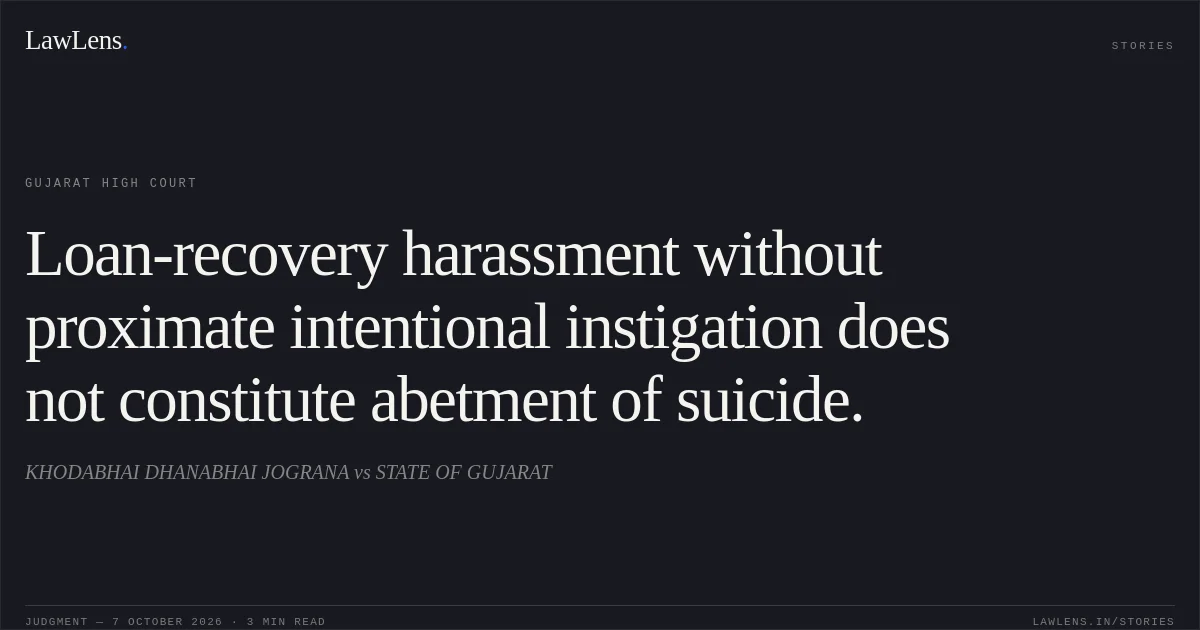
The deceased had borrowed money from several persons, including the applicants, and his wife alleged that the lenders demanded high interest and subjected him to persistent pressure and harassment to recover the debts.
Source reference: paras. 2, 4; pp. 2–6The FIR alleged that, after consuming poison, the deceased told his family that the lenders’ harassment had driven him to do so; he later died in hospital.
Source reference: paras. 2, 4; pp. 2–6The FIR charged the applicants under Sections 306, 386 and 114 of the IPC and Sections 5, 40 and 42 of the Gujarat Money-Lenders Act, 2011.
Source reference: paras. 2, 4; pp. 2–6The applicants sought quashing under Section 482 of the Code of Criminal Procedure.
Source reference: paras. 6–7; pp. 7–11Issues
Whether the FIR and charge-sheet material disclosed the ingredients of abetment of suicide under Sections 306 and 107 IPC against the applicants.
Source reference: paras. 9.3–9.5; pp. 15–17Whether the allegations disclosed extortion under Section 386 IPC, or offences under Sections 5, 40 and 42 of the Gujarat Money-Lenders Act, 2011.
Source reference: paras. 9.6–9.8; pp. 17–18Whether the criminal proceedings should be quashed under Section 482 CrPC as an abuse of process.
Source reference: paras. 9.1, 10; pp. 13–14, 19Law Applied
Section 482 CrPC empowers the High Court to prevent abuse of process and secure the ends of justice; its use is sparing and guided by the illustrative categories in State of Haryana v. Bhajan Lal, 1992 Supp (1) SCC 335, including cases where allegations, taken at face value, disclose no offence or proceedings are manifestly malicious.
Source reference: para. 9.1; pp. 13–14Under Sections 306 and 107 IPC, abetment requires instigation, conspiracy or intentional aid; the court stated that the prosecution must show a deliberate act with a proximate nexus to the suicide.
Source reference: paras. 9.3–9.4; pp. 15–17Relying on Abhinav Mohan Delkar v. State of Maharashtra, (2026) 6 SCC 233, the court stated that harassment alone does not establish abetment without material from which the accused’s intention to drive the victim to suicide can be inferred.
Source reference: para. 9.4; pp. 15–17Sections 383 and 386 IPC require extortion by intentionally putting a person in fear of injury and thereby dishonestly inducing delivery of property or valuable security; Section 386 concerns extortion by putting a person in fear of death or grievous hurt.
Source reference: paras. 9.6–9.7; p. 17Reasoning
The court found that the allegations principally concerned loan transactions, high-interest demands and recovery pressure.
Source reference: paras. 9.5–9.7; pp. 17–18Even assuming severe financial pressure, it found no proximate act demonstrating a deliberate intention by the applicants to cause the deceased’s suicide.
Source reference: paras. 9.5–9.7; pp. 17–18As to extortion, the signed blank cheques and stamp paper were alleged to have been given as security when the loans were obtained; the FIR did not allege that the deceased was put in fear of death or grievous hurt when he delivered them.
Source reference: paras. 9.6–9.7; pp. 17–18The later dishonour of cheques and service of legal notices did not, in the court’s view, turn loan recovery into extortion under Section 386.
Source reference: paras. 9.6–9.7; pp. 17–18The court further found no documentary or financial material substantiating the alleged money-lending offences, and considered the suicide note to contain general references to financial stress and creditors rather than a specific proximate act by the applicants.
Source reference: paras. 9.8–9.10; pp. 18–19It concluded that the proceedings fell within categories (1), (3), (5) and (7) of Bhajan Lal.
Source reference: para. 10; p. 19Holding
The High Court allowed both applications and quashed the FIR, charge-sheet and all consequential criminal proceedings against the applicants.
Rule was made absolute, and direct service was permitted.
Source reference: paras. 10–12; pp. 19–20Acts & Sections Cited
7 provisions across 3 statutes referred to in this judgment. Each provision opens on LawLens.
Indian Penal Code, 18605
Code of Criminal Procedure, 19731
Negotiable Instruments Act, 18811
Original Court PDF
KHODABHAI DHANABHAI JOGRANAvsSTATE OF GUJARAT
Click to open original judgment
Original judgment, available to read, download and summarize on LawLens.in