Facts
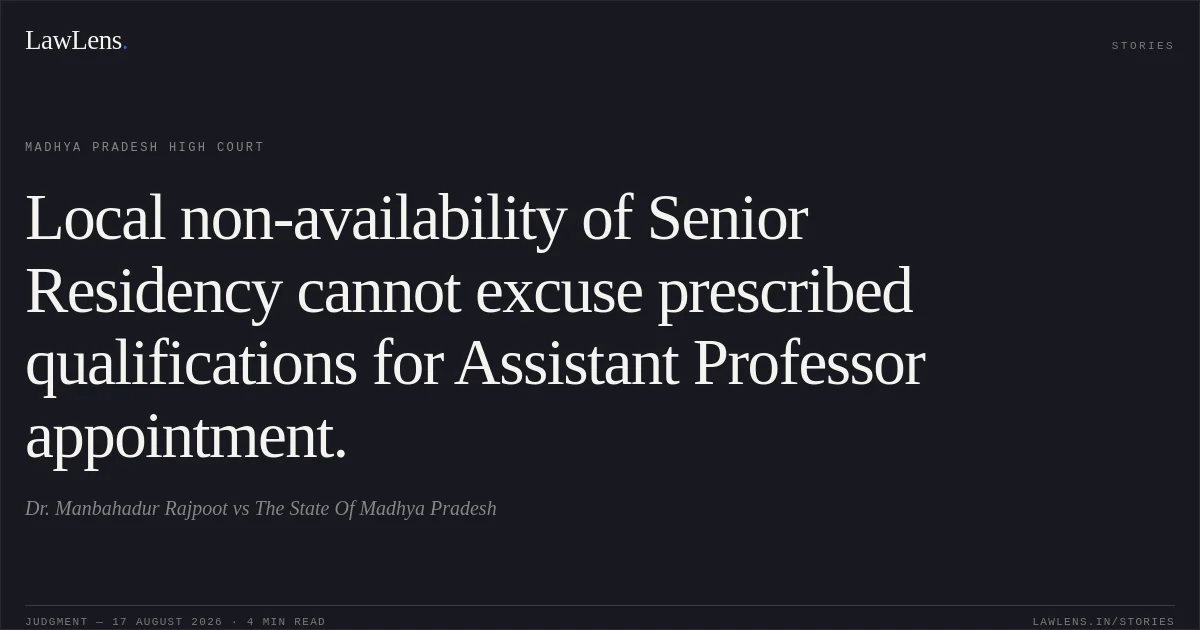
The appellant instituted a writ petition in the nature of quo warranto challenging the appointment of respondent No. 5 as Assistant Professor (Community Medicine) at Shrimant Vijaya Raje Scindia Medical College, Shivpuri, made by order dated 20 August 2018.
Source reference: para. 2The appellant contended that respondent No. 5 had obtained his MD degree only on 9 June 2018 and lacked the prescribed teaching and research experience—three years as Junior Resident and one year as Senior Resident in the concerned subject—required under the Minimum Qualifications for Teachers in Medical Institutions Regulations, 2017.
Source reference: para. 2The State and other respondents argued that no post of Senior Resident in Community Medicine existed in Madhya Pradesh in 2018, and therefore respondent No. 5 could not be required to acquire an impossible qualification.
Source reference: paras. 4–7The learned Single Judge accepted this defence and dismissed the challenge, holding that the requirement of one year’s Senior Residency applied only where such posts were prescribed by the Medical Council of India.
Source reference: para. 9During the writ appeal, the respondents conceded that the requisite Senior Residency could be obtained from any NMC-recognized institution in India.
Source reference: paras. 11–16The appellant produced a 2017 result notice from Safdarjung Hospital and V.M.M.C., New Delhi, showing the availability of Senior Resident posts in Community Medicine; the respondents admitted that the institution was recognized by the NMC.
Source reference: paras. 11–16Issues
Whether respondent No. 5 possessed the minimum qualifications prescribed for appointment as Assistant Professor (Community Medicine), including three years’ Junior Residency and one year’s Senior Residency in the concerned subject?
Source reference: para. 8(i)Whether the non-availability of a Senior Resident post in Community Medicine in Madhya Pradesh in 2018 excused respondent No. 5 from satisfying the prescribed Senior Residency requirement?
Source reference: paras. 8(ii), 11–15Whether the appellant could maintain a writ of quo warranto despite any alleged lack of personal eligibility for appointment to the post?
Source reference: paras. 17–20Law Applied
The Court applied Section 33 of the Indian Medical Council Act, 1956, under which the Medical Council of India framed minimum qualification regulations for medical teachers.
Source reference: para. 2Under the Minimum Qualifications for Teachers in Medical Institutions Regulations, 2017, appointment as Assistant Professor required a postgraduate qualification in the concerned subject together with three years’ Junior Residency and one year’s Senior Residency in a recognized medical college.
Source reference: paras. 2–3, 8(i)FAQ No. 31 clarified that the one-year Senior Residency requirement applied in disciplines where Senior Resident posts were prescribed under the MCI’s minimum standards.
Source reference: para. 4The Court relied on Gambhirdan K. Gadhvi v. State of Gujarat, (2022) 5 SCC 179, and Central Electricity Supply Utility of Odisha v. Dhobei Sahoo, (2014) 1 SCC 161, for the principles that quo warranto lies to prevent an ineligible person from holding public office, that strict rules of locus standi are relaxed, and that the Court must examine whether the appointment violates statutory eligibility requirements.
Source reference: paras. 18–20The Madhya Pradesh Uchcha Nyayalaya (Khand Nyaypeeth Ko Appeal) Adhiniyam, 2005 provided the appellate jurisdiction under Section 2(1).
Source reference: para. 1Reasoning
The Court held that the respondents’ “impossibility” defence was factually and legally untenable.
Source reference: paras. 11–14Although the respondents had asserted before the Single Judge that no Senior Resident post in Community Medicine existed, they admitted in appeal that the required experience could be acquired from any NMC-recognized institution in India.
Source reference: paras. 11–14The Safdarjung Hospital and V.M.M.C. result notice established that a Senior Resident post in Community Medicine existed in 2017, before respondent No. 5’s appointment, and the respondents admitted that the institution was NMC-recognized.
Source reference: paras. 13–16Consequently, the absence of such a post in Madhya Pradesh did not make the qualification impossible to obtain.
Source reference: paras. 13–16Since respondent No. 5 lacked the minimum experience required under the 2017 Regulations, his appointment was contrary to the prescribed legal requirements.
Source reference: para. 21The Court further held that, in quo warranto proceedings, the appellant’s own eligibility was irrelevant; it was sufficient to establish that the office was public and that the incumbent lacked lawful authority to hold it.
Source reference: paras. 17–20Holding
The Court allowed the appeal and held that respondent No. 5 was not eligible for appointment as Assistant Professor (Community Medicine) because he did not possess the minimum qualifications prescribed by the 2017 Regulations.
The appointment to the post at Shrimant Vijaya Raje Scindia Medical College, Shivpuri, was accordingly quashed, and respondent No. 5 was directed to stop functioning as Assistant Professor (Community Medicine) with immediate effect.
Source reference: para. 21The writ petition was allowed, and I.A. No. 10937 of 2026 seeking production of additional documents was also allowed.
Source reference: paras. 16, 22Acts & Sections Cited
3 provisions across 2 statutes referred to in this judgment. Linked provisions open on LawLens.
M.P. Uchcha Nyayalaya (Khand Nyayapeeth Ko Appeal) Adhiniyam, 20051
Indian Medical Council Act, 19562
Original Court PDF
Dr. Manbahadur RajpootvsThe State Of Madhya Pradesh
Click to open original judgment
Original judgment, available to read, download and summarize on LawLens.in