Facts
The petitioners included a registered trade union and workers engaged locally as “No Work No Pay” (NWNP) handling labourers at the Food Corporation of India’s Buniadpur depot.
Source reference: para. 10–13, 29, 31–32They were daily-rated workers receiving minimum wages and held no posts under the FCI.
Source reference: para. 10–13, 29, 31–32By office order dated 14 October 2025, the FCI directed the workers’ transfer from Buniadpur to Adra, citing labour shortages at Adra and a policy of rationalising labour across depots.
Source reference: para. 15, 25–30The workers challenged the order, arguing that the depots were more than 400 kilometres apart, they had been engaged locally, and transfer was not a condition of their engagement.
Source reference: para. 6, 16, 33The FCI maintained that the movement was a bona fide rationalisation measure.
Source reference: para. 25–28Issues
Whether the FCI could transfer or shift locally engaged, daily-rated NWNP workers from Buniadpur to Adra when transfer was not a condition of their engagement.
Source reference: para. 32–33, 39–41Whether the office order dated 14 October 2025 was lawful in the circumstances, given the workers’ status and the hardship caused by the proposed relocation.
Source reference: para. 39–42Law Applied
The Court treated the distinction between transfer of an employee holding a post and the shifting of daily-rated workers as material: these petitioners held no post, and their engagement did not include transfer as a condition of service; accordingly, the order was not a conventional service transfer and the shifting was impermissible in the circumstances.
Source reference: para. 32–33, 40The Court also invoked the principles of natural justice and the obligation of the FCI, as a model employer, not to impose undue hardship on workers.
Source reference: para. 41–42The judgment refers to the Contract Labour (Regulation and Abolition) Act, 1970, and a FCI circular concerning labour rationalisation and depot operations, but does not apply those provisions as the basis for its holding.
Source reference: para. 14, 25, 34–38Reasoning
The FCI relied on labour shortages at Adra and its rationalisation policy to justify moving workers from Buniadpur.
Source reference: para. 25–30The Court acknowledged that policy rationale but found that the workers were daily-rated, locally engaged, and not holders of posts to which ordinary transfer principles applied.
Source reference: para. 29, 31–33Because transfer was not a condition of their engagement, relocating them more than 400 kilometres away would impose serious financial and practical hardship.
Source reference: para. 6, 39–41The Court therefore concluded that the policy rationale did not justify the impugned order in these circumstances.
Source reference: para. 40–42Holding
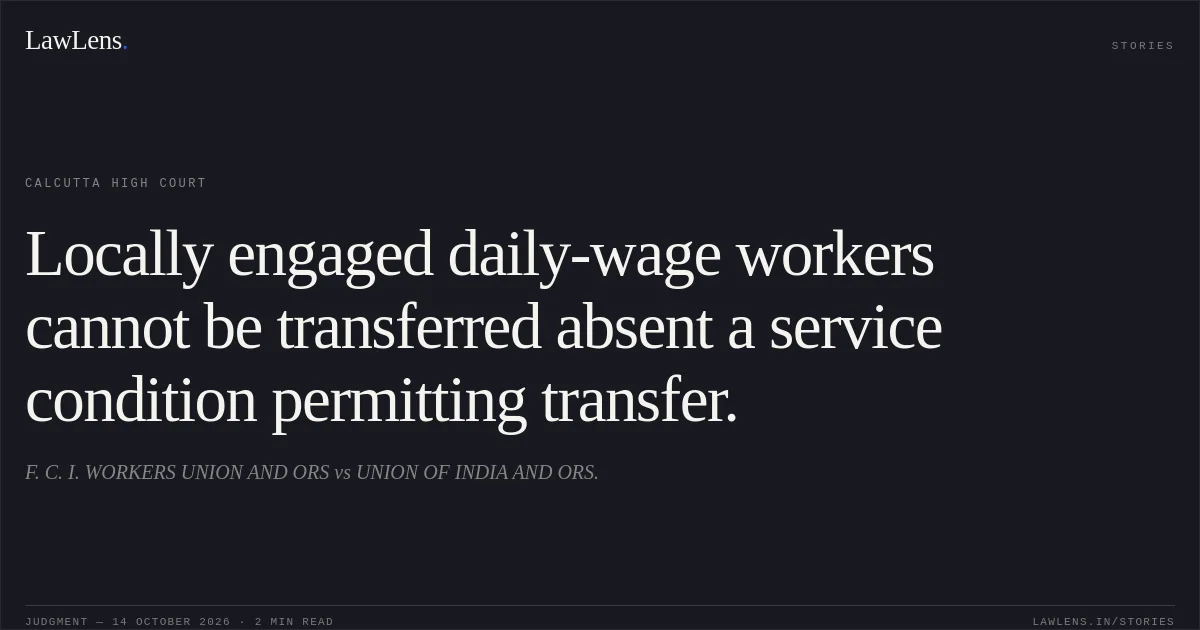
The Court held that shifting the petitioners to a distant depot was impermissible where they were locally engaged daily-rated workers and transfer was not a condition of their employment.
It found the order contrary to the principles of natural justice and law, quashed and set it aside, and allowed WPA 24450 of 2025.
Source reference: para. 40–43Acts & Sections Cited
2 provisions across 1 statute referred to in this judgment. Linked provisions open on LawLens.
Contract Labour (Regulation and Abolition) Act, 19702
Original Court PDF
F. C. I. WORKERS UNION AND ORSvsUNION OF INDIA AND ORS.
Click to open original judgment
Original judgment, available to read, download and summarize on LawLens.in


