Facts
During the pendency of Regular Civil Appeal No. 108 of 2019, the parties entered into a compromise, which was presented before the Appellate Court in a Lok Adalat on 13 July 2019; a consent decree followed.
Source reference: para. 6The petitioners later challenged that decree by a writ petition, Special Civil Application No. 13630 of 2020, which they did not press on 19 August 2025, and pursued a review application under Order 23 Rule 3 of the Code of Civil Procedure, 1908, alleging fraud.
Source reference: paras. 4, 7The Appellate Court rejected the review application on 18 June 2026 as not maintainable. The petitioners challenged that rejection under Article 227 of the Constitution.
Source reference: paras. 2–3, 8Issues
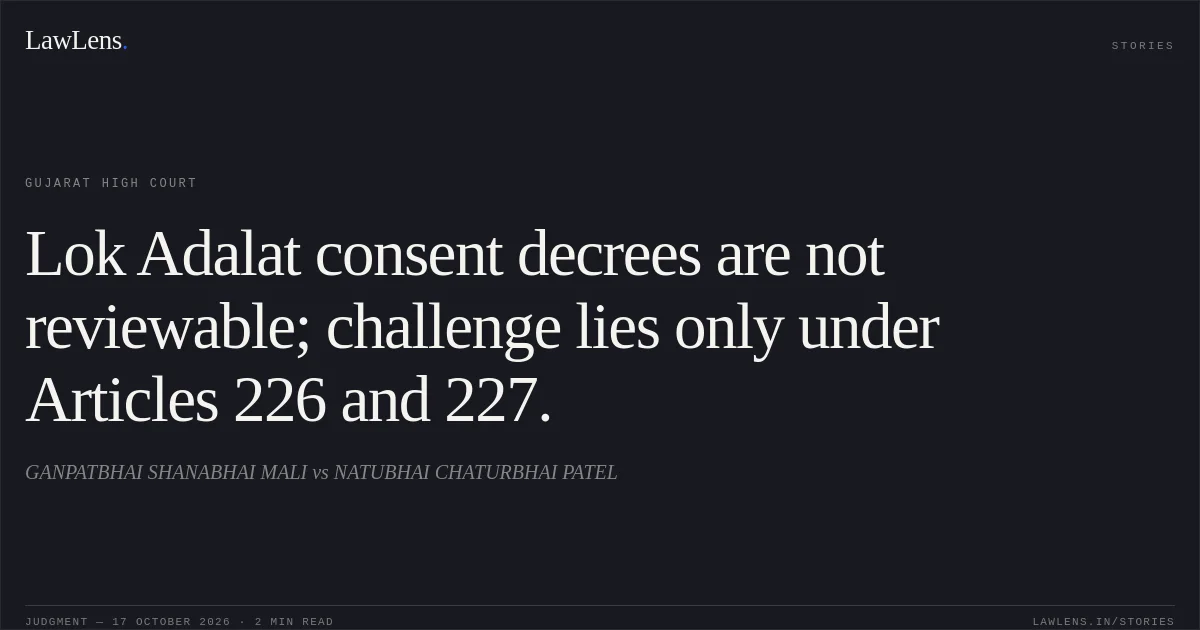
Whether a consent decree recorded in a Lok Adalat may be reviewed or recalled by the court that recorded it, including on an allegation of fraud.
Source reference: paras. 3, 7–8Whether the Appellate Court’s rejection of the petitioners’ review application warranted interference under Article 227 of the Constitution.
Source reference: paras. 2, 8–9Law Applied
Section 21 of the Legal Services Authorities Act, 1987, governs the finality and enforceability of Lok Adalat awards; the Court held that an application under Order 23 Rule 3 CPC to set aside a compromise decree recorded in a Lok Adalat was not maintainable.
Source reference: para. 8Relying on Dilip Mehta v. Rakesh Gupta, 2025 SCC OnLine SC 2737, the Court stated that a Lok Adalat order, including a consent decree, is not subject to review or recall by the court concerned; an aggrieved party’s remedy is to challenge it by a writ petition under Articles 226 and 227 of the Constitution.
Source reference: para. 7Reasoning
The Court treated the compromise and resulting Lok Adalat consent decree as undisputed.
Source reference: para. 6Since the petitioners sought to set aside that decree through a review application under Order 23 Rule 3 CPC, the application was not maintainable under the legal position governing Lok Adalat decrees.
Source reference: paras. 7–8The Court therefore found that the Appellate Court had correctly rejected the application and did not undertake an adjudication of the petitioners’ fraud allegations on their merits.
Source reference: paras. 3, 8–9Holding
The Court held that the review application was not maintainable and that the Appellate Court had correctly rejected it.
Finding no merit in the Article 227 petition, the Court dismissed it in limine, with no order as to costs.
Source reference: para. 9Acts & Sections Cited
1 provisions across 1 statute referred to in this judgment. Each provision opens on LawLens.
Legal Services Authorities Act, 19871
Original Court PDF
GANPATBHAI SHANABHAI MALIvsNATUBHAI CHATURBHAI PATEL
Click to open original judgment
Original judgment, available to read, download and summarize on LawLens.in