Facts
The first respondent, then an Assistant Director, was accused of misusing public funds for watershed and related programmes.
Source reference: para. 4.1–4.12, 2Following a complaint dated 29 November 2015, the Upalokayukta submitted a report under Section 12(3) of the Karnataka Lokayukta Act, 1984.
Source reference: para. 4.1–4.12, 2On 6 March 2017, the State Government, recording that it had considered the report and that a prima facie case warranted enquiry, entrusted disciplinary proceedings to the Upalokayukta under Rule 14-A of the Karnataka Civil Services (Classification, Control and Appeal) Rules, 1957.
Source reference: para. 4.1–4.12, 2Articles of charge were issued on 13 September 2017.
Source reference: para. 4.1–4.12, 2The first respondent challenged the entrustment and charges before the Karnataka State Administrative Tribunal, which set them aside on grounds including the Lokayukta’s lack of competence and inadequate application of mind.
Source reference: para. 4.1–4.12, 2Issues
1. Whether the Tribunal was correct in holding that the subject matter of the proposed departmental enquiry fell outside the Lokayukta’s competence under Section 8 and the Second Schedule to the Karnataka Lokayukta Act, 1984.
Source reference: para. 19–202. Whether the State Government’s order entrusting the enquiry under Rule 14-A was vitiated by a failure to apply its mind to the material before it.
Source reference: para. 21–253. Whether the complaint was time-barred under Section 8(2)(c) of the Act, and whether the complainant’s purported withdrawal prevented further proceedings.
Source reference: para. 16–17, 26–294. Whether the writ petition was liable to be dismissed for delay and laches, or because the Lokayukta lacked locus standi to challenge the Tribunal’s order.
Source reference: para. 8–15Law Applied
Section 8(1)(a) of the Karnataka Lokayukta Act, 1984 excludes investigation of a complaint involving a grievance concerning matters specified in the Second Schedule, including public servants’ service conditions; Section 8(2)(c) imposes a six-month limit for complaints involving a grievance, while Section 8(2)(d) imposes a five-year limit for complaints involving an allegation, subject to the statutory proviso.
Source reference: para. 26–28Under Sections 2(2) and 2(8), an allegation concerns specified misconduct by a public servant, whereas a grievance requires a claim of personal injustice or undue hardship caused by maladministration.
Source reference: para. 26–28Rule 14-A of the KCS (CCA) Rules permits the Government to entrust a departmental enquiry to the Lokayukta; at that stage, the Government need only form a prima facie view that an enquiry is warranted.
Source reference: para. 19, 21–25Under Union of India v. Kunisetty Satyanarayana, (2006) 12 SCC 28, courts ordinarily should not interfere with a charge-sheet or enquiry at its initial stage, except in exceptional cases such as want of jurisdiction or illegality.
Source reference: para. 11M/s. Dehri Rohtas Light Railway Co. Ltd. v. District Board, Bhojpur, (1992) 2 SCC 598, establishes that delay and laches are discretionary considerations assessed on the facts of each case.
Source reference: para. 14The Court also relied on The Karnataka Lokayukta v. Ishwar, W.P. No. 105477/2023, concerning the Lokayukta’s locus standi to challenge a Tribunal order where the Government does not do so.
Source reference: para. 11, 14Reasoning
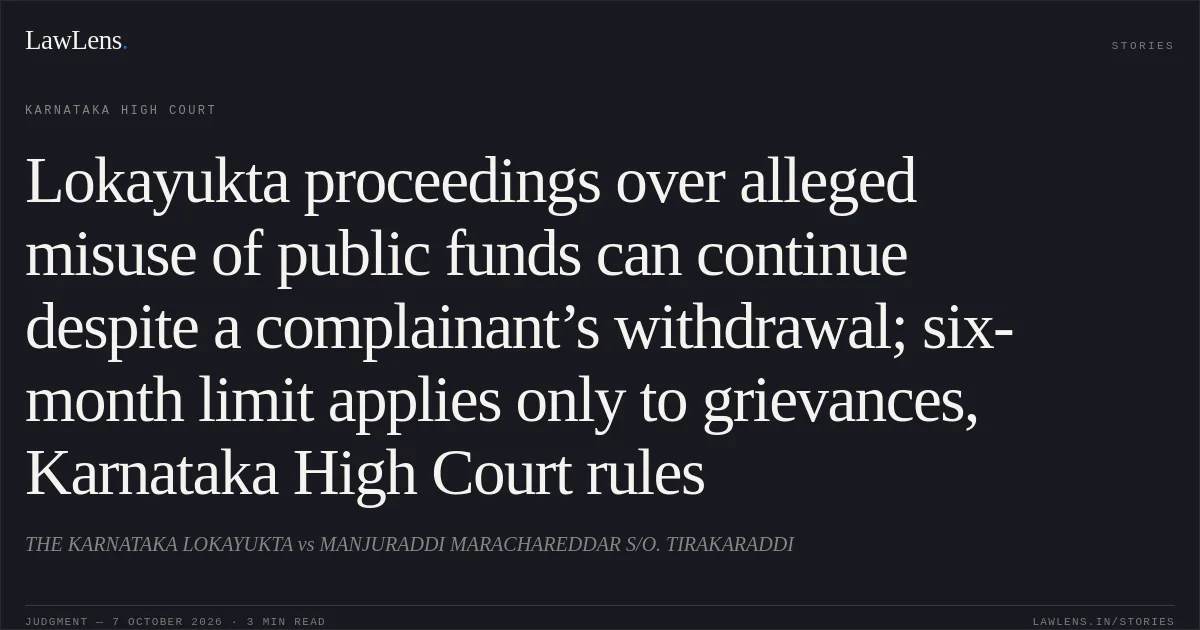
The Court held that the Second Schedule exclusion did not apply: the complaint alleged misconduct affecting public funds, rather than personal grievance or a matter concerning the respondent’s service conditions, and the challenged action was the entrustment of a departmental enquiry under Rule 14-A.
Source reference: para. 19–20The Government’s order referred to the Upalokayukta’s report, the material considered, and the prima facie grounds for enquiry; it therefore satisfied the limited application-of-mind requirement at the entrustment stage.
Source reference: para. 21–25Interference before the enquiry was completed was unwarranted absent a demonstrated jurisdictional or legal bar.
Source reference: para. 21–25The complaint raised allegations, not a personal grievance, so the five-year period under Section 8(2)(d), rather than the six-month period under Section 8(2)(c), applied; the complaint was within that period.
Source reference: para. 26–28The complainant’s purported withdrawal did not terminate the statutory process after the Lokayukta had taken cognizance and proceeded with the matter.
Source reference: para. 28–29Finally, the intervening Government decisions and the significance of the Lokayukta’s statutory authority led the Court to reject the objections based on delay and locus standi.
Source reference: para. 13–17Holding
The High Court allowed the writ petition and set aside the Tribunal’s order dated 2 July 2020.
It directed that the enquiry proceed from the stage at which it had stopped, while preserving the first respondent’s right to raise all available defences and adduce permissible evidence before the enquiring authority.
Source reference: para. 30There was no order as to costs.
Source reference: para. 30Acts & Sections Cited
4 provisions across 1 statute referred to in this judgment. Each provision opens on LawLens.
KARNATAKA LOKAYUKTA ACT, 19844
Original Court PDF
THE KARNATAKA LOKAYUKTAvsMANJURADDI MARACHAREDDAR S/O. TIRAKARADDI
Click to open original judgment
Original judgment, available to read, download and summarize on LawLens.in