Facts
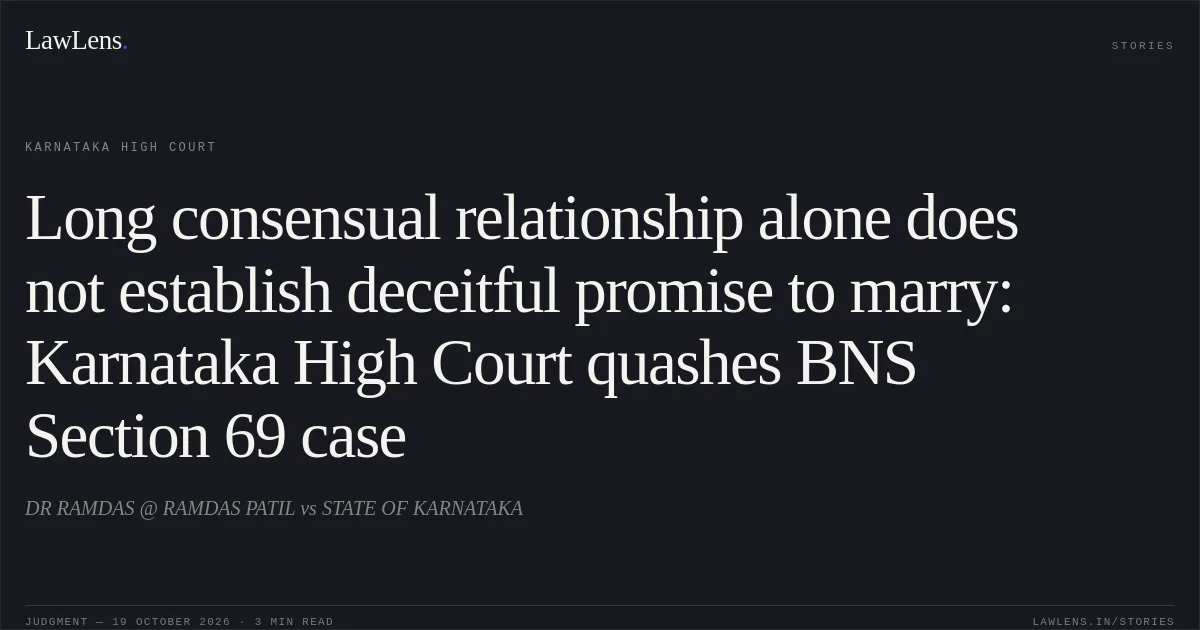
The complainant and petitioner, both doctors, became acquainted in 2017 and were in a relationship.
Source reference: p. 3–4, 8–12The complaint alleged that they had sexual relations from 2019 to November 2023 on the petitioner’s promise to marry, resumed contact and intimacy in September 2024, and that the petitioner later refused to marry her because of caste differences.
Source reference: p. 3–4, 8–12It also alleged that he assaulted her and pressured her to commit suicide.
Source reference: p. 3–4, 8–12The police filed a charge sheet for offences under Sections 69 and 115(2) of the Bharatiya Nyaya Sanhita, 2023 (BNS), and Sections 3(1)(w)(i)–(ii) and 3(2)(va) of the Scheduled Castes and Scheduled Tribes (Prevention of Atrocities) Act, 1989.
Source reference: p. 3–4, 8–12The petitioner sought to quash the charge sheet and proceedings in Special Case No. 88 of 2025.
Source reference: p. 3–4, 8–12Issues
Whether the complaint and charge-sheet materials disclosed an offence under Section 69 BNS, where the parties had a prolonged relationship and the alleged promise to marry was not fulfilled.
Source reference: p. 12–14, 48–49Whether the allegations disclosed offences under Section 115(2) BNS or Sections 3(1)(w) and 3(2)(va) of the SC/ST Act.
Source reference: p. 49–52Whether continuation of the prosecution amounted to abuse of process warranting exercise of the High Court’s quashing jurisdiction under Section 528 BNSS.
Source reference: p. 52–53Law Applied
Section 69 BNS criminalises sexual intercourse obtained by deceitful means or by a promise to marry made without any intention of fulfilling it; the relevant deceit must exist when the promise is made, and a later failure to marry does not by itself establish the offence (Kunal Rameshbhaai Kalyani v. State of Gujarat, 2026 SCC OnLine SC 1818).
Source reference: p. 43–45The Court also relied on the distinction between a false promise and a subsequent breach of a genuine promise, and on the requirement that the promise have a direct connection to the complainant’s decision to engage in sexual relations (Pramod Suryabhan Pawar v. State of Maharashtra and related authorities).
Source reference: p. 15–19, 29–30Section 115(2) BNS requires the relevant elements of voluntarily causing hurt.
Source reference: p. 49–51Section 3(1)(w) of the SC/ST Act requires, among other things, non-consensual sexual touching or sexual words, acts or gestures, with knowledge of the woman’s caste or tribe; Section 3(2)(va) requires commission of a scheduled offence against a person knowing that person’s protected status.
Source reference: p. 49–51Under Section 528 BNSS, the High Court may quash proceedings where the allegations, even taken at face value, do not disclose an offence or continuation would constitute abuse of process.
Source reference: p. 38–39, 52–53Reasoning
The Court treated the complaint as describing a relationship that began years before the alleged refusal to marry, continued over an extended period, and resumed after a gap.
Source reference: p. 12–14, 48–49It found no material showing that the petitioner had made a marriage promise from the outset without intending to fulfil it, or that the alleged deceit induced the sexual relationship; the later breakdown of the relationship was insufficient to establish Section 69 BNS.
Source reference: p. 12–14, 48–49The Court also found no specific allegation or medical evidence of hurt to support Section 115(2).
Source reference: p. 49As to the SC/ST Act, the Court considered the alleged sexual relationship consensual and held that the allegation of caste-based opposition to marriage did not, on the materials before it, establish non-consensual sexual conduct or the necessary predicate offence under Section 3(2)(va).
Source reference: p. 50–52It therefore concluded that the charge-sheet allegations did not disclose the charged offences and that continuing the case would abuse the process of law.
Source reference: p. 52–53Holding
The Court allowed the petition and quashed the proceedings in Special Case No. 88 of 2025, arising from Crime No. 27 of 2025, pending before the II Additional District and Sessions Judge, Mangaluru.
The connected application was disposed of consequentially.
Source reference: p. 53Acts & Sections Cited
13 provisions across 5 statutes referred to in this judgment. Each provision opens on LawLens.
Bharatiya Nagarik Suraksha Sanhita, 20231
Bharatiya Nyaya Sanhita, 20232
Scheduled Castes and the Scheduled Tribes (Prevention of Atrocities) Act, 19891
Indian Penal Code, 18606
Code of Criminal Procedure, 19733
Original Court PDF
DR RAMDAS @ RAMDAS PATILvsSTATE OF KARNATAKA
Click to open original judgment
Original judgment, available to read, download and summarize on LawLens.in