Facts
The respondent-plaintiff claimed possession of property bearing No. 1/2494, Moti Ram Marg, Shahdara, Delhi, on the basis of a General Power of Attorney, Agreement to Sell and Receipt dated 18 July 1988, executed in her favour by Sh. Sarwan Singh. She alleged that the appellant-defendant and her deceased husband had worked as domestic helps and were permitted to reside in the property temporarily and without rent, to look after it during the plaintiff’s absence abroad. When the plaintiff sought possession in 2018 for reconstruction, the defendant refused to vacate, leading to a suit for possession, damages and mesne profits.
Source reference: paras. 3–11; pp. 2–4The defendant denied permissive occupation and claimed that the plaintiff and her husband had orally gifted the property to her and her husband out of love and affection, particularly in view of their assistance to the plaintiff’s family during the 1984 riots. She also disputed the plaintiff’s title on the ground that the relied-upon GPA, Agreement to Sell and Receipt were unregistered, and subsequently sought to rely on long possession and adverse possession.
Source reference: paras. 12–20, 35–46; pp. 4–12The Trial Court decreed possession in favour of the plaintiff and awarded Rs. 1,00,000 towards damages/mesne profits with future interest at 6% per annum. During the appeal, possession was delivered to the plaintiff in execution proceedings on 26 November 2024. The plaintiff subsequently stated that she was not interested in recovering the damages/mesne profits awarded by the Trial Court.
Source reference: paras. 22–33; pp. 6–9; para. 52; para. 111Issues
1. Whether the defendant established ownership of the suit property on the basis of the alleged oral gift?
Source reference: para. 53(i); pp. 13–162. Whether the defendant’s long possession created any proprietary right in the suit property?
Source reference: para. 53(ii); pp. 22–253. Whether the defendant acquired ownership by adverse possession?
Source reference: para. 53(iii); pp. 25–294. Whether the award of Rs. 1,00,000 towards damages/mesne profits was sustainable?
Source reference: para. 53(iv); pp. 29–30Law Applied
The Court applied Section 123 of the Transfer of Property Act, 1882, which requires a gift of immovable property to be made through a registered instrument signed by or on behalf of the donor and attested by at least two witnesses.
Source reference: paras. 76–80Relying on Gomtibai v. Mattulal, (1996) 11 SCC 681, and R.N. Dawar v. Ganga Ram Saran Dhama, 1992 SCC OnLine Del 446, the Court held that an unregistered or oral gift of immovable property cannot transfer title where Section 123 applies.
Source reference: paras. 78–80Under Suraj Lamp & Industries Pvt. Ltd. v. State of Haryana, (2012) 1 SCC 656, a GPA, Agreement to Sell and Receipt do not constitute a registered conveyance conferring absolute ownership, although such documents may have evidentiary and comparative significance in determining the parties’ competing rights.
Source reference: paras. 59–63Under Maria Margarida Sequeria Fernandes v. Erasmo Jack de Sequeria, (2012) 5 SCC 370, gratuitous or permissive possession, including possession as a caretaker, servant, relative or agent, does not mature into ownership merely by lapse of time.
Source reference: paras. 86–89Adverse possession requires possession that is actual, open, continuous, exclusive and hostile, accompanied by the requisite animus possidendi for the statutory period; the claimant must specifically plead and prove when and how permissive possession became hostile, as explained in Karnataka Board of Wakf v. Government of India, (2004) 10 SCC 779; Konda Lakshmana Bapuji v. Government of A.P., (2002) 3 SCC 258; Ravinder Kaur Grewal v. Manjit Kaur, (2019) 8 SCC 729; Narasamma v. A. Krishnappa, AIR 2020 SC 4178; and Bhag Singh v. Basant Kaur, 2026 INSC 983.
Source reference: paras. 93–105Reasoning
The Court held that the defendant failed to prove the alleged oral gift. She admitted that she possessed no documentary proof of ownership, that no written gift deed had been executed, and that the property continued to stand in the plaintiff’s name.
Source reference: paras. 64–67The defendant’s witnesses either lacked personal knowledge of the alleged gift or merely repeated information allegedly conveyed by the family; the electricity and water records also stood in the name of the plaintiff or her son.
Source reference: paras. 68–75Although the plaintiff’s documents did not amount to an absolute registered conveyance under Suraj Lamp, they, read with the municipal, electricity and water records and the defendant’s own case that her occupation originated through the plaintiff, established the plaintiff’s superior right against the defendant.
Source reference: paras. 60–63The defendant’s long possession was found to have originated permissively, in connection with domestic assistance and care of the property; such possession could not become proprietary merely through duration.
Source reference: paras. 82–90The adverse-possession claim failed because it was not pleaded in the written statement, no date or act of hostile assertion was identified, and the defendant’s case of ownership by gift was inconsistent with a claim that her possession was hostile to the plaintiff’s title.
Source reference: paras. 91–106Although the Trial Court had awarded damages without specific evidence of rental value, the plaintiff expressly relinquished her claim to recover that amount during the appeal.
Source reference: paras. 107–111Holding
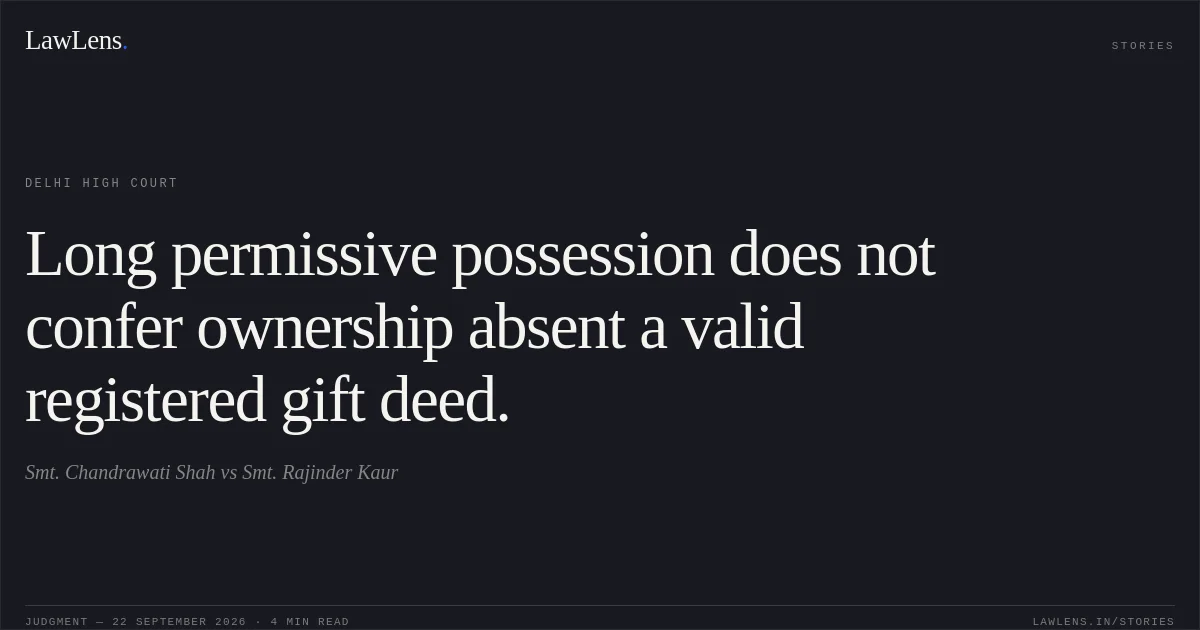
The High Court dismissed the appeal and upheld the decree for possession, holding that the defendant had neither acquired ownership through the alleged oral gift nor obtained any proprietary right through long or adverse possession.
Since possession had already been delivered to the plaintiff on 26 November 2024, no further direction regarding possession was necessary.
Source reference: para. 112The plaintiff’s statement that she would not recover the Rs. 1,00,000 damages/mesne profits, along with interest, was recorded and the monetary relief was accordingly treated as relinquished.
Source reference: paras. 111–113Pending applications, if any, were also disposed of.
Source reference: para. 115Acts & Sections Cited
4 provisions across 3 statutes referred to in this judgment. Each provision opens on LawLens.
Code of Civil Procedure, 19082
Transfer of Property Act, 18821
Registration Act, 19081
Original Court PDF
Smt. Chandrawati ShahvsSmt. Rajinder Kaur
Click to open original judgment
Original judgment, available to read, download and summarize on LawLens.in