01Facts
Kadheru, predecessor-in-interest of the petitioners, held 161 kanals 1 marla in Village Sarurpur, Tehsil Ballabgarh, District Faridabad, as an occupancy tenant.
He allowed Chattar Singh and Balwant Singh, sons of Ram Nath and his nephews, to cultivate the land. Mutation No. 189 was entered on 17.01.1946 on the basis of an oral perpetual lease allegedly granted on 16.01.1946.
¶ 2Kadheru was later declared owner under the Punjab Occupancy Tenants (Vesting of Proprietary Rights) Act, 1952.
¶ 3The petitioners sued for ejectment on 25.10.1985, alleging non-payment of rent since 1982 and failure to cultivate according to village custom.
¶ 4The respondents sued for occupancy rights before the Assistant Collector, 1st Grade, on 29.11.1985.
¶ 5The Assistant Collector dismissed the occupancy suit for failure to prove occupancy rights.
¶ 8The Collector dismissed the appeal on 19.11.1991, and the Divisional Commissioner affirmed on 20.11.1992.
¶ 9The Financial Commissioner, in revision on 12.11.1996, held that the respondents had been in continuous occupation for over 50 years at nominal rent, invoked Section 8 of the Punjab Tenancy Act, 1887, and decreed the occupancy suit.
¶ 10Petitioners contended that rent rose from ₹21 and 8 annas to ₹500 per annum and that Balwant Singh, the best witness, withheld testimony.
¶ 11Respondents contended that rent never exceeded land revenue, and that a 1986 suit by petitioners seeking a declaration of ₹500 rent was dismissed and affirmed.
¶ 12The parties' close kinship is undisputed and PW-1 Ram Gopal admitted Kadheru was his maternal uncle.
¶ 8 · ¶ 14CWP No. 17035 of 1997 arose from the petitioners' ejectment suit against the respondents' predecessor, Chattar Singh.
¶ 6The impugned Collector orders, affirmed by the Divisional Commissioner and Financial Commissioner, treated the tenancy as one for a fixed term.
¶ 2002Issues
i.1. Whether the Financial Commissioner erred in granting occupancy rights to the respondents under Section 8 of the Punjab Tenancy Act, 1887, on the basis of an oral lease, long possession, and non-enhancement of rent, where Balwant Singh, the alleged lessee, did not testify.
¶ 14–16 · pp. 7–10ii.2. Whether the tenancy in favour of the respondents was a fixed-term tenancy (Section 40) or a year-to-year tenancy (Section 41) of the Punjab Tenancy Act, 1887, for the purpose of deciding the ejectment claim.
¶ 20 · p. 1103Law Applied
Section 8 of the Punjab Tenancy Act, 1887, preserves the right to establish occupancy on grounds other than those specified in the preceding sections.
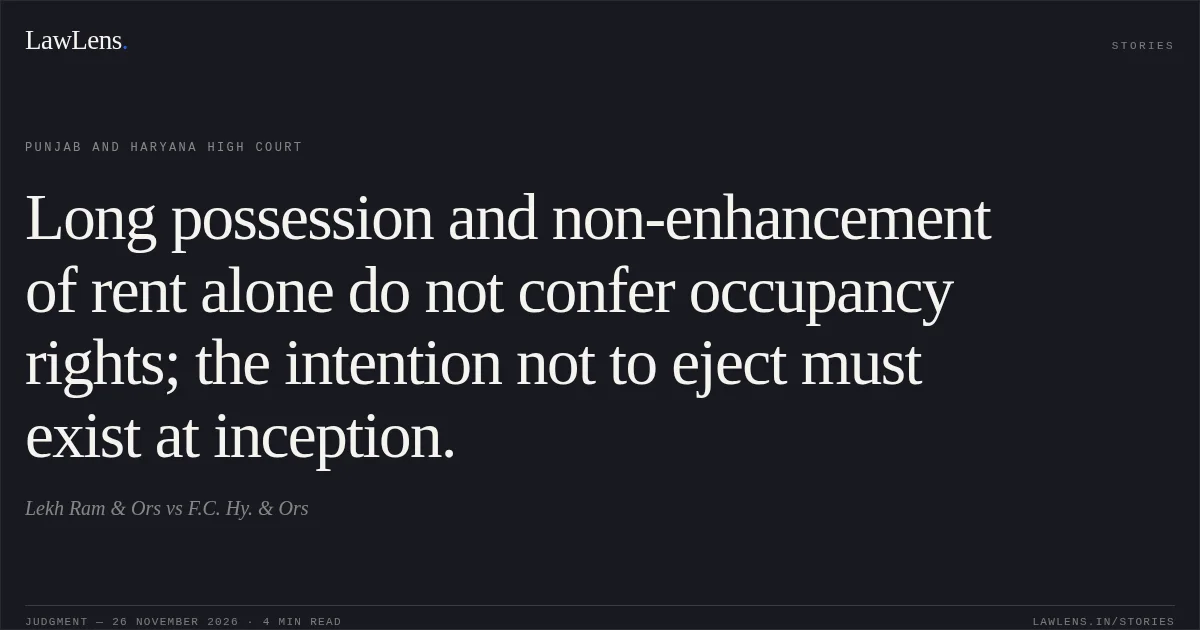
¶ 14 · pp. 7–8The principles in Muni Ram v. Phullia and Lalu, 1974 PLJ 369, hold that: (i) the landlord's intention not to eject must be assessed at the inception of the tenancy; (ii) mere length of possession does not confer occupancy rights; (iii) where an implied promise not to eject can be inferred, the burden of rebuttal shifts to the landlord; and (iv) a strong presumption arises where a tenancy has lasted many years, prices have risen, and the landlord made no effort to enhance rent.
¶ 15 · pp. 8–9A party who withholds the best evidence cannot seek refuge in presumptions.
¶ 16 · pp. 9–10Classification of tenancies under Section 40 (fixed term) and Section 41 (year-to-year) of the Punjab Tenancy Act, 1887.
¶ 20 · p. 11Provisions in the judgment · 5 · Linked ones open on LawLens
Punjab Tenancy Act, 1887. Section 8Section 5Section 6Section 41Section 40
04Reasoning
The relevant intention was the landlord's intention at the inception of the oral tenancy, not later conduct, and the respondents' claim was tested against the Muni Ram principles.
¶ 16 · p. 9The only witness who could prove that intention was Balwant Singh, who was present at the inception and did not appear.
¶ 16 · pp. 9–10Having withheld this evidence, the respondents could not rely on the presumption arising from non-enhancement of rent.
¶ 16 · p. 10The close family relationship between the parties was a more plausible explanation for the low rent than an implied promise not to eject.
¶ 16 · p. 10No evidence of a perpetual lease was found, and the Financial Commissioner erred in applying Section 8 without proof of an inducement on promise of non-ejectment.
¶ 16–17 · p. 10In CWP No. 17035 of 1997, the revenue authorities had treated the tenancy as a fixed-term tenancy, whereas the Court held it to be a year-to-year tenancy, so the ejectment claim had to be adjudicated under Section 41, not Section 40.
¶ 20 · p. 1105Holding
The Financial Commissioner erred in granting occupancy rights under Section 8 of the 1887 Act, because the respondents failed to prove an oral promise not to eject at the inception of the tenancy and withheld the testimony of Balwant Singh. The onus of proof lay on the respondents and was not discharged.
¶ 16–17 · p. 10In CWP No. 3547 of 1997, the petition was allowed, the Financial Commissioner's order dated 12.11.1996 was set aside, the Divisional Commissioner's order was restored, and the respondents' occupancy suit was dismissed.
¶ 18–19 · p. 10In CWP No. 17035 of 1997, the petition was allowed on the ground that the tenancy was year-to-year and governed by Section 41. The impugned Collector, Divisional Commissioner, and Financial Commissioner orders were set aside and the matter was remanded to the Collector to decide afresh in accordance with law, with parties to appear on 15.12.2026.
¶ 20–23 · p. 11Applications for impleadment of legal representatives of deceased respondents were allowed.
p. 2, no citationOriginal Court PDF
Lekh Ram & OrsvsF.C. Hy. & Ors
Click to open original judgment
Original judgment, available to read, download and summarize on LawLens.in