Facts
The petitioners in the connected writ petitions were engaged between 2007 and 2010 in the Computer Science & Information Technology and Biotechnology/Molecular Biology & Biotechnology Departments of the erstwhile Cotton College.
Source reference: paras. 3–5, 53–54, 64–65Their initial designations included “Academic Counsellor,” “Academic Counsellor (Contractual)” and “Associate Faculty.” Their engagements followed public advertisements, applications and interviews, and they possessed the qualifications prescribed in those advertisements.
Source reference: paras. 3–5, 53–54, 64–65The petitioners claimed that, despite their contractual designations, they continuously performed duties substantially similar to regular Assistant Professors, including teaching, examination work, evaluation of answer scripts, curriculum development, research supervision and departmental administration.
Source reference: paras. 59, 68, 74They were subsequently redesignated as “Assistant Professors (Contractual)” without a fresh recruitment process.
Source reference: paras. 61, 65, 70–72The petitioners continued for more than a decade through successive extensions.
Source reference: paras. 56–57, 66The University thereafter advertised regular Assistant Professor posts on 19.06.2019. Some petitioners participated but were unsuccessful or were not shortlisted. Their contractual services were subsequently discontinued, leading to the writ petitions challenging the recruitment process, termination orders and denial of regularisation.
Source reference: paras. 7, 57, 66–67The respondents contended that the petitioners had never been appointed against sanctioned teaching posts under the applicable statutory recruitment rules, including the Assam Education Service Rules, 1982, and the UGC Regulations.
Source reference: paras. 6, 13–20, 21–25Issues
Whether the petitioners’ initial engagements were illegal appointments or merely irregular appointments, considering the manner of selection, qualifications, sanctioned posts and applicable recruitment framework?
Source reference: para. 29(i)Whether the redesignation of the petitioners as Assistant Professors (Contractual) constituted a fresh appointment or merely formalised the nature of duties already performed by them?
Source reference: para. 29(ii)Whether the petitioners were entitled to consideration for regularisation, absorption or other equitable relief notwithstanding the principles in Secretary, State of Karnataka v. Umadevi (3)?
Source reference: para. 29(iii)Whether participation by some petitioners in the 2019 regular recruitment process precluded them from subsequently challenging that process or seeking regularisation?
Source reference: paras. 19, 24, 78Law Applied
The Court applied the constitutional requirements of Articles 14 and 16, under which appointments to public employment must ordinarily be made through a fair, transparent and legally prescribed recruitment process.
Source reference: paras. 30–32Under Secretary, State of Karnataka v. Umadevi (3), (2006) 4 SCC 1, illegal or backdoor appointments cannot ordinarily be regularised, but duly qualified persons appointed against sanctioned vacant posts through an appointment process suffering only from procedural irregularity may be considered for regularisation as a one-time measure after long service.
Source reference: para. 31State of Karnataka v. M.L. Kesari, (2010) 9 SCC 247, clarified that the one-time exercise contemplated in Umadevi must include all eligible employees who had completed ten years’ service without court protection.
Source reference: paras. 33–34The Court also relied on Jaggo v. Union of India, Shripal v. Nagar Nigam Ghaziabad, Vinod Kumar v. Union of India and Dharam Singh v. State of Uttar Pradesh for the principles that the substance of employment, perennial nature of duties, transparent selection and prolonged service must be examined rather than contractual nomenclature alone.
Source reference: paras. 35–40Sukhendu Bhattacharjee v. State of Assam was relied upon for the proposition that Umadevi is not an absolute bar where equitable and equality-based claims arise from a State policy or prolonged, comparable service.
Source reference: para. 41The Court further considered Narayan Prasad Rabha v. State of Assam, which held that appointments made through public advertisement and selection, followed by long uninterrupted service, cannot be treated as void ab initio merely because of employer-attributable procedural lapses.
Source reference: paras. 50–51The Court recognised that genuinely illegal or backdoor appointments, as discussed in Najima Khatun v. State of West Bengal, cannot be regularised.
Source reference: paras. 42–46Reasoning
The Court found that the petitioners’ entry into service was not clandestine or backdoor: public advertisements were issued, applications were invited, interviews were conducted and the petitioners possessed the qualifications prescribed for their initial engagement.
Source reference: paras. 53–55, 64, 70, 76Although they were not initially appointed directly to sanctioned cadre posts of Assistant Professor, the records indicated continuing vacancies and a persistent institutional requirement for teaching personnel.
Source reference: paras. 62, 66, 75Their work was not casual or sporadic; they performed teaching, examination, curriculum, accreditation, research and administrative functions over more than a decade.
Source reference: paras. 59, 68, 74The Court treated the successive redesignations as evidence that the University itself had recognised the substantive nature of the petitioners’ work.
Source reference: paras. 61, 65, 71–72Since the redesignation as Assistant Professors (Contractual) involved no fresh recruitment and no material change in duties, it was held to be a formal recognition of the existing engagement rather than a new appointment.
Source reference: paras. 61, 65, 71–72The absence of NET/SLET qualifications at the initial stage did not, by itself, make the appointments illegal; the competent authority was directed to examine each petitioner’s present eligibility under the applicable UGC Regulations and statutory requirements.
Source reference: para. 73The Court held that Umadevi could not be applied mechanically to permit the University to benefit from its own prolonged failure to undertake regular recruitment.
Source reference: paras. 76–81The petitioners’ appointments were, at the highest, procedurally irregular and not illegal, particularly in view of the transparent initial process, long continuous service, perennial institutional duties, absence of fraud or misrepresentation, and the existence of teaching vacancies.
Source reference: paras. 76–81Participation in the 2019 recruitment process was not treated as a waiver, because the claim for regularisation arose independently from the petitioners’ long service and the University’s conduct.
Source reference: para. 78Holding
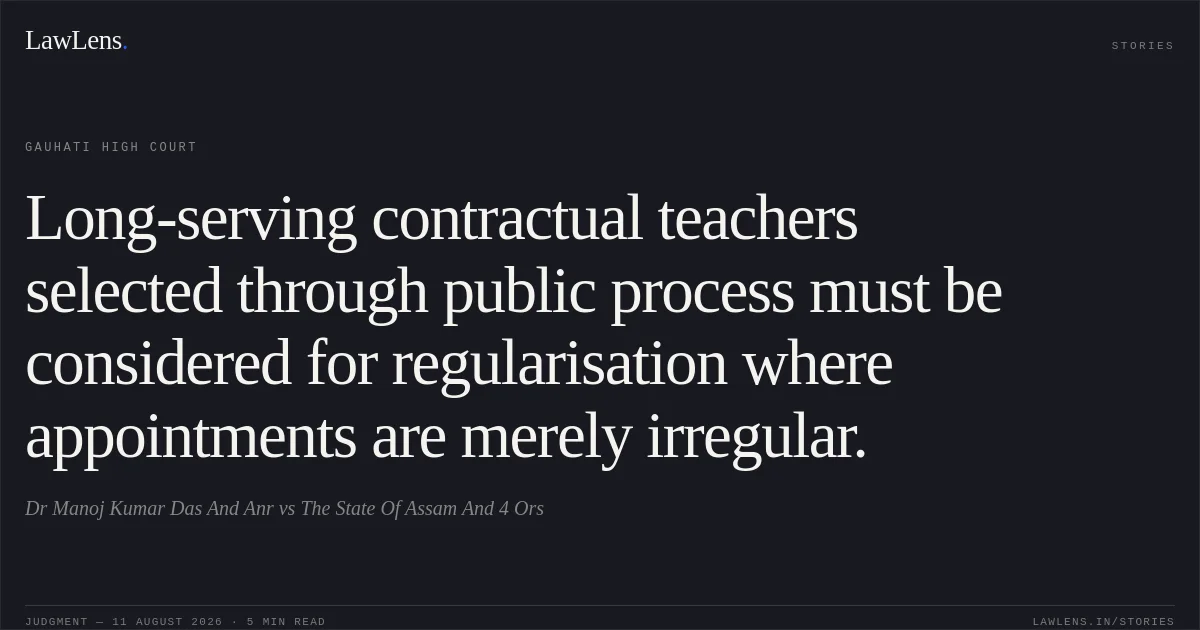
The Court answered Issues 1 and 2 in favour of the petitioners, holding that their appointments were not illegal or backdoor appointments and that their redesignation as Assistant Professors (Contractual) substantially recognised the duties they had continuously performed.
Issue 3 was also answered in their favour: the petitioners were held entitled to consideration for regularisation as Assistant Professors, subject to satisfying the applicable educational qualifications and other statutory requirements.
Source reference: para. 81The respondents were directed to examine each petitioner’s case and pass a reasoned decision on regularisation within two months from receipt of the certified judgment.
Source reference: paras. 82, 84Pending that exercise and final decision, the impugned termination orders were directed to remain in abeyance, with continuation or discontinuation governed by the outcome of the regularisation exercise.
Source reference: para. 83All four writ petitions were accordingly allowed on those terms, with no order as to costs.
Source reference: para. 85Original Court PDF
Dr Manoj Kumar Das And AnrvsThe State Of Assam And 4 Ors
Click to open original judgment
Original judgment, available to read, download and summarize on LawLens.in