Facts
The petitioner was engaged as a daily-wage worker in the establishment of Opposite Party No. 2 from 1 July 1987. He was disengaged with effect from 18 October 1995, following which he raised an industrial dispute in I.D. Case No. 60 of 1997.
Source reference: p. 3By award dated 29 July 2005, the Labour Court held the retrenchment illegal, directed reinstatement, and awarded lump-sum compensation of ₹4,000 towards back wages.
Source reference: p. 3; p. 28The challenge to the award in W.P.(C) No. 12870 of 2005 was dismissed on 4 May 2016, after which the petitioner was re-engaged on daily-wage basis by order dated 13 June 2016.
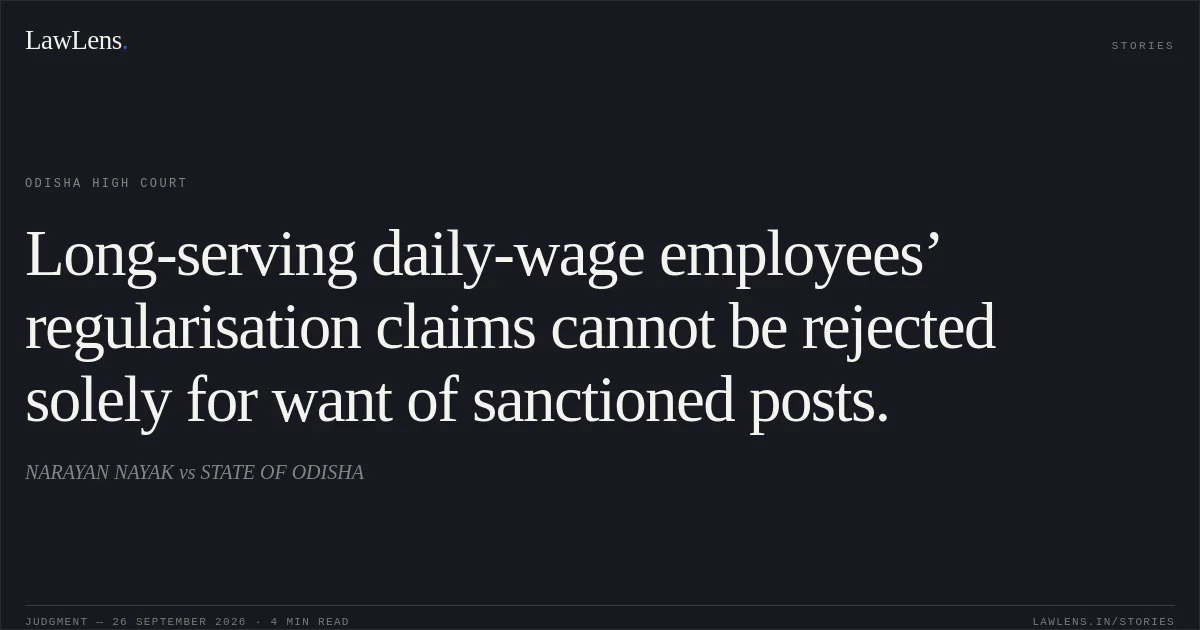
Source reference: p. 3; p. 28The petitioner thereafter sought regularisation. Pursuant to directions issued in W.P.(C) No. 37255 of 2021, Opposite Party No. 1 reconsidered his claim but rejected it by order dated 12 August 2022, principally on the ground that he had not been engaged against a sanctioned vacant post and was not covered by the principles in Secretary, State of Karnataka v. Uma Devi, M.L. Kesari and Amarkanta Rai.
Source reference: pp. 3–4; p. 28Issues
Whether the rejection of the petitioner’s claim for regularisation solely on the ground that his engagement was not against a sanctioned vacant post was legally sustainable?
Source reference: pp. 3–4; paras. 9.1–9.2Whether the petitioner’s prolonged engagement, the Labour Court’s finding that his retrenchment was illegal, and his continued service on daily wages required fresh consideration of his claim in light of the later Supreme Court decisions on exploitative and perpetual temporary employment?
Source reference: pp. 27–29; para. 9.2Whether the petitioner was entitled to immediate regularisation and consequential service benefits, or only to reconsideration of his claim by the competent authority?
Source reference: p. 2; paras. 9.2–10Law Applied
The Court applied the constitutional principles of non-arbitrariness, fairness and the State’s obligation to act as a model employer under Articles 14, 16 and 21 of the Constitution.
Source reference: no citationIt considered Secretary, State of Karnataka v. Uma Devi and M.L. Kesari, particularly the distinction between illegal appointments and irregular appointments and the possibility of regularisation in appropriate cases.
Source reference: pp. 3–4, 21–22The Court also relied on Jaggo v. Union of India, which deprecated the prolonged use of temporary labels for work that is perennial and integral to government functioning.
Source reference: pp. 4–8, 17–20Shripal v. Nagar Nigam, Ghaziabad, which held that Uma Devi cannot be used to justify exploitative, perpetual daily-wage engagements.
Source reference: pp. 8–9Dharam Singh v. State of U.P., which criticised outsourcing and refusal to sanction posts where work is perennial.
Source reference: pp. 9–14Bhola Nath v. State of Jharkhand, which emphasised fair treatment of long-serving contractual workers and required reasoned decisions regarding their continuation.
Source reference: pp. 14–17, 22–24Sukhendu Bhattacharjee v. State of Assam, which held that the absence of initial appointment against a sanctioned post is not an absolute bar where workers have performed essential and recurring functions for a prolonged period.
Source reference: pp. 17–27These authorities establish that the State cannot mechanically rely on contractual nomenclature, absence of sanctioned posts, or a rigid reading of Uma Devi to defeat a claim requiring consideration on the basis of long, continuous and necessary service.
Source reference: no citationReasoning
The Court found that the petitioner had served as a daily-wage worker for a substantial period, that his earlier disengagement had been held illegal by the Labour Court, and that he had been re-engaged after the Labour Court’s award was affirmed by the High Court.
Source reference: p. 28Although the State argued that the petitioner had suffered a break in service between 1995 and 2016 and had initially been engaged against a non-sanctioned post, the Court held that these matters could not justify a mechanical rejection of his claim.
Source reference: pp. 27–29The petitioner was continuing on daily wages, and the Labour Court’s reinstatement direction established that the earlier termination could not be treated as legally valid.
Source reference: pp. 27–29In light of the later authorities condemning prolonged temporary engagement and requiring the State to assess the perennial nature of the work, the Court held that the impugned order had not adequately considered the petitioner’s claim under the applicable constitutional principles and precedents.
Source reference: para. 9.2Holding
The High Court quashed the order dated 12 August 2022 rejecting the petitioner’s claim for regularisation.
It directed Opposite Party No. 1 to reconsider the petitioner’s claim afresh in light of Jaggo, Shripal, Dharam Singh, Bhola Nath and Sukhendu Bhattacharjee, and to take a reasoned decision within two months from receipt of the judgment.
Source reference: para. 9.2Pending that decision, the authorities were directed not to take coercive action against the petitioner.
Source reference: para. 9.3The Court therefore granted procedural reconsideration, but did not itself order immediate regularisation or award consequential service benefits.
Source reference: no citationThe writ petition was accordingly disposed of.
Source reference: para. 10Original Court PDF
NARAYAN NAYAKvsSTATE OF ODISHA
Click to open original judgment
Original judgment, available to read, download and summarize on LawLens.in